
Corn earworm moths reach Virginia gardens by late spring, migrating north from warmer states, and their numbers build steadily through summer. The worst damage lands on sweet corn silking in August and September, when several overlapping generations are active at once. No single treatment stops it entirely; timing your planting and checking ears before harvest matter more than any spray.
The weeks to watch

Corn earworm activity in Virginia typically starts in late May to early June along the coast and Piedmont, then climbs through July and peaks in August and September as later-planted sweet corn reaches the silking stage. Virginia Cooperative Extension does not publish a fixed flight calendar specific to this insect for the state, so the timing below follows the general pattern documented across the mid-Atlantic and Southeast rather than a locally dated schedule.
First flight, late spring
Moths arrive on wind currents from Gulf Coast states where the insect overwinters more reliably. Early-planted corn often escapes the worst of this flight simply because it silks before populations have built up. Gardens with corn silking in early June usually see lighter pressure than those silking a month later.
Mid-summer buildup
A second wave develops locally from eggs laid by the spring arrivals. This is when numbers start climbing noticeably, and it’s also when many home gardeners first notice damaged tips on early sweet corn.
Late-summer peak
By August and into September, populations reach their highest point of the season. Corn that silks during this window, which includes most main-season and succession plantings, faces the heaviest feeding pressure of the year. This is the generation most Virginia gardeners actually battle.
Reading the calendar from your last frost

Virginia’s last spring frost falls between March 20 and April 3 at the coastal Virginia Beach reference station (NOAA NCEI 1991-2020 Climate Normals, station USW00013769). That date is a normal, not a guarantee, and it shifts significantly inland: the Blue Ridge and southwest Virginia run weeks later in spring and earlier in fall than the coast.
Corn earworm doesn’t respond to a calendar date at all. It responds to when corn silks are present and receptive, which is itself a function of when the ground warmed enough to plant. That’s why the frost date matters here indirectly, through planting date, rather than as a direct signal for the insect.
- Start from your local last frost date (March 20 to April 3 on the coast, later inland) and count forward to when the soil is warm enough to plant corn, generally a week or two after that frost date for most varieties.
- From planting, silking follows several weeks later depending on the variety’s maturity length, and that silking window is when moths need to be watched closely and any protective measures need to be in place.
A gardener in the mountains redoing this math will land on a later window across the board, planting later and silking later, which usually means facing a heavier late-season moth population than a coastal grower does.
What it attacks, and what the damage looks like

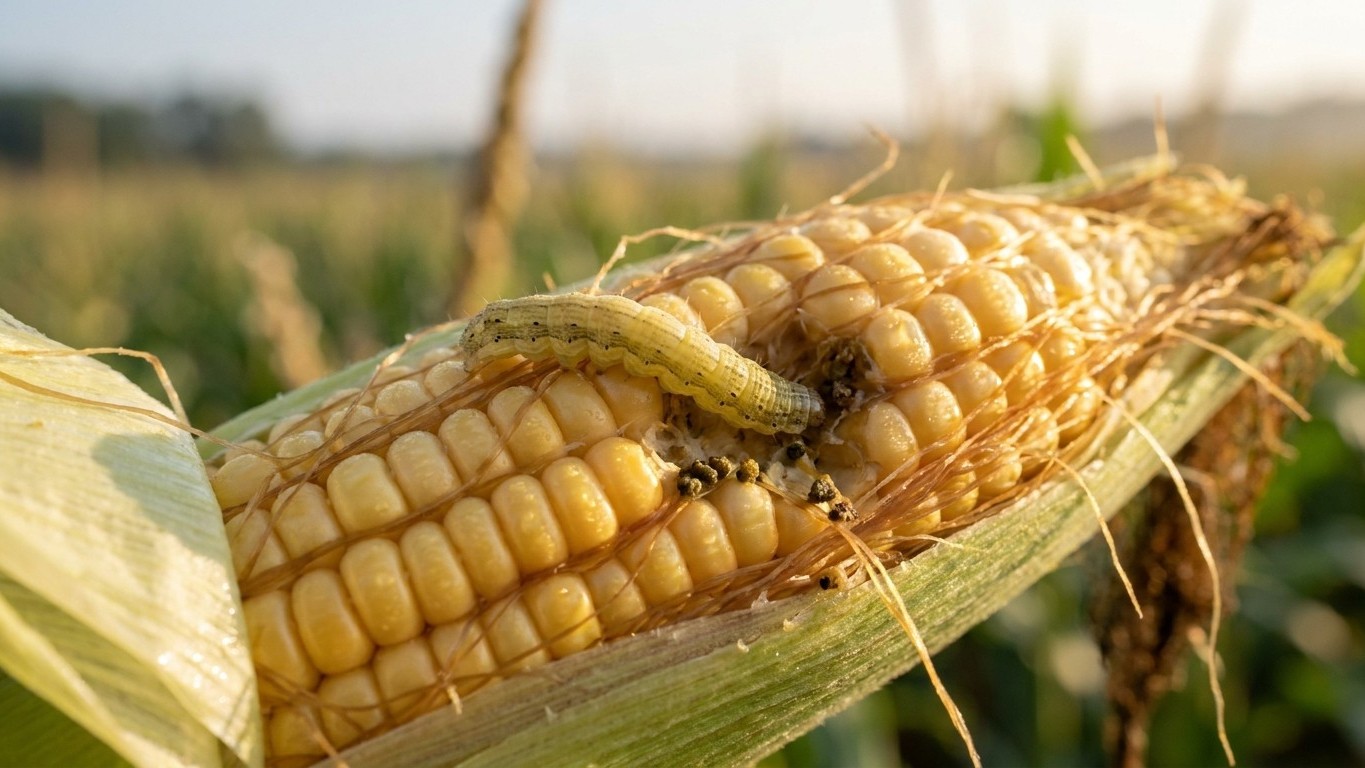
The first sign is usually at the ear tip: a small hole chewed through the silk channel or husk, sometimes with visible frass (the caterpillar’s droppings) pushed out near the opening. Pull back the husk and you’ll often find chewed kernels at the top few inches of the ear, sometimes with the caterpillar itself still feeding. On tomatoes, the same insect (called tomato fruitworm in that context) bores into the fruit near the stem, leaving a similar entry hole and internal tunneling.
The damage comes entirely from the larval stage. The moth itself does no feeding damage; it lays eggs on fresh corn silk or on developing fruit, and the caterpillar that hatches does all the eating as it works down toward the kernels or fruit interior. That single fact matters for control, because once the larva has tunneled past the silk channel and into the ear, nothing applied from outside reaches it.
Crops affected in Virginia gardens include:
- Sweet corn (the primary host, especially at silking)
- Field corn (less often treated, but attacked the same way)
- Tomatoes (as tomato fruitworm)
- Green beans and snap beans
- Peppers
- Sorghum
How Virginia sits in this pest’s range

Corn earworm is present in nearly every state that grows corn, tomatoes, or beans, which makes it one of the more widespread garden pests rather than a regional specialty. Across that range, presence isn’t the variable that changes state to state, timing is. A Georgia garden and a Virginia garden both deal with this insect; they just deal with it on different weeks of the calendar.
Within Virginia itself, the coastal plain around Virginia Beach warms earliest and can support the most generations in a season, since more of the warm months are available for the insect to cycle through egg, larva, pupa, and moth. Moving inland and into the Blue Ridge and southwest, the same general pattern holds but shifted later, tracking the same weeks-later frost dates that push back planting and silking.
Because the state doesn’t publish its own flight calendar for this species, Virginia gardeners in practice lean on the same general Southeast and mid-Atlantic seasonal pattern that applies broadly, adjusted by their own local frost date and planting schedule rather than a state-specific published timeline.
What actually works against it

- Plant early or choose early-maturing varieties. Corn that silks in early June, before moth populations peak, sees measurably less pressure than corn silking in August. This costs nothing beyond choosing a variety and planting promptly after the soil warms.
- Choose varieties with tight, long husks. A husk that extends well past the ear tip and closes tightly gives the newly hatched larva a longer, harder path to the kernels, and some never make it through at all.
- Apply mineral oil to the silk channel. A few drops placed into the silk opening a few days after silks emerge (once pollination has occurred) can block newly hatched larvae from entering. This is a mechanical barrier, not a chemical one, and its timing matters: too early and it can interfere with pollination; too late and the larva has already gotten in.
- Check ears before harvest and trim damaged tips. Cutting off the top inch or two of a damaged ear at harvest removes the caterpillar and the ruined kernels, leaving the rest of the ear usable. This works after the fact rather than preventing anything.
- Till the soil after harvest and rotate crops. Mature larvae drop to the soil to pupate. Tilling exposes those pupae to weather and predators, and rotating away from corn the following season reduces local buildup, though it does nothing about moths migrating in from elsewhere.
Once a larva has tunneled past the silk channel and started feeding down inside the ear, none of the above measures reach it anymore. At that point trimming the damaged portion at harvest is the only remaining option.
Common questions
Does corn earworm survive Virginia winters?
It survives poorly in most of the state through cold winters, though mild winters in the warmest coastal areas may allow some pupae to overwinter successfully. Most of the season’s pressure still comes from moths migrating north from warmer states each spring rather than from local overwintering populations.
Can I still eat corn with earworm damage?
Yes. Cutting off the damaged tip, typically the top inch or two where the caterpillar fed, leaves the rest of the ear perfectly edible. The damage is cosmetic and localized to where the larva tunneled.
Do row covers help against corn earworm?
Row covers work well early in the season but have to come off once corn tassels and silks form, since corn needs wind and insect movement for pollination. That timing gap is exactly when the moths lay eggs, which limits how much protection covers actually provide against this particular pest.