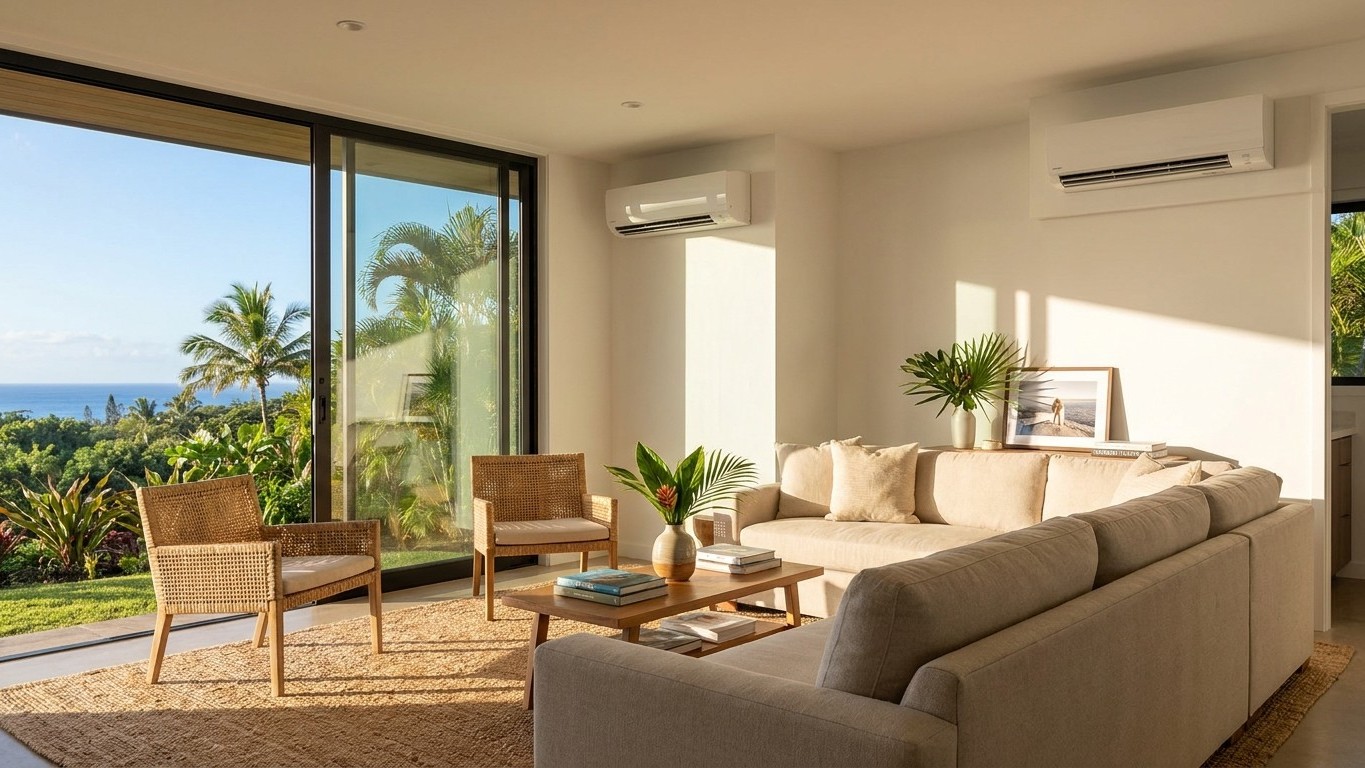

Turn off the heat around July, when Washington’s monthly temperatures climb back above the 65°F mark that NOAA uses to measure heating demand, and hold off on flipping it back on until September, when averages slide below that line again. In between sits the state’s quietest month, August, at roughly 122 combined heating and cooling degree days, a low enough number that most households genuinely get a rest rather than a swap.
The quietest month in Washington

August is that quiet month, and its total, about 122 combined degree days, is worth putting next to the national picture: the calmest month anywhere in the fifty states runs around 70 degree days, and the busiest quietest-month figure tops out near 246. A degree day isn’t a temperature reading. It’s a measure of how hard a heating or cooling system had to work that day, tallied against a 65°F baseline, so a bigger number always means more demand, not a hotter or colder thermometer.
At 122, Washington sits closer to the calm end of that range than the demanding one. That matters for how you read the answer to “when can I shut the heat off.” A high quietest-month total, somewhere near 246, would mean there’s no real gap in the year at all, just a hard handoff from furnace to air conditioner with barely a breath between them. A number like this state’s is different. It signals a stretch of weeks when neither system is doing much of anything.
What that pause actually feels like
Picture the year here less as a switch and more as a long slow curve. Demand builds through the cold months, tapers hard through spring, bottoms out around midsummer, and only starts rebuilding as fall sets in. There’s no jarring collision between the two seasons, no week where the house is fighting itself. The shape is gentle, which is unusual: plenty of states get a sharp handoff instead of a soft one. Washington’s coastal, marine-influenced climate is a big part of why that curve stays so flat through summer.
That gentleness is also why the answer to this page’s question is a genuine one rather than a dodge. Some states simply don’t get a real off period; the honest answer there is “you don’t get one.” Here, the low quietest-month total backs up what a lot of Washington homeowners already sense: there’s a real stretch, roughly the two months bracketing August, when the thermostat can be left alone entirely.
Shutting the heat down for the year
Do the shutdown near the point where the monthly average temperature climbs back above 65°F, which for this state’s climate normal falls around July. That’s the natural cutoff, not a fixed calendar date, since the actual week varies year to year. A few steps, done in order, make the difference between a clean shutdown and a system that sits neglected until fall.
- Set the thermostat so it stops calling for heat, rather than killing power at the breaker or panel.
- Let the system finish whatever heating cycle is already running before you touch anything else.
- For gas or propane furnaces, follow the manufacturer’s guidance on the pilot light or ignition system; this isn’t something to shut off as a routine seasonal task.
- Inspect the area around the furnace or boiler and clear away anything stored too close to it over the winter.
- Inspect, clean, or change the air filter. ENERGY STAR is specific on this: “Inspect, clean, or change air filters once a month in your central air conditioner, furnace, and/or heat pump.”
- Shut down a whole-house humidifier attached to the ductwork if the house has one. It’s the step almost everyone skips, and a humidifier left running into an idle system just wastes water and adds unnecessary humidity to a closed-up house.
- Note anything that sounded off, ran long, or short-cycled during the season, so it’s on the list before the system fires back up in fall.
None of this calls for shutting the heat off entirely in a way that risks frozen pipes, and in this state that’s not a concern at this time of year. Washington’s heating season runs long, on the order of ten months, but the summer window when it’s reasonable to power the system all the way down falls in the warmest stretch, not anywhere near freezing conditions. That caution matters more in places where a mild day can still dip well below freezing overnight; it doesn’t apply to a Washington summer.
The first run of the cooling season
Do this check on a mild day, not on the first genuinely hot afternoon of the year. A mild day gives you time to fix a problem before you’re depending on the system to keep the house livable. Waiting until the first heat wave means discovering a dead capacitor or a clogged line exactly when everyone else with the same problem is also calling for service.
- Clear leaves, grass clippings, and debris from around the outdoor condenser unit, giving it a couple feet of open space on all sides.
- Check the condensate drain line for clogs; a blocked line is one of the most common reasons a system trips a safety switch and stops cooling.
- Change or wash the filter, following the same monthly habit ENERGY STAR recommends for central systems.
- Run the system in COOL for a full cycle on a mild day, watching for it to actually cycle off once the space cools rather than running continuously.
- Feel the airflow at a register far from the air handler, not the closest one, since a weak far register is often the first sign of a duct or airflow problem.
What actually applies in a Washington home
Not every home here even has a full check to run. Statewide, 53% of homes use some form of air conditioning, and that splits into 30% running a central system and 25% relying on individual equipment, a ductless mini-split, a window or wall unit, or a portable. Another 44% lean on ceiling fans, and for a meaningful share of households, that’s the entire summer cooling plan. If your setup is a window unit or mini-split, the relevant version of this list shrinks to cleaning or swapping the filter and making sure nothing is blocking the unit’s airflow. The condenser and duct checks matter most for the roughly three in ten homes running central air. ENERGY STAR’s broader point still holds across all of them: “Airflow problems can reduce your system’s efficiency by up to 15 percent,” which is a lot of lost performance for the cost of a clean filter.
The days that ask for both
Every homeowner in a temperate climate knows this week: heat kicks on before sunrise, and by mid-afternoon the same house wants cooling. For this article, a month is counted as asking for both when it racks up at least 50 heating degree days and at least 50 cooling degree days in the same 30-day stretch. That’s a line drawn here for the purpose of explaining the pattern, not a category NOAA itself publishes.
Measured against that line, Washington doesn’t actually have a month that clears both bars at once. The state’s monthly degree-day record shows no month where heating and cooling demand overlap that heavily on a monthly basis. But that’s a monthly average smoothing out a daily reality. Even in a month that doesn’t hit the combined threshold, individual days can still swing hard, cool mornings followed by warm afternoons, especially in the shoulder weeks bracketing summer. The house doesn’t read the monthly average; it reads the current temperature.
| Situation | What to do |
|---|---|
| Cool mornings, warm afternoons | Use AUTO mode if the thermostat supports it, so the system chooses heat or cool as needed without you swapping modes by hand. |
| AUTO changeover | Convenient, but it can mean more short cycles in a single day, since the system may run heat at 6 a.m. and cooling again by 3 p.m. |
| Wide deadband between setpoints | Set the heating and cooling targets several degrees apart (for example, heat below 68°F, cool above 76°F) so the house isn’t fighting itself over a narrow band. |
| Narrow gap between setpoints | The expensive mistake: a tight gap means the system heats in the morning, then air conditions the same air it just paid to warm a few hours later. |
| Mild, dry afternoon | Open the windows instead of running either system; it’s often the simplest and cheapest option on days that don’t get truly hot. |
And the changeover in the other direction
Heating demand here starts building again in September, the first month when the normal mean temperature drops back below the 65°F baseline NOAA uses to count heating degree days. It builds through fall and peaks in December, and the full season stretches across roughly ten months of the year, one of the longer heating seasons among the fifty states.
What that pre-season check should focus on depends on what’s actually installed in the house. In Washington, 47% of homes report a furnace as their main heating equipment, and 9% run a central heat pump; boiler and steam-heat figures for the state weren’t reported in the most recent federal survey, which means suppressed for reliability, not zero, so radiator households shouldn’t assume they’re the only one on the block. Natural gas fuels 37% of homes and electricity fuels 55%, a split that leaves a fair number of houses on electric furnaces or heat pumps rather than gas.
The autumn version of this checklist runs in reverse: inspecting the furnace or boiler before the first cold snap, testing the ignition system, changing the filter one more time, and turning the humidifier back on if the house has one. For the full step-by-step version tailored to what’s actually running in a Washington basement or utility closet, that detail belongs in the heating-season guide for Washington, not repeated here.