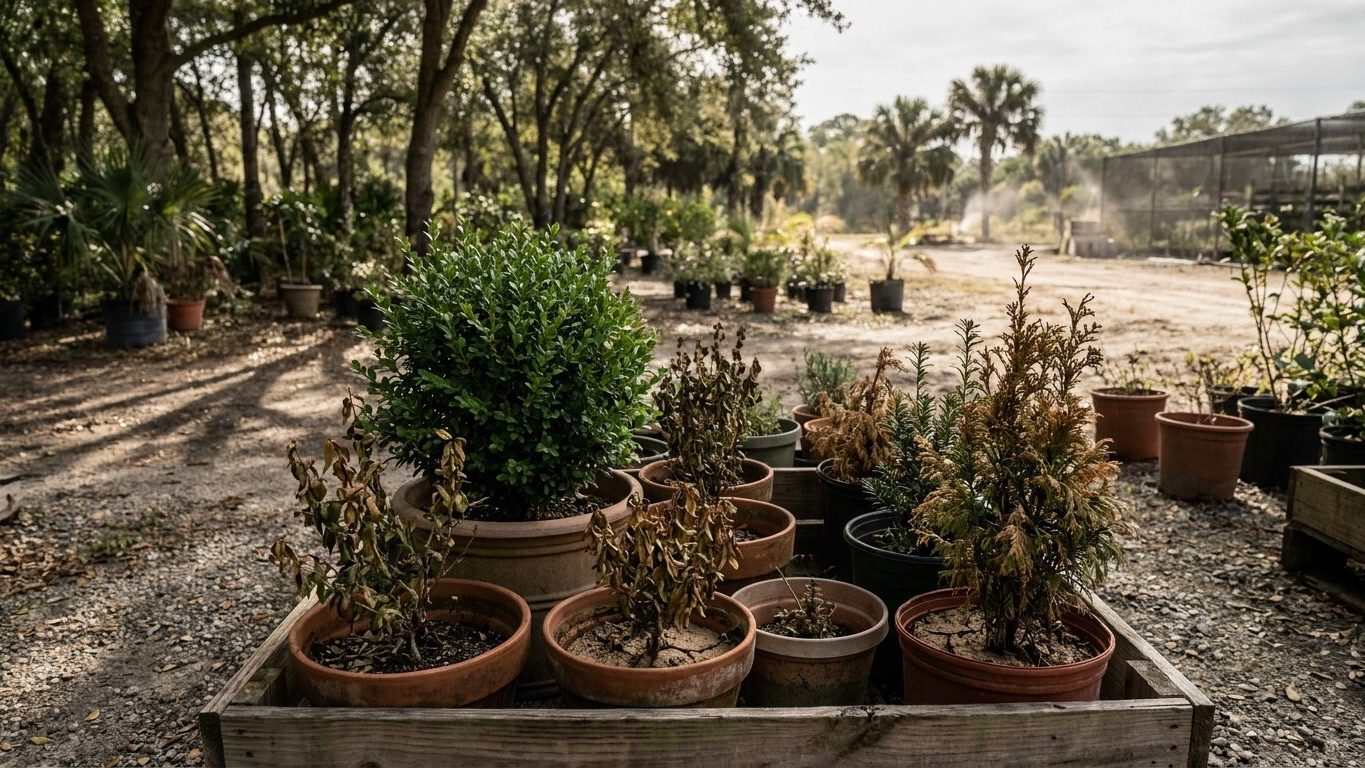

Of twelve common hedge plants, four survive every zone Washington has, from 4a to 9a on the USDA system: American hornbeam, inkberry holly, winterberry holly and eastern red cedar. The other eight hold in only part of that range. None fail everywhere, so the risk is subtler than a dead hedge. It is buying a plant that suits one end of the state and planting it at the other.
What actually holds in Washington
A hardiness zone is built on one number, the average annual extreme minimum temperature. Washington runs from 4a to 9a on the USDA Plant Hardiness Zone Map (2023 edition, 1991-2020 normals), so a nursery tag that says “hardy” can be true in one county and false in the next. “Holds” here means survives the winter. It does not promise the plant will look good. The warm edge of a plant’s range is often a heat limit, and a hedge sitting at that edge can survive for years while looking tired.
Western Washington is mild and maritime. The reference station at Seattle-Tacoma sees its last spring frost between February 27 and March 18, and its first fall frost between November 13 and November 30 (NOAA NCEI 1991-2020 Climate Normals, 30-70% probability band). East of the Cascades the land is high desert with a much shorter season, so those dates do not travel across the state. Look up your own ZIP code on the USDA map before you buy anything.
Which hedge plants fail in part of Washington?
Eight of the twelve have a zone window. Outside it, they either freeze out or sit past their warm limit.
| Plant | Holds in zones | Growth per year | Hedge height | Regrows from old wood? |
|---|---|---|---|---|
| Boxwood | 5a to 8b | 3 to 6 inches | 2 to 6 feet | Yes |
| Leyland cypress | 6a to 9a | 3 to 4 feet | 15 to 25 feet (screen) | No |
| Privet | 4a to 7b | 2 to 3 feet | 4 to 12 feet | Yes |
| Cherry laurel | 6a to 8b | 1 to 2 feet | 6 to 15 feet | Yes |
| Yew | 4a to 7b | 6 to 12 inches | 3 to 8 feet | Yes |
| Arborvitae | 4a to 7b | 6 to 9 inches | 4 to 15 feet | No |
| Eastern hemlock | 4a to 7b | 12 to 24 inches | 10 to 20 feet | Yes |
| Arrowwood viburnum | 4a to 8b | 12 to 24 inches | 6 to 10 feet | Yes |
Read the table from the cold end first. Leyland cypress and cherry laurel both need 6a or warmer, so a garden in 4a or 5b should skip them. Boxwood starts at 5a. At the other end, privet, yew, arborvitae and hemlock top out at 7b. A garden in 8a or 9a is asking for trouble with any of them, and the warm limit is more likely to show up as stress than as a clean winter kill. Arrowwood viburnum stretches furthest, from 4a to 8b.
Which hedge plants hold in every zone?
Four plants cover the whole 4a to 9a span. American hornbeam grows about 12 inches a year and makes a hedge of 6 to 15 feet. Inkberry holly, the evergreen one, and winterberry holly, which loses its leaves in winter, each add 6 to 12 inches a year and reach 5 to 15 feet as a hedge. Eastern red cedar grows 12 to 24 inches a year and reaches 8 to 20 feet as a screen. None of them is the flashiest choice, but you can plant them without checking a zone map first.
The hedges you can never cut back down
Three of the twelve cannot regrow from old wood: Leyland cypress, arborvitae and eastern red cedar. Cut into the bare, leafless interior of any of them and the branch stays bare. There is no second chance, and that changes how you manage them from the first year.
Leyland cypress is the sharpest example. It adds 3 to 4 feet a year and aims for 15 to 25 feet. Left alone for three seasons, it is taller than the fence. Cutting it back then means cutting into brown wood, and the hole does not fill. The only workable method is to trim every year, from late spring to midsummer, and never take more than the green growth. Plant one only where it can reach 25 feet without touching a power line or a neighbor’s roof.
Arborvitae is slower, 6 to 9 inches a year, and the problem is quieter. Trim it in late winter before growth starts, or in midsummer. A hedge sheared tight for years has a dense green skin over bare wood, and you cannot cut below the skin. Eastern red cedar takes light cuts only, in late winter. Treat it as a screen you steer, not one you reset.
The other nine will forgive a mistake. Yew, privet, cherry laurel, boxwood, hemlock, arrowwood viburnum, hornbeam, inkberry and winterberry all regrow from old wood, so an overgrown hedge can be cut hard and rebuilt. Yew and privet are the classic rescue hedges. A plant that regrows costs you a few ugly months. One that doesn’t costs you the hedge.
Matching the plant to the job
Start with the job, then check the zone. A screen to block a neighbor’s second-story window needs height and evergreen leaves. A front-yard edge needs a plant that stays small. A wildlife border can be loose and leafless in winter.
For a tall evergreen screen, the choices narrow quickly. Eastern red cedar holds in every zone and reaches 8 to 20 feet. Eastern hemlock reaches 10 to 20 feet, but only in 4a to 7b. Leyland cypress is the fastest, limited to 6a through 9a, and can never be cut down. Cherry laurel is slower at 1 to 2 feet a year but reaches 6 to 15 feet in 6a to 8b, and it regrows if you need to cut it back. If speed is not the priority, cherry laurel is the safer choice of those three for the milder zones.
For a formal, clipped hedge under about 8 feet, boxwood and yew are both slow, which is the point: you trim less and the line stays crisp. Boxwood is pruned in late spring after the last frost. Yew is pruned in late spring after new growth hardens. Boxwood holds only in 5a to 8b, yew in 4a to 7b, so the coldest and warmest gardens need a different formal plant. Privet is the faster alternative, but it needs two cuts a season.
For an informal or wildlife-friendly border, the zone-proof plants come into their own. Hornbeam, inkberry and winterberry all hold in every zone in the state. Inkberry keeps its leaves through winter, so it works where you want year-round cover. Winterberry drops its leaves, which makes it a poor winter screen. Arrowwood viburnum fits here too if your garden falls in 4a to 8b.
Gardeners comparing Washington with colder states can see how much the choices shrink at the 4a end in Hedge Plants for North Dakota: What Holds, and What Only Looks Hardy. The full set is gathered under Hedges.
The ground you are planting into
The soil USDA lists as representative of Washington is the Tokul series, an Andisol. That is a volcanic-ash soil: light, porous, and unusually good at holding both water and phosphorus. The surface layer runs about 45 percent sand, 10 percent clay and 45 percent silt, which sorts it as a loam to silt. It is moderately well drained, and the surface pH is about 4.5, which is strongly acid. The organic matter reads about 75 percent (USDA NRCS Soil Data Access, representative surface values for the major components of the series).
That organic matter number tells you the mapped surface is a natural layer of forest litter, not a garden bed. Treat these figures as a description of how the ground tends to behave in the region: it holds moisture, and it runs acid. They are not your pH and they are not your soil. River bottoms, hillsides, the dry ground east of the Cascades, and any lot a builder has scraped or filled will all differ.
For a hedge, the practical step is a soil test before planting. A hedge goes in once and stays for decades, so it is worth knowing the pH and drainage of the exact strip. Inkberry and winterberry are the hollies often grown in acid ground, which gives them an edge on soils like the Tokul. If your test comes back strongly acid and you want boxwood or another species, ask Washington State University Extension whether lime makes sense for your site. A low spot that stays wet through winter is a poor place for any of these plants. Planting on a slight rise helps.
Timing follows the soil, not just the frost dates. In western Washington, the first fall frost arrives between November 13 and November 30, so late October still gives new roots some warm, wet weeks. In spring, cold, wet soil holds plants back well past the last freeze, so do not rush a planting because the calendar says you can.
Common questions
What is the fastest-growing hedge for Washington?
Leyland cypress, at 3 to 4 feet a year, reaching 15 to 25 feet. It holds only in zones 6a to 9a, and it cannot regrow from old wood, so it has to be trimmed every year from late spring to midsummer. Eastern hemlock and eastern red cedar are slower at 12 to 24 inches a year, and the cedar holds in every zone.
Which hedge plants survive in every part of Washington?
American hornbeam, inkberry holly, winterberry holly and eastern red cedar hold across the full 4a to 9a range. Surviving is not the same as thriving, so a soil test and good drainage still matter.
Can I cut an overgrown arborvitae or Leyland cypress back hard?
No. Neither regrows from old wood, and neither does eastern red cedar. Cutting into bare, leafless wood leaves a permanent gap. The fix is prevention: trim a little each year and stay in the green growth. If the plant is already too big, replacing it is usually more reliable than cutting it back.
Should I prune my hedge this month?
Probably not. The pruning windows for these twelve plants run from late winter through midsummer, and none fall in late October. This month is better for planting. For site-specific timing, check with your county extension office.