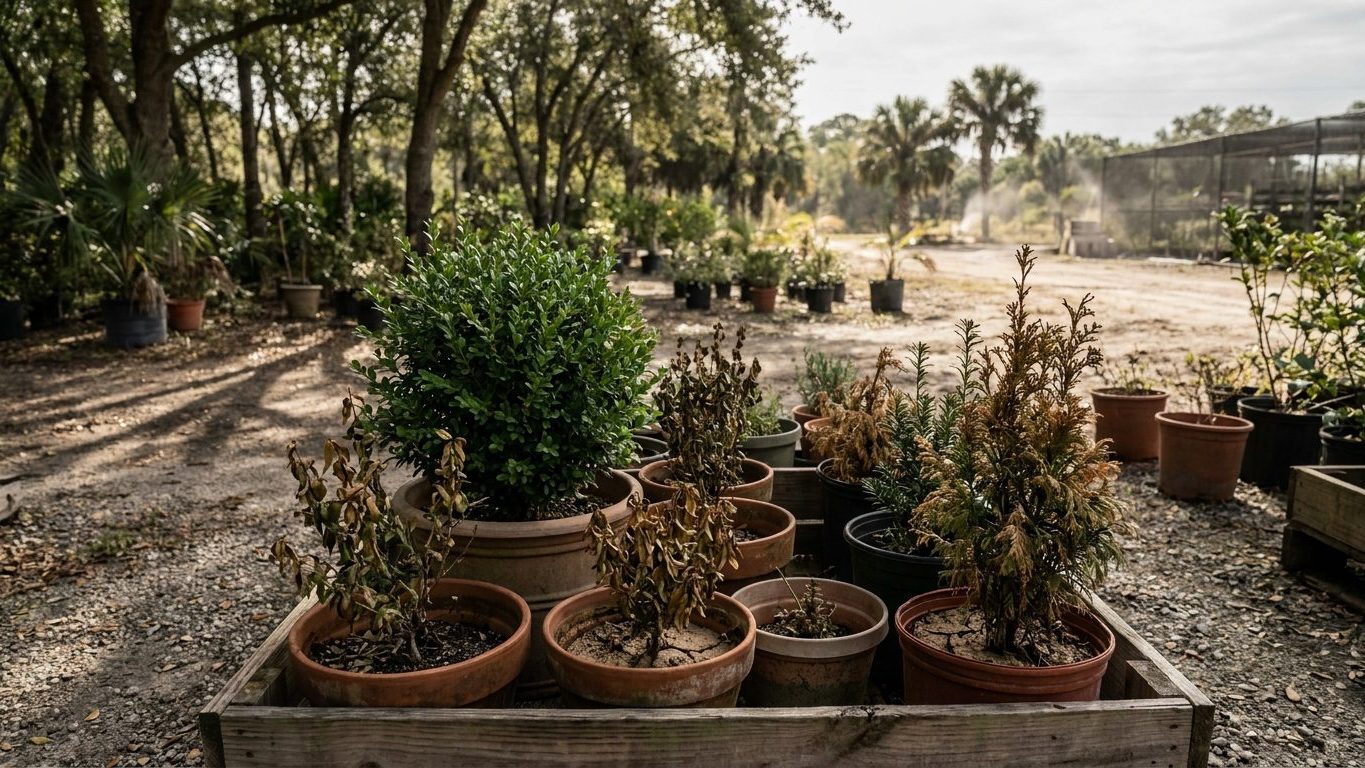

Of the 12 hedge species documented on this site, six hold across all of North Dakota. Three survive only in the warmer zones, 4a and 4b, and three fail everywhere in the state. Boxwood, Leyland cypress and cherry laurel are the ones to cross off. The six statewide performers are a mix of evergreens and deciduous shrubs, and two of them can never be cut back to size once they outgrow the space.
What actually holds in North Dakota
The USDA Plant Hardiness Zone Map (2023 edition, built on 1991-2020 normals) rests on a single variable: the average annual extreme minimum temperature. North Dakota spans zones 3a to 4b, so “hardy here” has no single answer. A shrub that is fine in one county can die in another a few hours’ drive away. The hardiness ranges behind this page come from the NC State Extension Gardener Plant Toolbox, laid over the state’s own zone span. “Holds” here means survives, not thrives. A plant sitting at the edge of its range lives, but it can look rough after a hard winter.
The three that will not survive
Boxwood (Buxus sempervirens), Leyland cypress (x Hesperotropsis leylandii) and cherry laurel (Prunus laurocerasus) are not hardy anywhere in the state, including its mildest zone. They are staples of hedging in gentler climates, which is why they show up in so many photos and catalogs. If a tag or a neighbor’s old photo from another region sells you one of them, the recommendation was written for a different winter. For a sense of how the same question plays out where those plants do work, compare the guides for Hedge Plants for Washington: What Holds, and What Only Looks Hardy and Hedge Plants for Florida: What Holds, and What Only Looks Hardy.
The three that hold in 4a and 4b only
This is the middle group, and it needs zones named rather than a yes or a no. Each of these survives only in zones 4a and 4b. In a 3a or 3b garden, skip them.
| Plant | Zones in ND | Growth per year | Height as a hedge | When to prune |
|---|---|---|---|---|
| Inkberry holly (Ilex glabra), evergreen | 4a, 4b only | 6 to 12 inches | 5 to 15 feet | Late winter, while dormant |
| Privet (Ligustrum vulgare) | 4a, 4b only | 2 to 3 feet | 4 to 12 feet | Twice a season, spring and midsummer |
| Yew (Taxus x media) | 4a, 4b only | 6 to 12 inches | 3 to 8 feet | Late spring, after new growth hardens |
All three regrow from old wood, so a hard cut to fix shape is possible. Their weak point is the cold itself. Check your zone on the USDA map before buying, and if you are in 4a, choose a sheltered spot rather than an exposed prairie edge.
The remaining six (hornbeam, winterberry, red cedar, arborvitae, hemlock and arrowwood viburnum) hold in every zone the state has. They are worth a closer look, starting with the two that come with a permanent condition.
The hedges you can never cut back down
Two of the six statewide performers will not regrow from old wood: arborvitae (Thuja occidentalis) and eastern red cedar (Juniperus virginiana). Cut past the green growth into the bare interior and no new shoots appear. The hole stays a hole. Nothing else in the group carries a penalty this permanent, and it is the fact most worth knowing before you buy.
Arborvitae grows 6 to 9 inches a year and reaches 4 to 15 feet as a hedge. Prune it in late winter before growth starts, or in midsummer. Eastern red cedar moves faster, at 12 to 24 inches a year, and is a screen rather than a tidy hedge, reaching 8 to 20 feet. It takes only light cuts, in late winter. At up to two feet a year, a skipped season adds a lot of wood you cannot take back later.
The practical rule is to choose for final height on the day you plant. An arborvitae set beneath a window that tops out at 15 feet cannot be lowered later. The only fix is a shovel and a replacement. Space these plants for the width they will reach, and trim lightly every year rather than rescuing them every fifth.
The ones that forgive
Everything else on the list regrows from old wood, which means a neglected hedge can be cut hard and left to resprout. That covers American hornbeam, winterberry holly, arrowwood viburnum, eastern hemlock, and the three zone 4a and 4b plants above. It is a real safety net if you inherit an overgrown planting or misjudge the growth rate.
Each of them still has a preferred time for cutting:
- Hornbeam: midsummer, after the first flush of growth.
- Winterberry: late winter, while dormant.
- Arrowwood viburnum: right after flowering.
- Hemlock: late spring, light cuts only.
Hemlock deserves a note. It does regrow from old wood, but the guidance on it is still light cuts, so treat it gently even though it can recover.
Matching the plant to the job
Growth rate is what most often decides whether a hedge does its job. The six plants that hold statewide differ by a factor of four on that measure.
| Plant | Growth per year | Height | Regrows from old wood |
|---|---|---|---|
| Arborvitae (Thuja occidentalis) | 6 to 9 inches | 4 to 15 feet as a hedge | No |
| Winterberry holly (Ilex verticillata), loses its leaves | 6 to 12 inches | 5 to 15 feet as a hedge | Yes |
| American hornbeam (Carpinus caroliniana) | 12 inches | 6 to 15 feet as a hedge | Yes |
| Arrowwood viburnum (Viburnum dentatum) | 12 to 24 inches | 6 to 10 feet as a hedge | Yes |
| Eastern hemlock (Tsuga canadensis) | 12 to 24 inches | 10 to 20 feet as a hedge | Yes |
| Eastern red cedar (Juniperus virginiana) | 12 to 24 inches | 8 to 20 feet as a screen | No |
For a formal, evergreen hedge in a small space, arborvitae is the slowest and therefore the easiest to keep to size. The trade-off is patience, and the permanent-height rule from the last section. Plant it where the top of its range is acceptable.
For fast privacy, hemlock and red cedar both add 12 to 24 inches a year. Hemlock is the one you can cut back later. Red cedar is the one you cannot. Both suit a boundary that has room to grow. Neither suits a narrow strip beside a driveway.
For a deciduous hedge that still gives winter interest, hornbeam and arrowwood viburnum are the straightforward picks, and both recover from a hard cut. Winterberry holly gives up its leaves in winter, which is worth knowing if you want screening in January. It is the deciduous option here for berries, though berrying generally needs both male and female plants nearby, so ask the nursery.
If you garden in zone 4a or 4b, the wider list opens up. Privet is the fast one at 2 to 3 feet a year, and it needs two trims a season to stay formal. Yew is slow, reaches the lowest height in the group at 3 to 8 feet, and suits a short, dense hedge. For more on structure and upkeep across the country, see the main Hedges guide.
The ground you are planting into
The soil USDA lists as representative of North Dakota is the Williams series, a Mollisol: the deep, dark prairie soil that helped build the Corn Belt. Its surface layer averages about pH 7.2 (near neutral), with 38 percent sand, 22 percent clay and 40 percent silt. That makes it a loam to silt, with organic matter around 4.0 percent, and it is well drained. These are representative values from USDA NRCS Soil Data Access for the surface horizon of the series’ major components (549 mapped), not a measurement of a worked garden bed.
What that tends to mean for a hedge: roots find good structure and nutrients, water does not sit for long, and the near-neutral pH suits most of the plants above. Some species on the list are commonly grown in more acidic ground, so it is worth checking your own number before you plant hemlock or inkberry holly in particular. But this is the soil that represents the state, not necessarily the soil in your yard. River bottoms, hill country and any lot a builder has scraped or filled can differ completely. Never treat the pH above as yours. A soil test through NDSU Extension gives you the actual figure.
Frost dates for planting and pruning
NOAA NCEI’s 1991-2020 U.S. Climate Normals, using 32°F freeze probabilities (the 30-70% band) at the reference airport station in Fargo, put the last spring frost between May 4 and May 15 and the first fall frost between September 25 and October 5. Today is September 29, so that fall window is open now. Suburban and rural gardens typically see the last spring frost later and the first fall frost earlier than an airport does, often by one to two weeks, so check the dates for your own county. A firm cutoff date for fall planting is not published here. What matters is getting evergreens in and watered while the ground is still workable.
Common questions
Which hedge plant is the safest choice for the whole state?
Any of the six that hold in every zone, from 3a to 4b: American hornbeam, winterberry holly, eastern red cedar, arborvitae, eastern hemlock and arrowwood viburnum. Of those, arborvitae and hemlock give you a true evergreen hedge, though only hemlock can be cut back hard later.
Can I grow boxwood or Leyland cypress in North Dakota with winter protection?
Boxwood (Buxus sempervirens), Leyland cypress and cherry laurel are not hardy anywhere in the state. Wrapping or mulching does not change the zone, so choose a plant that holds in your zone from the start.
How do I find out which zone my yard is in?
Look up your ZIP code on the USDA Plant Hardiness Zone Map (2023). North Dakota spans 3a to 4b, and the map is built on the average annual extreme minimum temperature. That number decides whether inkberry holly, privet and yew are options for you.
Can I fix an overgrown arborvitae or red cedar?
Not by cutting it back hard. Neither regrows from old wood, so cuts into the bare interior stay bare. If the plant has outgrown its spot, replacing it is usually the only real fix. Hornbeam, arrowwood viburnum and hemlock are the ones you can prune back severely and expect to recover.