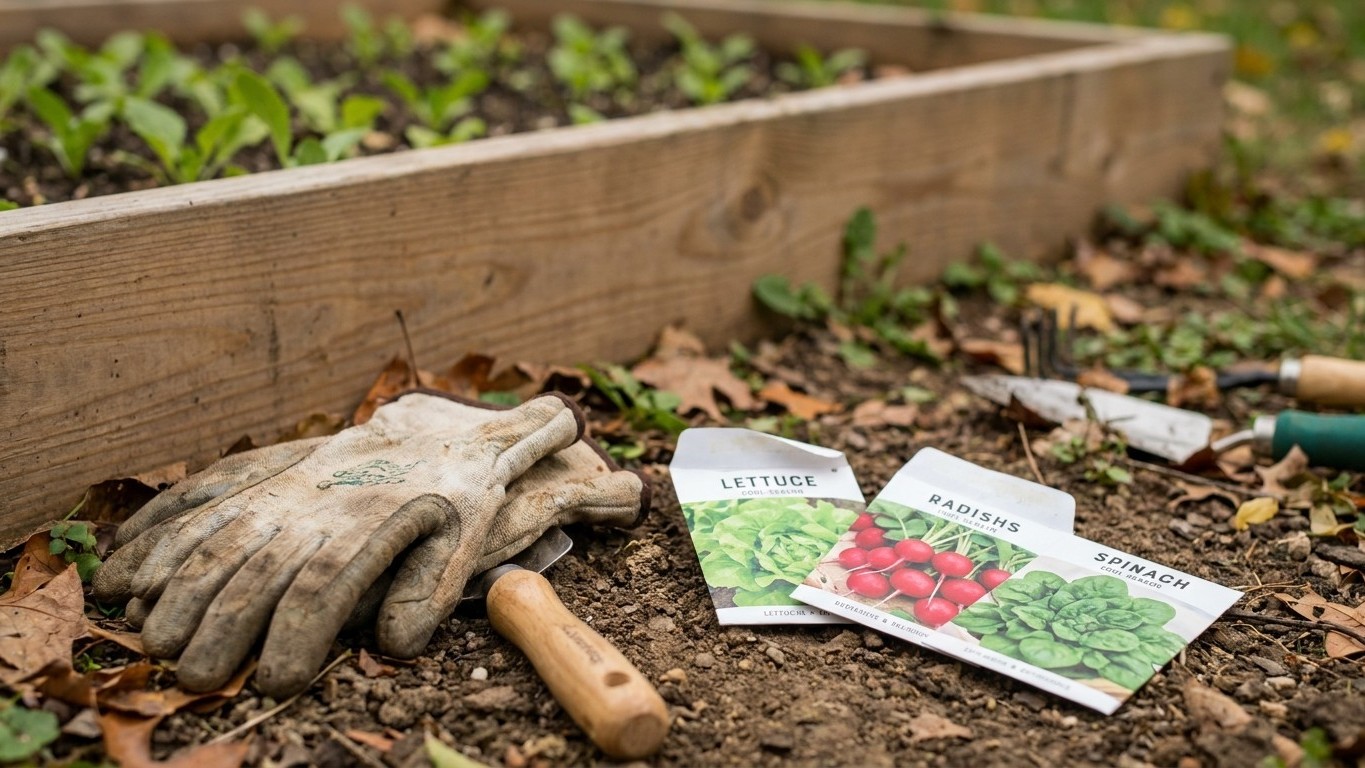

September is a working month in Washington gardens, not a wind-down. With the first fall frost still weeks away across most of the state, there’s time to get cool-season crops in the ground, pull in the last of summer’s harvest, and set up beds that will carry crops through winter. What you can plant depends less on the date than on how much runway is left before cold weather locks things down.
What goes in the ground in September
The number that actually matters this month is the first fall frost window, not the calendar page. In western Washington, that falls between November 13 and November 30, based on 1991-2020 NOAA climate normals for the Seattle station. That gives most of the Puget Sound corridor roughly ten to twelve weeks of frost-free growing left when September opens, which is enough for a real second wave of cool-season crops, but not enough for anything that needs summer heat to finish.
Direct-sown into open ground this month: spinach, arugula, corn salad (mâche), radishes, turnips, and hardy lettuce mixes. All of these germinate in cool soil and mature fast enough to size up before the days shorten too much to matter. Peas sown early in the month can still produce a light fall crop in milder western counties, though yields drop off compared to a spring sowing. Cover crops like crimson clover and winter rye are also a September job, going down as soon as a bed empties out, to hold soil and add organic matter over the wet months ahead.
Transplants are the better bet for anything in the cabbage family. Kale, collards, Swiss chard, and fast-maturing cabbage or broccoli varieties started as transplants in August can go into the ground now and still reach usable size before growth slows. Garlic and shallots are close behind but not quite here yet in most of the state; that planting generally waits until soil temperatures drop further in October.
Eastern Washington is a different calculation entirely. Beyond the Cascades, the high-desert climate runs a shorter, harder-edged season, and a frost can arrive well before the western Washington window closes. Gardeners east of the mountains should treat September as a month to finish up fast-maturing greens and radishes only, and to shift energy toward bed cleanup and cover cropping rather than new plantings that need a long runway.
What to start under cover
Counting backward from the first fall frost window (November 13-30 in western Washington) is the way to figure out what still has time to mature, and it works the same in any county once you know the local frost date. A crop that needs eight weeks to reach harvest size, sown the first week of September, finishes right around the start of November, cutting it close in a mild year and missing entirely in an early-frost one. That’s the arithmetic worth running before starting anything new.
Under cold frames, cloches, or unheated hoop houses, September is prime time to start a second round of lettuce, spinach, and Asian greens like tatsoi and mizuna. The protection buys several extra weeks of growing temperature and light retention once outdoor conditions turn wet and gray. Onion sets and shallot starts destined for overwintering can also go into protected beds now in preparation for an early spring harvest.
Two mistakes show up every year. Starting too early, while the weather is still warm, pushes seedlings into leggy, stretched growth before they even reach the garden; a hot spell under cover can stress young greens as badly as frost does outside. Starting too late means the crop is racing against dropping daylight hours as much as temperature, and even protected plants stall out once the light drops below what leafy greens need to keep producing. Aiming for the first half of the month gives the most reliable results for anything meant to mature before the frost window closes.
What is ready to pick
September is peak harvest across most of Washington, and the list is long. Tomatoes, peppers, and summer squash are still coming in from plantings set months earlier, while winter squash, pumpkins, and the first apples and pears reach maturity as the month goes on. Sweet corn wraps up its run, and dry beans left on the vine begin rattling in their pods, a sign they’re ready to strip and store.
Knowing when to pull a crop matters as much as knowing what’s ripe. Winter squash is ready when the rind resists a fingernail press and the stem has started to dry and corky; picking too early leaves thin skin that won’t store. Apples come off the tree with a gentle upward twist, no tugging required, once the background color has shifted away from green. Onions and garlic planted earlier in the season should already be cured and stored by this point, but it’s worth checking that stored bulbs are firm, not soft at the neck, since a soft neck is the first sign of rot spreading through a batch in storage.
Late-planted beans, cucumbers, and zucchini are still producing in most western Washington gardens through September, and picking regularly keeps plants setting new fruit instead of shutting down early. In eastern Washington’s shorter season, harvest tends to compress into a narrower window this month, with growers pulling in warm-season crops faster as nighttime temperatures drop.
The jobs that matter this month
Clearing, feeding, and protecting soil
As summer crops finish, the beds they leave behind need attention before winter rain arrives. Pulling spent plants and adding finished compost now gives soil time to settle before the next planting, and it’s far easier to work compost into dry September soil than into the saturated ground of November. Any bed not going into a fall crop should get a cover crop or a heavy mulch layer, since bare soil through a Washington winter erodes and loses nutrients fast under sustained rain.
Watering rhythm and pest scouting
Watering needs are shifting, not disappearing. Late-summer heat can still stress fall transplants in their first week, so new seedlings need consistent moisture even as overall rainfall starts to pick up later in the month. This is also the window to scout brassicas for cabbage worms and aphids before cooler weather naturally slows pest pressure; an infestation that takes hold now can wipe out a fall kale or broccoli planting before it ever sizes up.
Looking ahead to dormant-season work
September is also the moment to start planning the tasks that follow once growth slows: ordering garlic and cover-crop seed before good varieties sell out, mapping next year’s rotation while this season’s layout is still fresh, and getting pruning tools cleaned and sharpened ahead of the dormant pruning window for fruit trees and cane berries, which typically runs later in fall and winter. Staking and tying anything still producing, like heavy tomato vines or top-loaded pepper plants, prevents storm damage as fall winds pick up.
What not to do in September
The most common mistake is treating a stretch of warm September weather as a green light for warm-season crops. Soil temperature lags behind air temperature, and a warm afternoon doesn’t mean the ground has enough residual heat left to germinate squash or bean seed reliably; anything direct-sown that needs summer warmth is working against a shrinking window rather than a growing one.
Late nitrogen is another classic error. Feeding high-nitrogen fertilizer to perennials, fruit trees, or even fall brassicas late in the month pushes soft, leafy new growth right when plants should be hardening off for cooler weather. That tender growth is the first tissue damaged when temperatures drop, and it can set a plant back further than doing nothing at all. If a fall crop needs feeding, an earlier, lighter application supports growth without forcing a late flush.
Leaving mature crops in the ground too long is a quieter mistake with the same effect. Winter squash left past full maturity on wet ground is prone to rot at the point of soil contact, and beans or corn left too long after ripening lose quality fast once fall moisture arrives. The safer approach is to harvest promptly at the signs of maturity described above rather than waiting for a slow month to get around to it.
Checking this against your own county
A statewide picture is a starting point, not a set of instructions for a specific yard. Washington’s elevation changes, the maritime influence around Puget Sound, and the sharp divide between the wet west side and the high-desert east side of the Cascades can shift real planting and frost windows by several weeks in either direction. A garden at elevation or in a valley cold pocket may see frost well outside the Seattle-station range cited here.
For a planting calendar built around local conditions, the Washington State University Extension service is the reliable next step, with county-level offices able to speak to microclimate differences a statewide guide can’t capture.
Common questions
Can I still plant tomatoes in Washington in September?
No. Tomatoes need a long, warm growing season to mature fruit, and with the first fall frost arriving between November 13 and November 30 in western Washington, there isn’t enough remaining warmth or daylight to start new tomato plants this month. Existing plants can keep producing until frost, but new plantings won’t have time to catch up.
Is it too late to plant garlic in September?
Garlic planting in Washington generally waits until soil temperatures drop further, typically into October. September soil is often still too warm, which can trigger premature top growth that leaves bulbs more vulnerable over winter.
What USDA hardiness zone is Washington in?
Washington spans USDA Plant Hardiness Zones 4a to 9a, based on the USDA Plant Hardiness Zone Map built on 1991-2020 climate normals. That’s a wide range driven by the state’s mix of maritime lowlands, mountain elevations, and high desert, so a zone number alone doesn’t substitute for local frost data.
Does eastern Washington follow the same September planting schedule as western Washington?
No. Eastern Washington’s high-desert climate runs a shorter, more abrupt season than the maritime west side, and frost can arrive earlier than the western Washington window. Gardeners east of the Cascades should lean toward fast-maturing crops and bed cleanup rather than new long-season plantings this month.