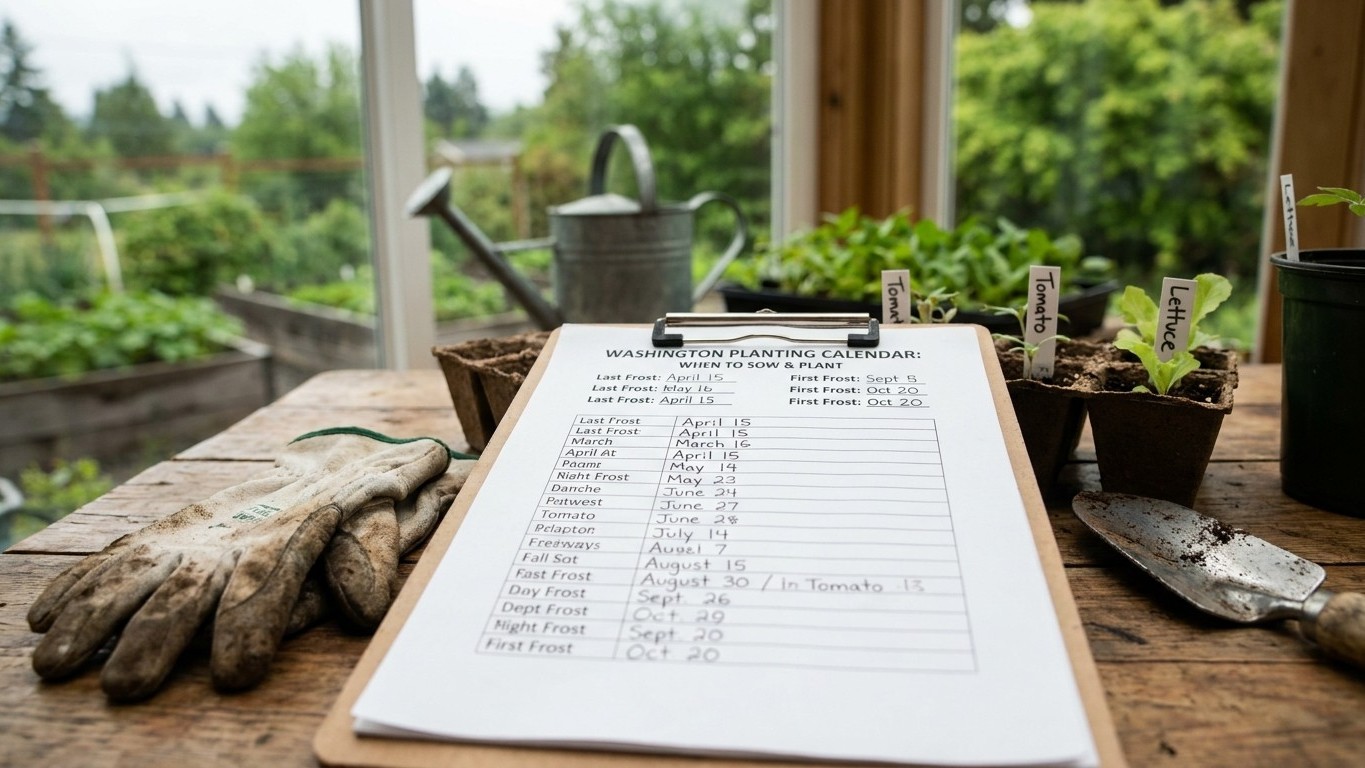

Washington’s growing season doesn’t run on a fixed date — it runs on where you are in the state and what your soil feels like right now. West of the Cascades, that gap between last spring freeze and first fall freeze can stretch past 240 days; east of the Cascades, in places like Spokane or Yakima, that same math falls apart because you’re gardening in high desert, not marine climate. So before you sow anything, figure out which Washington you’re actually in, then check whether your soil crumbles or squelches — if you’re getting an early start on spring sowings, see What to Plant in Washington in April, if you’re timing your main spring sowings, see What to Plant in Washington in May, if you’re just getting into the early-summer swing, see What to Plant in Washington in June, if you’re mid-season and wondering what to sow now, see What to Plant in Washington in July, and if you’re planning ahead for late-summer sowings, see What to Plant in Washington in August for month-specific guidance.
The frost window in Washington

Everything on a Washington planting calendar hangs off two numbers. NOAA’s NCEI 1991-2020 climate normals, measured at station USW00024233 near Seattle, put the last spring freeze between February 27 and March 18 and the first fall freeze between November 13 and November 30. Those are 30 to 70 percent freeze probability windows, not a single guaranteed day, which is why they’re given as a range rather than a date.
Pair the two extremes and you get the outer edges of the growing season. Subtract the earliest possible last frost (February 27) from the latest possible first frost (November 30) and the frost-free window stretches to roughly 276 days. Pair the more conservative dates, a last frost as late as March 18 and a first frost as early as November 13, and the window shrinks to about 240 days. Either way, that is a long season by American standards, and it is the main reason western Washington gardeners can grow crops that would struggle to finish in a shorter continental climate.
East of the Cascades is a different state, climate-wise
This data comes from a station near Seattle, and it describes the mild, marine-influenced climate of Puget Sound. Move north toward Bellingham or up into the foothills and frost lingers later into spring and returns earlier in fall. Cross the Cascades into central and eastern Washington, around Spokane, Yakima or the Columbia Basin, and the climate stops being maritime altogether. That side of the state is high desert: colder winters, hotter summers, and a shorter, more sharply bounded frost-free season than anything the Seattle numbers describe. Treat the dates above as a western Washington reference point, not a statewide instruction, and confirm your local window before committing seed to soil.
Cool-season crops
Cool-season vegetables go in before the last frost because they tolerate a light freeze and actually prefer to mature in cooler soil. Peas, spinach, lettuce, brassicas like kale and cabbage, and root crops such as carrots and beets all fall into this group. The trigger for sowing these isn’t a date on a calendar, it’s the state of the soil: cold, waterlogged ground in late winter will rot seed faster than a light frost will kill a seedling.
In the Seattle area, where NOAA’s normals put the last freeze between February 27 and March 18, gardeners typically start working cool-season beds in the weeks bracketing that window rather than strictly before or after it. Wet, heavy soil that hasn’t dried out enough to crumble in your hand is a bigger obstacle than the frost date itself, especially west of the Cascades where spring rain is the norm rather than the exception. Low light levels in late winter also slow germination regardless of soil temperature, so an early sowing date on paper doesn’t always translate into faster growth in the ground.
What tolerates the frost window and what doesn’t
- Peas: germinate in cool soil and shrug off a light frost once up
- Spinach and lettuce: bolt in summer heat, so they belong at the frost-window edges, not mid-season
- Brassicas (kale, cabbage, broccoli): transplants handle a freeze better than direct-sown seedlings
- Carrots and beets: need workable, crumbly soil more than they need warmth to germinate
None of these crops need to wait for soil to warm the way tomatoes or peppers do. Their limiting factor is almost always how workable the ground is, and in a wet maritime climate that can lag well behind the calendar date even after the freeze risk has technically passed.
Warm-season crops

Warm-season crops care about soil temperature more than they care about the frost date on its own. A tomato transplant set into cold, wet ground will simply sit there, stunted, even if the air hasn’t dropped near freezing in weeks. That’s why tomato and pepper planting windows in western Washington sit noticeably later than the last-frost date itself: soil needs time to catch up with the air after a cool, wet Pacific Northwest spring.
Tomato timing, cultivar by cultivar
Every catalogue days-to-maturity figure is counted from transplant, not from seed, and actual timing shifts by a week or two depending on the season, so treat the figures below as a starting calculation rather than a guarantee. Working from a Seattle-area transplant window of mid March to early April, here’s how several tomato cultivars line up against the first fall freeze:
| Variety | Days to Maturity | Type | First Ripe | Margin Before Fall Frost |
|---|---|---|---|---|
| Sakura | 55 | Indeterminate | Late May | 171 days |
| Edox | 55 | Indeterminate | Late May | 171 days |
| Valentine | 55 | Indeterminate | Late May | 171 days |
| Glacier | 55 | Determinate | Late May | 171 days |
| Sun Gold | 57 | Indeterminate | Late May | 169 days |
| Supersweet 100 | 60 | Indeterminate | Late May | 166 days |
| Juliet | 60 | Indeterminate | Late May | 166 days |
| Amalfi | 68 | Determinate | Early June | 158 days |
| Cherokee Purple | 72 | Indeterminate | Mid June | 154 days |
| Big Beef Plus | 72 | Indeterminate | Mid June | 154 days |
| Tiren | 75 | Indeterminate | Mid June | 151 days |
| Granadero | 75 | Indeterminate | Mid June | 151 days |
| San Marzano II | 78 | Indeterminate | Mid June | 148 days |
| Celebrity Plus | 78 | Determinate | Mid June | 148 days |
Even the longest-season variety on this list, San Marzano II or Celebrity Plus at 78 days, leaves nearly five months of margin before Seattle’s earliest possible fall freeze on November 13. That margin matters less for whether the fruit will ripen at all and more as a buffer against a cool, overcast summer that slows ripening further. Disease resistance is worth weighing alongside days to maturity: Celebrity Plus carries high resistance to Tomato Mosaic Virus and Gray Leaf Spot, while Amalfi resists both Early and Late Blight at an intermediate level, useful in a climate where humidity lingers into early summer.
For indoor starts, count backward from that mid-March-to-early-April transplant window rather than from the frost date itself. Most tomato seed needs roughly six to eight weeks indoors before it’s ready to go out, which puts a Seattle-area sowing date somewhere in late January to mid February, well before the last frost has even arrived. Compare that to the far longer, earlier-starting warm season laid out in our Texas planting calendar, where soil warms weeks ahead of anything possible in the Pacific Northwest.
The fall planting window
Working backward from first frost
Fall crops get planned in reverse. Start with NOAA’s first-freeze window for the Seattle area, November 13 to November 30, and count backward by the crop’s days to maturity, then add a couple of extra weeks because growth slows as daylight shortens through September and October. A crop that lists 60 days to maturity in a seed catalogue can easily take 75 to 80 days when it’s maturing into shorter, cooler fall days rather than the height of summer.
That backward count is why fall planting dates for quick crops like lettuce, spinach and radishes tend to land in mid to late summer, well before the weather itself feels like fall. Wait until the calendar says autumn and it’s too late for most fall crops in a maritime climate, because the window for sowing closes long before the frost that ends the season actually arrives.
Root crops and brassicas behave differently once they’re established. Carrots, parsnips, kale and Brussels sprouts all improve in flavor after a light frost converts starches to sugars, so there’s no rush to pull them the moment temperatures dip. Given western Washington’s mild fall freeze window, many of these crops can sit in the ground well past the first frost date and continue to be harvestable into early winter, particularly under a layer of mulch or a low tunnel.
The crops that don’t benefit from this treatment are the tender ones: beans, squash and cucumbers have no frost tolerance at all, and a first freeze anywhere in the November 13 to November 30 window will end their season outright regardless of how much more fruit was on the vine.
Reading a planting calendar properly
What to watch instead of the calendar
A statewide planting calendar, including this one, is a starting point built on averages from a single weather station. NOAA’s numbers here come from Seattle, and they describe one climate zone in a state that contains several. Elevation changes frost timing fast: gain a few hundred feet and the last frost can run later, the first frost earlier. Lake effects around Puget Sound moderate temperature swings near the water, while inland valleys away from that moderating influence see harder, more frequent frosts. Urban heat matters too: a garden against a south-facing wall in a paved city lot warms up weeks ahead of an open rural field a few miles away.
A gardener in Spokane or the Columbia Basin is working with something closer to the short, sharply defined season described in our Alberta planting calendar than to Seattle’s mild, drawn-out maritime timing, even though both places are technically the same state. That gap is exactly why a single set of dates can’t serve the whole territory.
The most reliable fix is to watch your own garden rather than lean entirely on published averages. Keep a simple log: the date of your last spring frost each year, the date of the first fall frost, and how the soil felt and drained in between. After two or three seasons, that log will tell you more about your specific plot, on your slope, behind your fence line, than any statewide table ever could. A late cold snap that arrives after a run of warm days is the single most common way gardeners get caught out, and it’s the thing no calendar, including this one, can predict for a given year.
Local help
For dates specific to your county, soil testing, and crop advice tuned to your side of the Cascades, contact WSU Extension directly rather than relying on a statewide average. Extension offices track local frost data and disease pressure that a single Seattle-area station can’t capture. For more on gardening across the state’s varied climates, see our other Washington guides.
Common questions
When is it safe to plant tomatoes outside in Seattle?
Most Seattle-area gardeners wait until mid March to early April, later than the last frost date itself, because tomatoes need warm soil more than they need frost-free air. Cold, wet ground in early spring will stall a transplant even if temperatures stay above freezing.
Does this frost date apply to Spokane too?
No. The February 27 to March 18 last-frost window and the November 13 to November 30 first-frost window come from a station near Seattle and describe western Washington’s maritime climate. Eastern Washington, including Spokane and the Columbia Basin, is high desert with a shorter, more sharply bounded growing season, so check WSU Extension for local figures rather than using the Seattle dates.
Can I start seeds indoors before the last frost date?
Yes, and for warm-season crops like tomatoes you generally have to. Most tomato varieties need six to eight weeks indoors before transplanting, which in the Seattle area means sowing in late January to mid February, well before the last frost has passed.
What happens if I plant too early in a wet spring?
Seed and transplants set into cold, saturated soil are far more likely to rot or stall than to simply grow slowly. In western Washington’s wet spring climate, waiting for the soil to dry out and warm up matters more than watching the calendar date alone.
Do I need to cover crops if frost hits after I’ve planted?
Cool-season crops like peas, brassicas and root vegetables typically shrug off a light frost without protection. Warm-season transplants such as tomatoes and peppers have no frost tolerance at all, so a floating row cover or cloche is worth keeping on hand through the tail end of the frost window.
Related guides
- Oregon Planting Calendar: When to Sow and Plant, Frost Dates Included
- Idaho Planting Calendar: When to Sow and Plant, Frost Dates Included
- Alberta Planting Calendar: When to Sow and Plant, Frost Dates Included
- When to Plant Melons in Washington
- What to Plant in Washington in November
- What to Plant in Washington in December