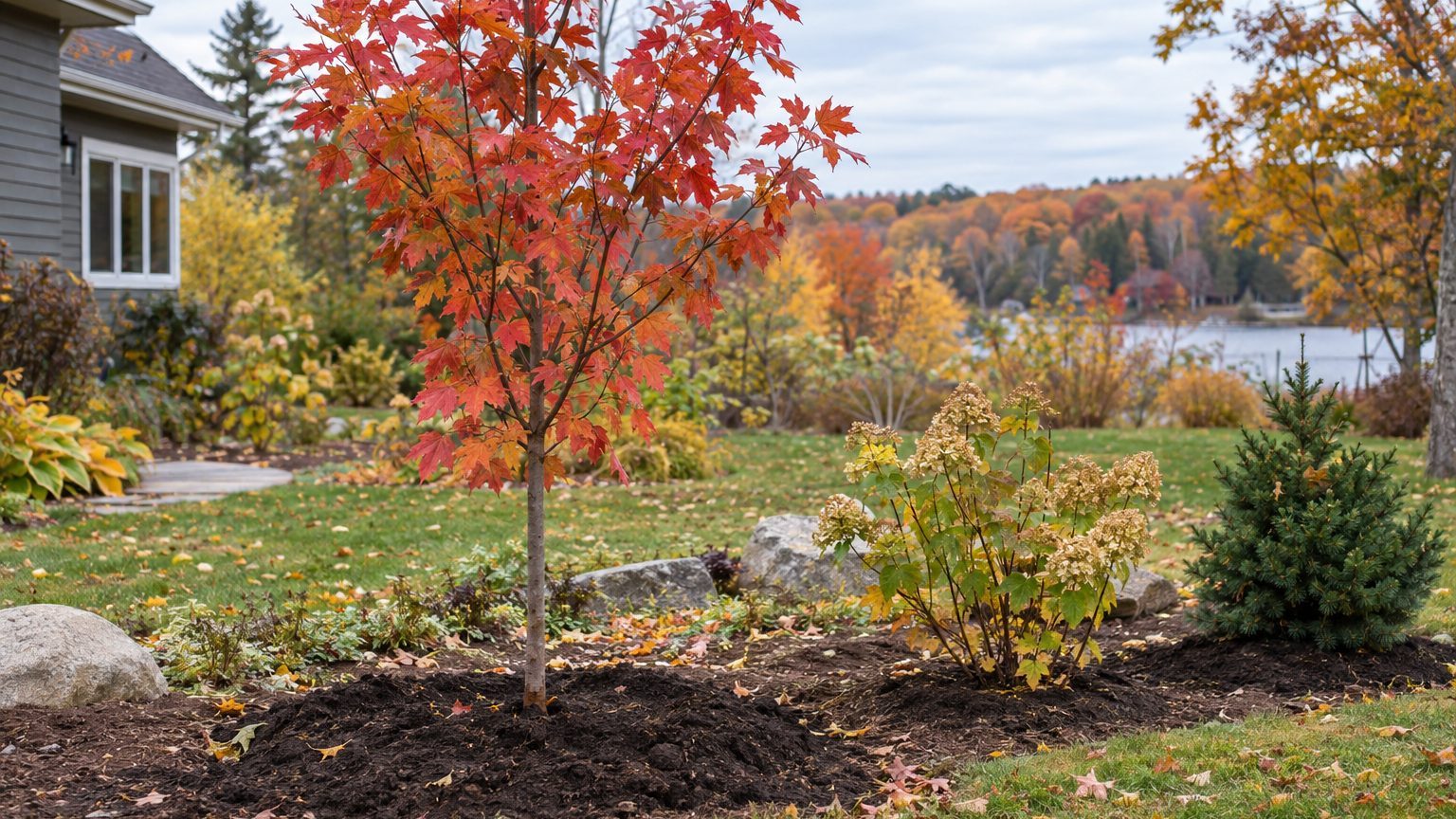

In Charleston, the safe window for planting trees and shrubs in fall closes between September 6 and September 20, which is six weeks before the first fall frost. Freezing temperatures become likely there from October 18 to November 1. That is the conservative date, not the hard stop. Roots keep growing until the soil itself freezes, so a planting made a little later in the valley can still work, just with less margin. Higher elevations in West Virginia freeze sooner, and their deadlines slide earlier to match.
The deadline in West Virginia
Roots don’t follow the air thermometer. A tree or shrub puts out new roots whenever the soil is workable and above freezing, and that can go on for weeks after the first frost has blackened the tomato vines. Top growth shuts down in fall, so the plant has nothing else to spend its energy on. That quiet underground push is what a fall planting is buying. Cornell Cooperative Extension states the rule this way: “Fall is an excellent time for transplanting, provided you get them to their new home at least 6 weeks before the ground freezes, allowing them time to establish roots before winter dormancy.”
That rule counts back from frozen ground, which is a soil condition, and soil freezes later than the air does. Nobody can predict the exact day the ground locks up, so a calendar target is easier to work from the first fall frost instead. NOAA’s 1991-2020 Climate Normals for the Charleston station put 32°F freeze probabilities in the 30-70% band from October 18 to November 1. Count six weeks back from that range and you get the conservative deadline: get trees and shrubs in the ground between September 6 and September 20. Treat it as the safe target. Cornell is in New York, where winters come harder, so counting from the air frost builds in extra cushion for a West Virginia valley.
Why the real limit falls later
In Charleston, the mean daily minimum of the coldest month is 26.1°F (NOAA NCEI Climate Normals, 1991-2020). That is an average low, not a record, and it sits well below freezing. The ground does freeze in the valley, so the six-week rule applies here in full. It also means plantings made after the safe window are not automatically doomed. Soil lags behind air temperature, and in many falls it stays workable for a good while after the first hard frost. A shrub planted in early or mid-October, while you can still dig easily, is a calculated risk with a thinner cushion, not a mistake.
Elevation moves the date
Charleston sits in a river valley, and that flatters it. Ridgetops and higher elevations across the state see freezing weather noticeably earlier in fall, so both ends of the planting window move earlier there. If your property sits well above the valley floor, the September range above is a ceiling, not a target. The state also spans a wide hardiness range. The USDA Plant Hardiness Zone Map (2023 edition, built on 1991-2020 normals) runs from 5a to 7a across West Virginia, and the system rests on a single variable, the average annual extreme minimum temperature. Because the zone differs by region, use your own local frost dates as the starting line. The First and Last Frost Dates in West Virginia page is a good place to look them up. Gardeners just across the border work from their own frost range in How Late Can You Plant Trees and Shrubs in Fall in Kentucky?
What to plant late, and what to wait on
Fully hardy plants sold in containers or as balled-and-burlapped stock handle a late-season move best. Hardy here means rated for your USDA zone, which, again, is set by the average annual extreme minimum. A maple, oak, or dogwood that is comfortably rated for your area has the cold tolerance to sit through winter while its roots catch up. Container plants also arrive with an intact root system, so the shock of moving is small. Balled-and-burlapped trees carry a heavy root ball that holds moisture well, though it has to be handled by the ball, never by the trunk.
The risky group is smaller but easy to identify. Plants rated at the warm edge of your range are the first. They may survive an average winter in Charleston, where the coldest month’s mean daily minimum is 26.1°F, but a first winter with half-established roots is the worst time to test that. Figs and crape myrtles are often in this category in the colder parts of the state. Evergreens are the second. Pines, spruces, hollies, and rhododendrons keep their foliage and keep losing water through it all winter, while roots in cold soil can barely replace what’s lost. Newly planted evergreens go into winter with the weakest water supply and the same demand as a mature plant.
| Plant type | Late-fall outlook | What to do |
|---|---|---|
| Hardy container-grown deciduous trees and shrubs | Establish well | Plant while soil is workable; finish early if you can |
| Hardy balled-and-burlapped deciduous trees | Establish well | Handle by the ball and water in thoroughly |
| Evergreens, needled or broadleaf | Risky after the safe window | Plant early in fall or wait for spring |
| Plants rated at the edge of your zone | Risky anywhere in the state | Hold until spring |
The practical split is simple. Finish evergreens within the September 6 to September 20 window, and move anything borderline-hardy to spring. If you’ve already bought a plant from either group and missed the date, a nursery container is a good holding pen. Keep it watered, set it somewhere sheltered, and plant it once the soil warms. A plant waiting in a pot is in better shape than one rushed into cold ground. Bare-root stock is a separate case, since it is sold dormant and is generally a spring job.
Watering and mulch until the ground freezes
Water deeply until freeze-up
Fall rain is unreliable, and a new planting has a small root system sitting in a loosened hole. Water slowly and deeply so moisture reaches the root ball and the soil just beyond it, not just the surface. Keep going through fall whenever rain falls short, and stop only when the ground freezes. Poke a screwdriver or a finger into the soil near the root ball. If it comes out dry a few inches down, the plant needs a drink. Frozen soil locks water away from roots, so a plant that goes into freeze-up with moist soil starts winter with a reserve it can draw on.
Mulch in a ring, not a volcano
Mulch evens out soil moisture and temperature, which matters most for roots that haven’t spread yet. NC State Extension’s Gardener Handbook gives two reasons for it. For weeds: “A 2-inch to 3-inch layer of mulch suppresses most annual weed seeds and makes it easy to hand-pull any that do germinate.” And for trees: “Provide a 3-inch layer of mulch to reduce water loss and maintain uniform soil moisture and temperature around roots.” Both point to the same depth. Spread a ring of mulch no more than 3 inches deep, and pull it back so the trunk flare stays visible and dry. Mulch piled against bark holds moisture where it doesn’t belong and gives rodents and rot a cozy start. More is not better here. A volcano around the trunk does harm that a flat ring never does. For the full technique, see Mulching Without Killing the Plant.
The first winter is about roots, not growth. Above ground, a freshly planted tree may look exactly the same in March as it did in October, and that is fine. Underneath, it is spreading into the surrounding soil, and that is the work that decides whether it survives its first summer. Skip fertilizer in fall, since it pushes tender top growth at the wrong moment, and hold off on heavy pruning until spring. Water and mulch are the whole job. The wider routine for woody plants is covered in Planting and Caring for Trees, Shrubs and Perennials.
What goes wrong
Too late, and too shallow
The most common failure is simply planting after the window has closed for your elevation. In a high, cold part of West Virginia, the first fall frost arrives earlier than in the Charleston valley, and ground freezing follows sooner too. A tree planted in what feels like a reasonable mid-October date at the valley floor may be too late on a ridge. The roots have no time to anchor before the soil locks up. A shallow root ball is a second weak point. Repeated freezing and thawing can push a poorly settled plant up out of the soil, exposing roots to cold, dry air. Planting at the right depth, firming the soil, and mulching in a ring all reduce that risk.
Winter burn and a dry fall
Winter burn shows up in late winter as brown, scorched-looking foliage on evergreens. The needles and leaves lose water to wind and sun while the roots sit in frozen soil and can’t resupply them. A newly planted evergreen is the most exposed because its roots are still small. Planting early in the window, watering through fall, and mulching all help. A dry fall is the quieter problem, because a plant can go into winter thirsty without any visible sign. Some falls bring steady rain, and some don’t, so check the soil rather than trusting the weather. If the ground is already frozen when you bring a plant home, leave it in its container in a sheltered spot and plant in spring. Forcing a root ball into frozen soil costs more than it saves.
Common questions
Can I still plant after September 20?
In the Charleston area, yes, with less margin. The September 6 to September 20 range is the conservative deadline, six weeks before the first fall frost. The true limit is when the ground freezes, which usually comes later. Choose fully hardy deciduous plants, water deeply, and mulch in a ring. Hold evergreens and borderline plants for spring.
Does the six-week rule count from the first frost or from frozen ground?
Cornell’s rule counts from when the ground freezes. Because that date is hard to predict, the safe calendar target here counts six weeks back from the first fall frost, October 18 to November 1 in Charleston. Frozen ground comes later than the air frost, so the safe date has some buffer built in.
Do mountain and high-elevation areas follow the same dates?
No. Charleston is a river valley, and higher elevations freeze noticeably earlier in fall. Move your planting deadline earlier the higher and colder your site is. Check local frost dates before settling on a date, since hardiness zones across the state run from 5a to 7a on the USDA Plant Hardiness Zone Map.
Is spring a better choice than fall?
For evergreens and plants at the edge of their hardiness, often yes. Spring planting avoids the first winter’s worst stress while roots are still small. For hardy deciduous trees and shrubs, fall planting remains a good choice if it happens within the window, since the plant spends the cool months building roots. One nuance: a fall planting still needs watering until the ground freezes, so factor in the upkeep before you commit.