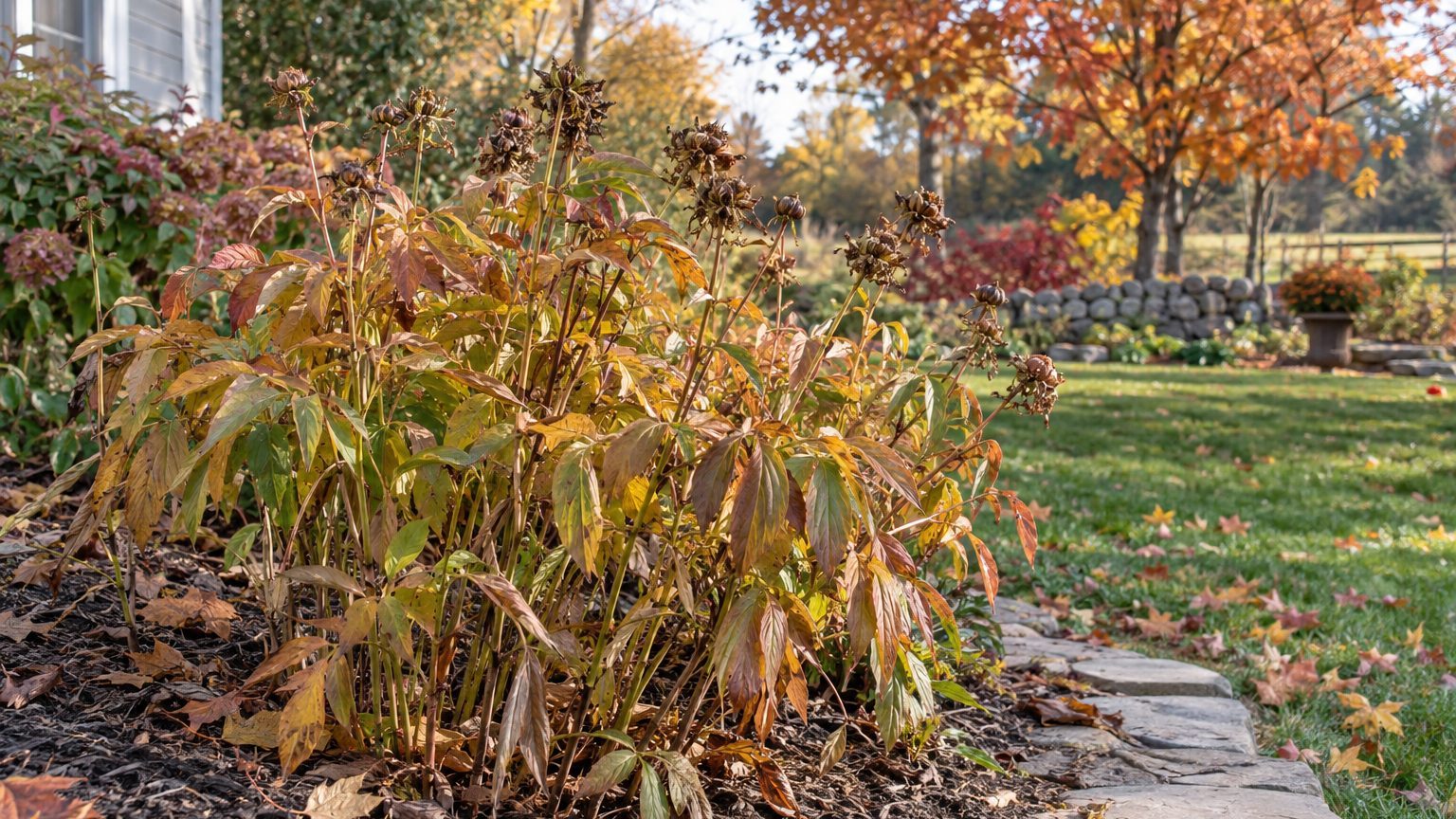

Peony stems cut down in summer, while the leaves are still green, can cost you blooms the next year. Wait until a hard freeze has wrecked the foliage, then cut the stems near ground level. Tree peonies are the exception, because they are woody shrubs and do not get cut back at all. Walk out after the first hard freeze, check that the leaves have collapsed, and cut only if your plant is a herbaceous peony.
After a hard freeze, down to the ground

Iowa State University Extension and Outreach says to cut back peony foliage after it has been destroyed by a hard freeze. The University of New Hampshire Extension gives the same advice in plainer words: wait until the foliage dies back in the fall. Both point to the plant, not the calendar. Your peonies tell you when the job is ready.
Herbaceous peonies
Most garden peonies are herbaceous. They are long-lived perennials that send up fresh stems each spring and give up the old ones each winter. The leaves keep working for the plant until cold ends the season, so cutting them early throws away that work. A frost that only nips leaf edges is a warning, not a signal. You want leaves that have gone limp and dark, the kind of collapse a hard freeze leaves behind.
The date this happens varies a great deal from one region to the next. You can look up first frost dates by state to know when to start watching, but the freeze itself is what counts. In a mild fall you may wait longer than a neighbor farther north.
Once the foliage is gone, the job is quick:
- Confirm the leaves have collapsed from freezing, not just yellowed in places.
- Cut the stems near ground level, as Iowa State advises.
- Gather every stem and leaf, including what has dropped around the crown.
- Bag it all for disposal rather than composting (see below).
Peonies are different from many other perennials here. Some perennials get cut back early for looks or are left standing for winter interest, and our guide on when to cut back perennials in fall covers how those compare. Peonies want a firmer rule: freeze first, then cut.
Tree peonies
Tree peonies look similar in bloom but grow differently. The Clemson Cooperative Extension Home & Garden Information Center puts it bluntly: never cut back tree peonies, because they are shrubs and will not grow back if cut down. Their stems are woody and stay on the plant through winter. If your plant keeps a framework of bare branches after the leaves drop, it is a tree peony, and the herbaceous routine above does not apply. Leave it standing, and take pruning questions to Clemson’s fact sheet or your own county extension office.
Why not in August
Iowa State warns that plants cut back in August or early September may have fewer blooms than those cut back in fall. The sources do not spell out every step of the mechanism, but the University of Wisconsin–Madison Division of Extension supplies the key piece. After bloom, it says, it is important to allow foliage to remain, so plants can produce energy for future growth and development. The leaves of a peony in late summer are not leftover clutter. They are feeding next year’s flower buds.
Deadheading is not cutting back
The two jobs sound alike and do opposite things. Deadheading removes the spent flower. Cutting back removes the foliage. Wisconsin Extension says both peonies and iris benefit from deadheading spent flowers after blooming, to prevent spending energy on fruit production. A peony that sets seed pods is putting resources into something you do not need. So in summer you snip the faded blooms and leave every leaf in place.
That matters most in the weeks when the plant looks worst. By late summer, peony foliage can look tired and ragged, and the urge to tidy is strong. Resist it. A ragged peony that is left alone does better than a neat one that has lost its leaves early.
If you cut the blooms for the house, the same logic holds. Take the flower and leave the leafy stem as much as you can, since those leaves are what the plant has left to work with.
The leaves go in the trash, not the compost
Iowa State says botrytis fungi survive in debris left in the garden over winter. That is why the fall cleanup is more than neatness. Botrytis is a fungal disease that attacks peony stems, buds and leaves. If the old foliage stays on the ground or around the crown, the fungus waits there and starts again when the new shoots come up.
Iowa State’s advice on this is direct. Remove the plant debris from the garden and destroy it. It also says diseased leaves should not be composted. Home compost piles often do not stay hot enough to be a safe place for them, and you cannot be sure which leaves carry the fungus. Our page on what goes in a compost pile lists what belongs there. Peony foliage that showed spots or gray mold does not.
Treat all of it the same way. You cannot reliably tell healthy leaves from lightly infected ones, so bag the whole lot. Bagging it for the trash is the simplest way to destroy it. Burning may be an option in some places, but local rules vary, so check with your town or county before lighting anything.
Sweep the ground around each clump when you finish. Leaves that dropped before you cut, and bits of stem that fell as you worked, count as debris too. The point of cutting near ground level is to leave the crown clean and the soil clear of anything the fungus can overwinter in.
Mulch, and tree peonies
The University of Illinois Extension has a page on dividing peonies, and it says that in early winter the plants should be mulched with straw, hardwood chips or pine bark. Keep in mind that this advice sits in a page about divisions, so it is aimed at newly planted or recently divided clumps. If you have just moved a peony, our guide to dividing perennials explains the process.
For established plants, the same materials are a reasonable choice, but the source does not say they are required. Do the mulching after the cleanup, never before. Mulch laid over leftover foliage buries the botrytis you were trying to remove. Our page on mulching goes through the materials in more detail. The Illinois page does not give a depth, so check that page or your county extension office for how much to apply.
One last reminder for the shrub-type plants. Do not cut back tree peonies, because Clemson says they will not grow back if cut down. They can take mulch like any other plant, but the stems stay.
If you garden in Canada, the same logic about frost and foliage holds, but the sources above are American. Use your provincial extension or a local master gardener program where its advice differs.
Common questions
Can I cut my peonies back after the first frost?
Only if that frost has actually destroyed the foliage. Iowa State’s rule is to cut after a hard freeze has done the damage, and New Hampshire’s is to wait until the foliage dies back. If the leaves are still partly green after a light frost, wait.
Should I deadhead peonies?
Yes, after they bloom. Wisconsin Extension says deadheading spent flowers keeps the plant from spending energy on fruit production. Remove the faded flower only and leave the foliage, since the plant needs it after bloom.
How do I know if I have a tree peony or a herbaceous one?
Look at the plant in winter. A herbaceous peony dies back and leaves nothing above ground once you have cut it. A tree peony is a shrub with woody stems that remain. Intersectional hybrids, sometimes sold as Itoh peonies, fall between the two, and the sources here do not cover them, so check the plant tag or your county extension office before cutting.
My peony leaves look bad in summer. Can I cut them off?
Leave them, unless you are removing a diseased leaf. Iowa State says plants cut back in August or early September may have fewer blooms, and Wisconsin says foliage should remain after bloom. If you suspect botrytis, ask your county extension office, and do the full cleanup in fall.
Rules and recommendations can change, so confirm current guidance with your county extension office before acting.