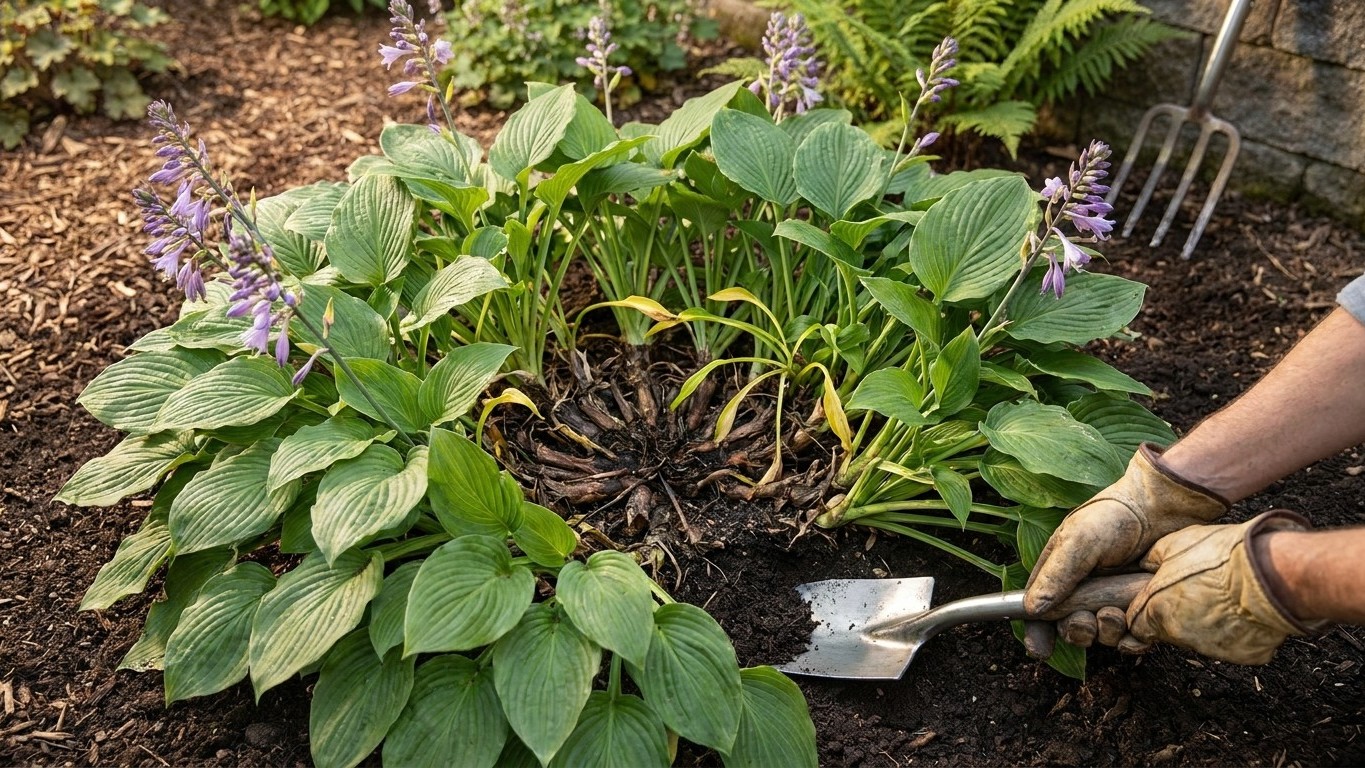

The answer isn’t a date on the calendar. A perennial tells you it’s ready to divide through its own growth: a clump that used to bloom solidly now blooms only around the edges, or flowers less than it did two seasons ago, or has started flopping open in the middle. Those signs matter more than any fixed number of years, because two gardeners growing the same species in different soil and climate will see that clump mature at very different speeds.
Why a clump needs splitting

Most Perennials that get divided share one growth habit: they spread outward from a central point, adding new shoots and roots at the perimeter year after year. That’s how a single hosta or daylily becomes a thick mass within a few seasons. The trouble is that the oldest tissue, the part sitting dead center, doesn’t get younger. It keeps producing stems and leaves on inertia while the soil around it gets progressively more compacted and depleted of the nutrients that original root system already pulled out.
Eventually that older core simply stops keeping up. It flowers less, its stems thin out, and in many species the crown itself turns woody or spongy rather than firm and white. Meanwhile the living, vigorous growth is still happening, just pushed to the outer ring where the roots are younger and the soil hasn’t been mined dry. The bare or weak middle surrounded by a green, functioning perimeter isn’t disease and it isn’t a mistake in care. It’s the plant’s own architecture reaching its limit.
What splitting actually fixes
Dividing does three things at once, and it’s worth being clear about which one matters to you. First, it removes the exhausted, unproductive core and keeps only the vigorous outer growth, which resets the plant’s energy toward flowering rather than toward feeding tissue that’s no longer contributing. Second, it multiplies your stock for free, turning one crowded clump into several plants you can move elsewhere in the bed or hand to a neighbor. Third, and often the reason people actually notice the problem in the first place, it restores a clump to the footprint it’s supposed to have, rather than letting it swallow the path or shade out whatever’s planted next to it.
None of that requires guessing at an age. A three-year-old clump in rich, loose soil with plenty of moisture might already need dividing, while the same species struggling along in compacted clay might take twice as long to reach the same point. The plant’s condition is the only reliable clock here, and that condition shows up as a specific, visible set of symptoms rather than a number of growing seasons.
The signs, not a schedule
Four things tell you a clump has outgrown itself, and any one of them is reason enough to plan a division. The first is a bare, sunken, or woody center surrounded by a ring of healthy growth, the most literal version of the “doughnut” pattern Perennials form as they age. The second is a decline in flowering, either fewer blooms than the plant produced in previous seasons or blooms that have gotten visibly smaller, a sign the plant is spreading its limited resources across too much old, unproductive tissue.
The third sign is structural rather than floral: a clump that has started flopping outward, splitting open in the middle, or leaning so that stems that used to stand upright now sprawl across their neighbors. The fourth is simple crowding, a plant that has physically outgrown its allotted space and is now pushing against, shading, or competing directly with whatever is planted next to it. Any of these four, alone, is a legitimate reason to lift and split. Together, they’re a clear signal that waiting another season will only make the job larger.
What none of these signs tell you is exactly when in the year to do the digging. That timing question depends on the plant’s own bloom season, since the safest window is when it isn’t actively flowering and isn’t pushing hard new growth. Each plant’s own page on this site lists its bloom period, and that’s the reference to check before picking a date, rather than relying on a generic month that may be wrong for your climate or for that particular species.
The method
Once you’ve spotted the signs, the process itself is mechanical and forgiving as long as one rule gets followed. Work through it in order:
- Pick a moment when the plant is not in flower and the weather isn’t hot or drying, so the divided pieces aren’t also fighting heat stress while their roots recover.
- Water the clump thoroughly the day before you dig, which keeps the root ball intact and makes the soil easier to work rather than crumbling apart as you lift.
- Lift the entire clump out of the ground, roots and all, rather than trying to slice off a wedge while it’s still in place.
- Split the clump into sections, making sure every single piece carries both roots and at least one visible growth point, whether that’s an eye, a bud, or an emerging shoot. A piece with roots but no growth point won’t resprout; a piece with growth but no roots won’t survive transplant. This is the one rule that decides whether a division lives or dies.
- Discard the old, exhausted center, the same bare or woody tissue that showed you it was time to divide in the first place. It isn’t worth replanting.
- Replant each division at the same depth it was growing before, with the crown sitting right at soil grade, neither buried nor exposed above the surrounding soil line.
Sizing the pieces isn’t a matter of hitting an exact measurement; the growth-point rule above matters far more than how big or small each division ends up being. When you dig the new planting hole for each piece, the same general guidance that applies to woody plants applies here too: according to the NC State Extension Gardener Handbook, “an ideal planting hole is only as deep as the root ball and at least two to three times wider, with roughened sides sloping in toward the bottom.” A hole dug narrow and smooth-sided in heavy clay behaves like the inside of a pot, and roots trying to spread out simply circle back on themselves instead of pushing into the surrounding bed.
Aftercare through establishment
Water each division regularly through its first weeks in the ground, since it’s rebuilding a root system with no reserve to draw on if the soil dries out. A mulch layer helps here too: the same handbook notes that “a 2-inch to 3-inch layer of mulch suppresses most annual weed seeds and makes it easy to hand-pull any that do germinate,” which also keeps moisture more even around the recovering roots. Keep that mulch pulled back roughly 6 inches from the crown itself, since the source is explicit that this clearance exists “to prevent bark decay and vole damage,” and a quick glance should always confirm the crown is visible and not buried under the mulch ring. Expect a modest first season, with fewer flowers or smaller growth than the parent clump produced, and treat that as normal rather than a sign something went wrong.
What not to divide
Not every perennial in the garden is built as a spreading clump, and forcing this method onto the wrong plant does more harm than good. The recognition is straightforward, and it comes down to looking at what’s actually below the soil line rather than at what the top growth looks like.
A plant with a single crown, one central growing point rather than a cluster of many, doesn’t have separate sections to split apart. Cutting into it doesn’t create two viable plants, it just wounds the one plant it had. Species built around a taproot, a single thick vertical root running straight down rather than a fibrous mass spreading sideways, resent the disturbance even more severely; slicing through that root often kills the piece that loses it, and some of these plants never recover from the attempt at all.
What to do instead
For a single-crown perennial, the practical path forward is usually starting a new plant from seed, or in some cases from a stem or root cutting, rather than trying to force a split that the plant’s own structure doesn’t support. For a taprooted species, seed is typically the more reliable route, since these plants are simply not built for the lift-and-divide treatment that works so well on clump-formers.
Woody Perennials sit in a separate category again. Their propagation runs through cuttings, layering, or grafting rather than through digging up and splitting a root mass, and treating a woody crown like a herbaceous clump usually damages the plant without producing anything usable in return. The safest habit, before reaching for a spade, is simply checking what’s growing below ground: many crowns spreading outward means division is an option, one crown or one taproot means it isn’t, and a woody base means an entirely different propagation method is called for.
Common questions
Can I divide a perennial that’s currently in bloom?
It’s better to wait. A plant in active flower is putting its energy into blooms rather than root recovery, which makes the transplant shock of division harder for it to absorb. Waiting for a non-flowering window, timed to that species’ own bloom season, gives the divisions a better chance of establishing quickly.
Do I need to replant divisions the same day I lift them?
Getting them back in the ground quickly is best, since exposed roots dry out fast and lose vigor the longer they sit in open air. If a short delay is unavoidable, keeping the roots covered and moist in the meantime helps, but same-day replanting remains the safer default.
How do I know if a piece has enough growth points to survive?
Look for at least one visible eye, bud, or emerging shoot on the piece, along with an attached section of root. A fragment of root with no visible growth point above it is not a viable division, no matter how healthy that root looks.
Should divisions be fertilized right after replanting?
The more urgent need in the first weeks is consistent moisture, not fertilizer, since a division is rebuilding roots rather than pushing new top growth. Check that specific plant’s own page for any fertilizing guidance suited to its needs once it’s established.