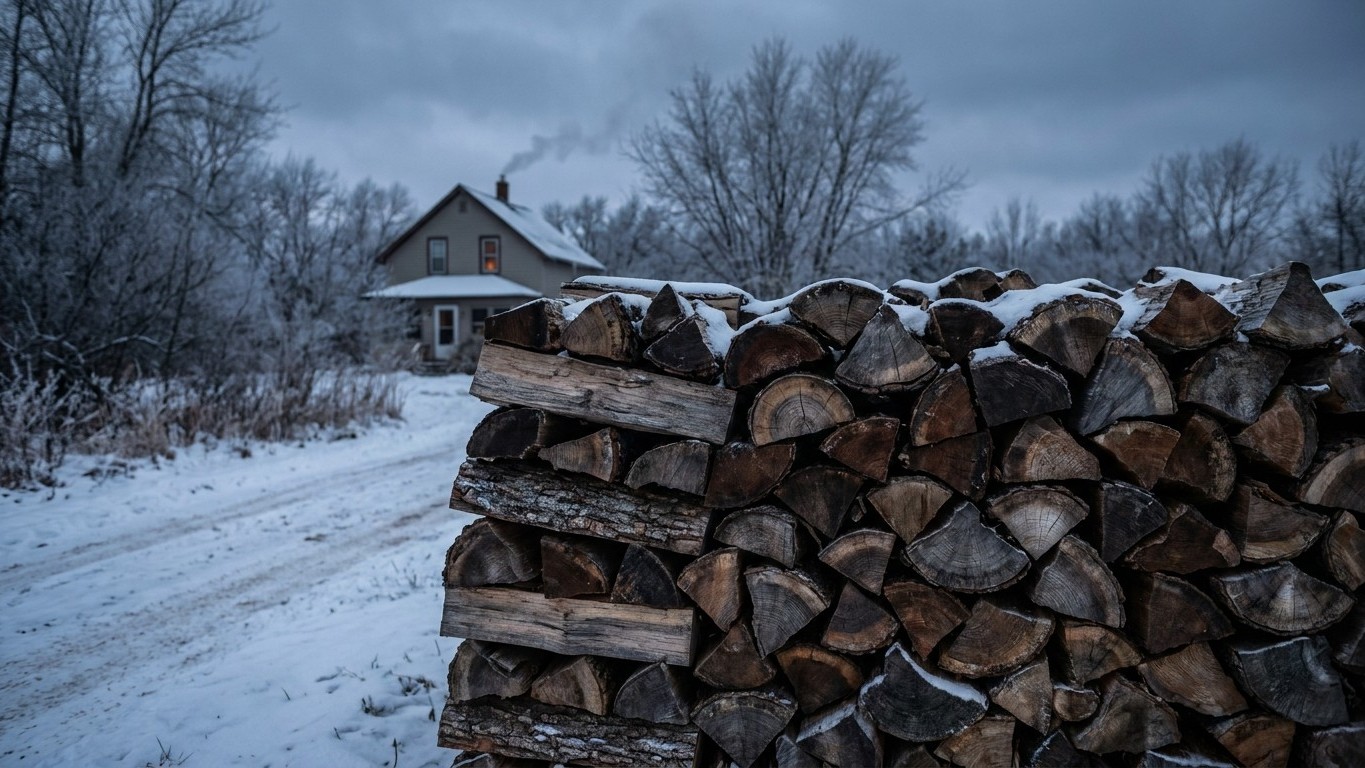

Wisconsin winters don’t ask what firewood you’d prefer. They tell you what you need. The average low in January at Milwaukee sits at 17.2°F, and that single number reshapes everything from which species belong in your stack to how many cords you’ll burn through before the thaw. This page walks through the cold you’re actually planning for, the woods that hold up to it, how to size a winter’s supply, and why the drying process here trips up more first-timers than any species choice ever could.
How cold it actually gets here

Start with the number that matters: 17.2°F. That’s the average daily low for the coldest month at the Milwaukee reference station, drawn from NOAA’s 1991-2020 Climate Normals. Not the record low that makes the evening news, and not some mild monthly average that flatters the season. This is the typical overnight temperature you’re heating against, night after night, for weeks at a stretch.
Seventeen degrees is not a mild-winter figure. It’s cold enough that a wood stove or fireplace insert running on undersized or poorly seasoned wood will struggle to keep a living room comfortable past midnight, let alone hold a house through a January cold snap. This is not the climate where firewood is a nice-to-have for ambiance on a chilly evening. In Wisconsin, if wood heat is part of your plan, it’s doing real work.
What that means in practical terms: the margin for error shrinks. A cord that’s only half-seasoned might get you through a 40°F night in October without much trouble, since the heat demand is low and any flame feels good. At 17°F, that same half-dry cord burns hotter on paper but delivers less usable heat, because a chunk of every log’s energy goes toward boiling off water before the wood ever warms the room. You notice the difference fastest on the coldest nights, which is exactly when you can least afford it.
What this means for planning
Because the cold here is real rather than decorative, every other decision on this page follows from it. Density matters more than it would in a milder state, since a dense cord packs more burnable mass into the same 128 cubic feet. Seasoning time matters more, because green or underdried wood punishes you precisely on the nights you need it most. And the quantity you’ll burn through a winter has to account for stretches where the thermometer sits in the teens for days, not hours.
None of this means every stick of wood needs to be the densest species available. It means the choices below aren’t cosmetic. They’re the difference between a stove that carries a house through February and one that just makes the living room smell nice for an hour.
Which woods are worth the effort here
With a cold figure like 17.2°F, density stops being a preference and becomes the variable that decides how much heat you actually get out of a cord. A cord is a fixed volume, that stack measuring 4 feet by 4 feet by 8 feet, or 128 cubic feet total. Two cords of two different species take up the exact same space in the woodshed, but a denser species packs more wood fiber, and therefore more stored energy, into that same box. On a night when the low is sitting in the teens, that difference shows up directly in how long a load lasts before you’re back out at the woodpile.
Michigan State University Extension puts the average energy content of a well-seasoned cord of hardwood at roughly 20 million BTU, comparable to about 145 gallons of #2 fuel oil or 215 gallons of LP gas. That average covers a range of hardwood species, and moisture content moves the real number a lot in either direction. It’s a useful benchmark for what a cord of solid, properly dried hardwood should deliver, not a guarantee for any specific load off any specific truck.
Within that hardwood category, red oak stands out for a different reason: density that comes from a tight cell structure. That same structure is exactly why oak resists drying, taking longer than a single summer to season properly. For a Wisconsin winter, that trade-off is usually worth it. Dense, well-seasoned oak is the wood you want set aside for the coldest nights and for an overnight burn you need to still find coals from at 6 a.m. Softer, lower-density species dry faster and light easier, which makes them the right call for kindling, for shoulder-season fires in October and April, and for stretches when you don’t need the stove holding steady all night.
Comparing the wood you actually have access to
None of this matters if the dense wood isn’t available seasoned. A species you can only buy green, or can’t source locally at all, is worse for your winter than a lighter wood you can get properly dried and stacked in time. Ask any seller directly how long the wood has been split and stacked, not just cut.
| Wood type | BTU per cord | Smoke | Sparks |
|---|---|---|---|
| Well-seasoned hardwood (average, per MSU) | About 20 million BTU | Low when properly dried | Low to moderate |
| Red oak, properly seasoned | Above the hardwood average, tighter grain and denser fiber | Low, burns clean once fully dry | Low |
Lighter, less dense woods burn faster and hotter at first but drop off sooner, which is exactly the profile you want for getting a stove going, not for carrying it through a subzero night.
How much wood a winter takes
Any number you find online for “cords per winter” is close to useless on its own, because it skips the three things that actually decide the answer for your house. The Milwaukee cold figure, 17.2°F for the coldest month’s average low, tells you the demand side. But demand only gets you halfway there. How well a house holds onto heat, and whether wood is carrying the whole load or just supplementing a furnace, move the final number just as much as the weather does.
A poorly insulated older farmhouse with drafty windows and a chimney that pulls warm air out as fast as the stove makes it can burn through double what a tightly built, well-insulated home uses in the identical Wisconsin winter. Same outdoor temperature, same stove, same wood. The difference lives entirely in the walls, the attic, and the seals around the doors. That’s why a flat statewide average is close to meaningless for planning your own woodshed.
Run the estimate yourself using these variables, in order:
- Local cold severity: how many weeks typically sit near or below that 17.2°F overnight average, versus milder stretches
- Home insulation and sealing: older, drafty construction demands significantly more wood than a tight, well-insulated build for the same outdoor temperature
- Role of wood heat: whether the stove or fireplace is the primary heat source for the house, or a supplement running alongside a furnace or boiler
- Stove or insert efficiency: an older, leaky unit wastes more of every cord than a newer, well-sealed one
- Square footage heated: a single room versus an entire house changes the math directly
Work down that list honestly and you’ll land on a range that fits your actual house, not a statewide guess that assumes everyone lives in the same building. A homeowner using wood as the sole heat source in a drafty older home should plan for meaningfully more cords than a neighbor with a tight, newer build who’s just supplementing a gas furnace on the coldest nights.
Drying wood in this climate
Seasoning decides more about how a fire performs than species ever will, and Wisconsin’s climate shapes how long that process actually takes. The target doesn’t change by region: wood needs to reach 20 percent moisture or less before it burns efficiently. Green wood, straight off a fresh cut, can hold over 60 percent moisture, and every bit of that water has to boil off inside the firebox before the wood contributes any real heat. That’s energy you paid for in cutting, splitting, and stacking, spent on steam instead of warmth.
What dries wood isn’t sun exposure. It’s air movement and time, which is why wood tossed in a pile against a wall, or left in rounds instead of split, seasons far slower than the same wood split and stacked with real gaps for airflow between rows. In a typical Wisconsin cycle, split and stacked hardwood usually reaches that 20 percent target after a full summer of drying, provided the stack lets air pass through rather than trapping humidity inside a dense pile.
Red oak is the named exception, and it’s worth remembering specifically because it trips people up. Its dense cell structure resists moisture loss, so it needs longer than a single summer to season properly, something that catches Wisconsin buyers off guard when a seller calls oak “seasoned” after only a few months on the ground.
Tie this back to the cold figure from the top of this page, and the most common local mistake becomes obvious: wood cut and split this spring is almost never ready for this coming winter. A spring cut gets one summer of drying time at best, which might just clear the bar for lighter species but usually leaves oak still too wet to deliver its full heat value. The wood that will carry a Wisconsin household through January with lows near 17.2°F should have been split and stacked the previous year, not the previous season.