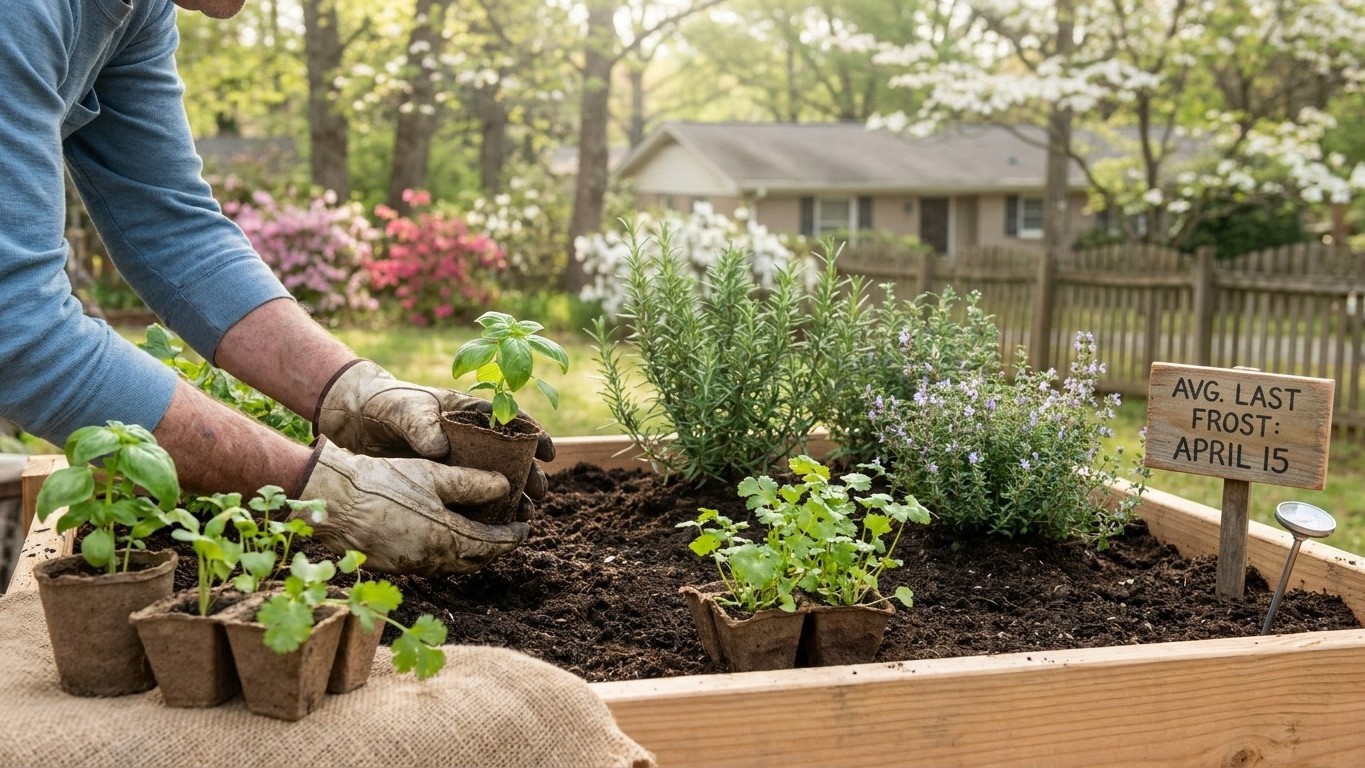

Sow hardy herbs like parsley, cilantro, and chives directly outdoors once the last spring frost has passed, using the April 16 to April 29 window as your probability guide. Tender herbs such as basil need soil that’s warmed well past that date, usually mid-to-late May. Start most seeds indoors 6 to 8 weeks before your local frost-out date.
The short answer for Wisconsin
That April 16 to April 29 frost window isn’t a single date you circle on the calendar. It’s a probability band from NOAA’s 1991-2020 Climate Normals, measured at station USW00014839, marking the range where the odds of a 32°F freeze sit between 30% and 70%. Translation: even by April 29, there’s still roughly a one-in-three chance of a freeze at that station. Gardeners who plant tender herbs the day the calendar hits April 29 are still gambling.
For hardy herbs, that gamble matters less. Parsley, chives, cilantro, and dill tolerate a light frost and can go into the ground as soon as the soil is workable, even before the last frost date arrives. For basil, which turns black at the first hint of cold, wait until you’re confidently past the tail end of that window, generally the second or third week of May for most of the state.
Indoor starts change the math. Basil, parsley, and even slower germinators like rosemary or thyme benefit from a 6-to-8-week head start under grow lights, timed backward from your expected transplant date rather than the frost date itself. That gives seedlings enough size to handle transplant shock once they hit outdoor soil.
Fall matters just as much as spring here. The first fall frost arrives between October 17 and October 29, again a 30-70% probability band from the same station. That gives most of Wisconsin a frost-free stretch of roughly 171 to 196 days depending on where you land inside both windows, enough for a full basil and cilantro succession but tight for herbs that want a long, hot summer to really perform.
Perennial herb survival is a separate question from sowing dates, and it hinges on winter cold, not frost timing. The coldest month’s average daily minimum at the Milwaukee reference station is 17.2°F. That’s the number that decides whether a rosemary or bay laurel plant left outdoors makes it to spring, not the record low everyone likes to quote. At 17.2°F average minimums, most Mediterranean perennial herbs need to come inside for winter, full stop.
Wisconsin’s USDA Hardiness Zone range runs 3b to 6a under the 2023 map (built on 1991-2020 normals). That’s a wide spread for one state, and it means any dated recommendation here has to be anchored to a specific place. Milwaukee, sitting toward the milder end of that range, is the reference point for the frost dates and cold minimums above. Your own yard may run colder or milder than that.
What will not work here
Long-season Mediterranean perennials are the first casualty. Rosemary, bay laurel, and some lavender varieties are marketed as perennials, but with a coldest-month average minimum of 17.2°F, none of them reliably survive an outdoor Wisconsin winter. Growers who plant them in the ground expecting a permanent herb bed are setting themselves up for a spring replanting job every single year, whether they realize it or not. Treat these as annuals or container plants that come indoors by October, not landscape perennials.
Basil varieties bred for a long, hot growing season are the second problem. Wisconsin’s frost-free window, at best around 196 days and at worst closer to 171, is workable for basil, but only if you’re not also fighting cool, wet spring soil. Basil seed germinates poorly below 60°F soil temperature, and much of southern Wisconsin doesn’t hit that mark reliably until well into May. Combine a late soil warm-up with an early fall frost risk starting October 17, and slow-maturing basil cultivars can run out of season before they produce a real harvest.
Humidity is the quieter threat. Wisconsin summers bring enough moisture, especially in low-lying gardens near the Great Lakes shoreline, that herbs planted at tight spacing struggle with fungal disease. Basil downy mildew and Powdery Mildew on sage both thrive when air can’t move freely between plants. A packet recommendation of 6-inch spacing, written for a drier climate, often needs to be doubled here. Gardeners who cram herbs close together to maximize a small bed frequently lose the crop to disease before frost ever becomes the issue.
Weekly watering schedules, common advice for drought-prone regions, don’t map cleanly onto Wisconsin either. The state doesn’t have the sustained summer heat that makes weekly deep watering the default; instead, rainfall variability means some weeks need no supplemental water and others need more frequent light watering to prevent shallow-rooted herbs like cilantro from bolting in a dry spell. A rigid schedule borrowed from a hotter, drier state’s guide will either drown herbs in a wet July or starve them in a dry one.
What changes across Wisconsin
A hardiness zone range of 3b to 6a inside one state’s borders is not a small spread. Zone 3b tolerates average annual extreme minimums roughly 20 degrees colder than zone 6a. That’s the difference between a garden where perennial herbs need aggressive winter protection every single year and one where a mild winter might let a marginal perennial sneak through unprotected.
Northern Wisconsin, inland from Lake Superior’s moderating influence, sits at the colder end of that range. Gardeners there should expect a shorter frost-free season than the Milwaukee-anchored dates above, a later last frost, and an earlier first fall frost. Anything timed off this page’s April-to-October window needs to shift later in spring and earlier in fall the further north you go.
Southern Wisconsin, especially areas close to the Illinois border, runs toward the milder end of the zone range, closer to what this page’s frost dates already describe. The Lake Michigan shoreline adds another layer entirely: the lake delays the first fall freeze at the immediate lakeshore, while inland southern Wisconsin typically freezes in early October and the north freezes far earlier still. Two gardens 30 miles apart, one lakeside and one inland, can have meaningfully different fall cutoff dates for tender herbs.
None of this means you should guess. The zone range given here describes the whole state, not any single yard, and this page can’t tell an individual reader which zone they’re standing in. Wisconsin gardeners should check the USDA Plant Hardiness Zone Map directly, entering their zip code, to see exactly where their property falls inside that 3b-to-6a range before deciding how much winter protection a perennial herb actually needs.
Where to check this for your own county
Everything above describes Wisconsin as a whole, anchored to one climate station near Milwaukee. That’s useful for a statewide picture, but it’s not a substitute for what your own county’s extension office has already worked out. The University of Wisconsin-Madison’s extension service, extension.wisc.edu, is the place to go next.
Once there, look specifically for two things. First, a county-level planting calendar, if your county office publishes one, will translate the statewide frost probability bands into dates calibrated for your actual local microclimate rather than the Milwaukee reference station. Second, look for variety trial results. Wisconsin’s extension system has tested herb and vegetable cultivars across different parts of the state for performance in the state’s shorter seasons and heavier soils, and those trial results tell you which basil, dill, or parsley varieties actually held up locally, not just which ones look good on a seed catalog page.
A county recommendation beats a state one every time, because it accounts for local soil types, local frost patterns, and local pest pressure that a statewide page like this one simply can’t capture. This page gives you the state-level baseline: the frost windows, the winter cold threshold, the hardiness zone range. Your county extension office narrows that down to what actually works on your street.
If your specific county doesn’t publish its own calendar, the statewide extension office can usually point you to the nearest one that has similar growing conditions, or to a regional bulletin covering multiple counties with comparable frost timing and soil types.
Checking this against your own garden
Every date in this article is a regional average built from decades of weather station data. Your own garden, with its particular slope, soil type, and exposure, can run days or even weeks ahead of or behind those averages. Three direct observations will tell you more than any calendar.
Start with soil warmth, checked by feel rather than a thermometer. Push your hand a few inches into the planting bed in spring. If the soil still feels cold and heavy against your skin, tender herb seed like basil will sit and rot rather than germinate, regardless of what the calendar says. Warm, crumbly soil that feels closer to room temperature is the real green light.
Watch for the first flush of weed germination in your beds. Weeds are unfussy opportunists, and when they start sprouting in volume, it’s a reliable sign that soil temperature in your specific yard has crossed the threshold most seeds need to break dormancy, herbs included.
Finally, track how quickly direct-sown seedlings push out their first true leaves, the second set that appears after the initial rounded seed leaves. Fast, sturdy true-leaf growth means your microclimate is running warm and the plant is off to a strong start; slow, pale, or stalled growth suggests your particular spot is running cooler or wetter than the statewide averages, and later plantings might do better waiting another week or two behind whatever the calendar recommends.