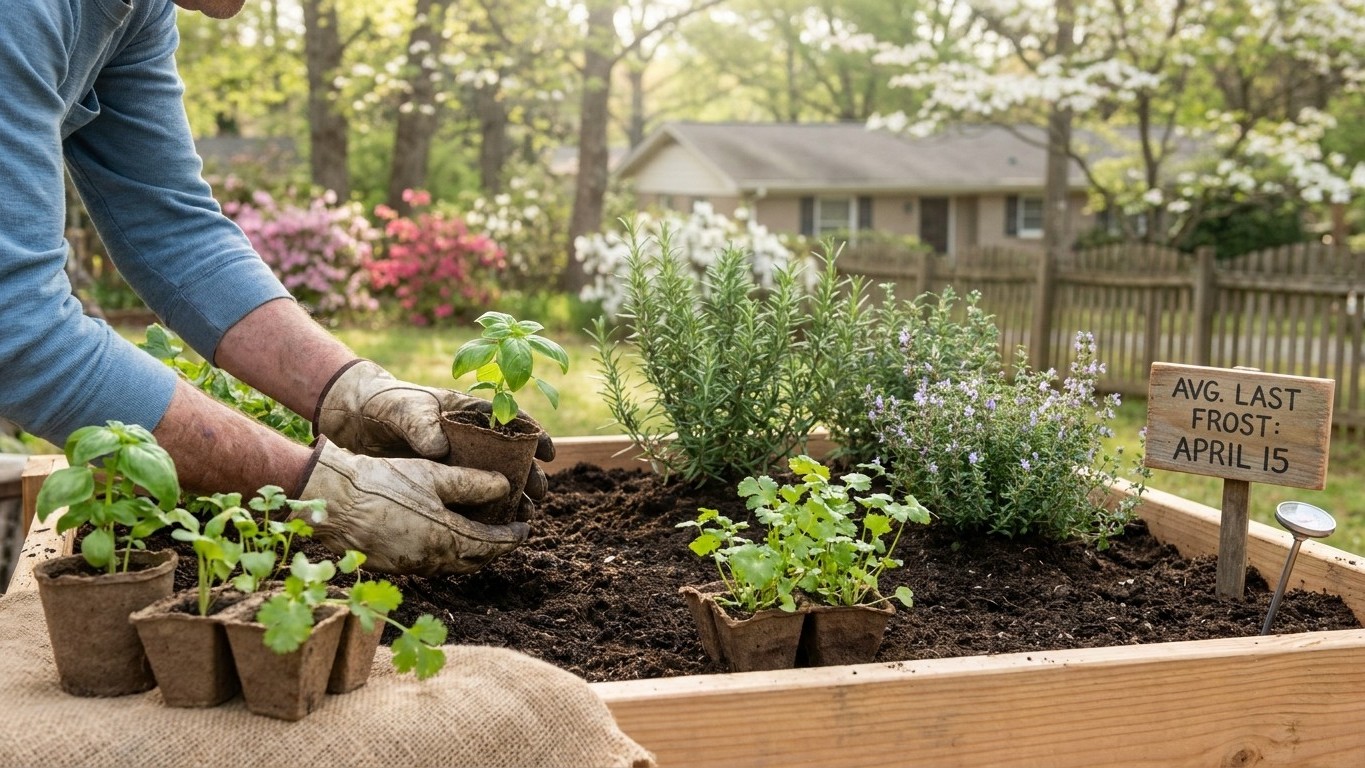

In most of Wyoming, direct-sow hardy herbs like dill, cilantro, and chives once the soil has thawed in late April, then wait until the May 7 to May 18 window closes before setting out tender herbs like basil. Perennial herbs need a plant that survives an average winter low of 18.1°F, not just one that likes the summer.
The short answer for Wyoming
Start with the frost dates, because they are the whole calculation. NOAA’s 1991-2020 Climate Normals put the last spring freeze at station USW00024018 somewhere between May 7 and May 18, and the first fall freeze between September 24 and October 5. Those are not fixed dates. They are a 30-70% probability band: the range in which a 32°F freeze is neither a sure thing nor a fluke. Plant tender herbs before that window closes and you are gambling against roughly a coin flip.
Run the subtraction and the growing season lands around 130 frost-free days at 6,000 feet elevation, which describes a lot of Wyoming ground. That is the number that should set your expectations before you set a single seed. Basil, cilantro that’s meant to bolt slowly, and any herb marketed as needing “a long, warm summer” is working with less runway here than it would in Ohio or Virginia.
Hardy herbs go in first. Chives, parsley, and dill tolerate a light frost and can go into the ground two to three weeks before that May 7-18 window closes, as soon as the soil can be worked. Cilantro follows the same logic: it prefers cool soil anyway, so an early start plays to its strength rather than against it.
Tender herbs, basil above everything else, wait for the back end of the frost window, not the front. Basil planted on May 7 in a year that turns out to sit at the late end of the probability band gets frostbitten within days. Wait until the window has fully passed, closer to May 18, and accept that you have traded a couple of weeks of growing time for a plant that survives to use them.
Perennial herbs answer to a different number. Rosemary, for instance, is commonly rated hardy only to about 10°F to 20°F depending on the cultivar, and Cheyenne’s coldest month averages a nightly low of 18.1°F. That’s an average, not the record cold snap, which means a hard January night can go well below it. Treat rosemary, and anything with similar hardiness claims, as a container plant that comes indoors for winter rather than a permanent bed resident.
There is no separate “fall planting” push here worth building a calendar around. With the first fall frost arriving by early October at the latest, a second sowing of anything but the fastest greens (arugula, some cilantro) has almost no season left to mature before the cold shuts it down.
What will not work here
Slow starters lose first. Anything that needs 90-plus days from seed to harvest is racing a 130-day season that already has weeks eaten up at both ends by cool soil and early frost risk. French tarragon grown from seed, or basil varieties bred for a long Southern summer, routinely run out of season before they’ve produced much worth cutting. The fix isn’t a different herb so much as a different starting point: transplants instead of direct seed buy back the weeks a short season takes away.
Weekly watering fails just as reliably, for the opposite reason a humid state would fail. Wyoming’s growing season runs dry and often windy, and container herbs or raised beds lose moisture fast in that combination. An herb that would tolerate a once-a-week soak in a humid Eastern state can wilt within two or three dry, breezy days here. This isn’t a season-length problem, it’s a moisture-budget problem, and it catches gardeners who plant the right herb at the right time and still watch it struggle because the watering schedule was copied from a seed packet written for a wetter climate.
Outdoor-wintered perennials that assume a mild cold snap also fail. Bay laurel, most rosemary cultivars, and some lavender varieties are rated for winter lows well above Cheyenne’s 18.1°F average minimum for the coldest month. Since that’s an average and not the extreme, a harder freeze in a bad year takes out plants that survived the previous two winters just fine. Betting a perennial herb bed on “it made it through the last two winters” ignores that the third one doesn’t have to look like the first two.
Tight spacing struggles here less from humidity, which is low, than from the wind and intense high-elevation sun drying soil between plants faster than a garden book written for a coastal or Midwest climate anticipates. Herbs planted at the spacing recommended on a seed packet from a wetter region often end up competing for moisture they don’t have to spare.
What changes across Wyoming
The USDA Plant Hardiness Zone Map puts Wyoming across zones 3a to 6a, and that spread matters more than it might first appear. Zone 3a describes places where perennial herbs need to survive average extreme minimums colder than -35°F. Zone 6a describes conditions more than 30 degrees warmer at the extreme end. A rosemary or lavender variety that overwinters fine at the zone 6a end of that range can die outright at the zone 3a end, in the same state, in the same growing season’s calendar.
Elevation drives most of that spread, and it also stretches or compresses the frost-free window well beyond the 130-day figure that describes the reference station. Valley floors and lower-elevation basins can see a longer, milder season than the high plains or mountain-adjacent towns, where frost has been recorded in every calendar month in some years. A gardener working land at 7,500 feet is not planning around the same dates as one at 4,500 feet, even if both are technically “Wyoming.”
That range means this page cannot tell an individual reader which zone applies to their yard, and it shouldn’t try. The honest answer is that Wyoming spans a hardiness range wide enough to separate a garden where lavender overwinters outdoors from one, not far away by highway miles, where it can’t survive a single January. Readers need the USDA Plant Hardiness Zone Map itself, not a guess based on a mailing address or county name, since two properties in the same county can sit at meaningfully different elevations.
What should shift for a reader at higher elevation or further north within the state: push the safe planting date later than the May 7-18 window suggests, keep season-extension tools (row cover, cold frames) in regular rotation rather than as a backup plan, and treat any perennial herb’s winter survival as unproven until it’s made it through a genuinely cold year, not just a mild one.
Where to check this for your own county
The University of Wyoming Extension is the source built for exactly this gap. A state-level page, this one included, can only work from station-level frost data and a hardiness zone range. County extension offices work from what has actually grown, and failed, in that specific county’s soil and elevation over multiple seasons.
Two things are worth looking for once there. First, a county-specific planting calendar, if one exists, which will translate the May 7-18 frost window into dates tuned to local elevation rather than the single reference station used here. Second, any list of herb or vegetable varieties the local extension office has trialled in county demonstration gardens. A variety recommendation that comes out of an actual planting in comparable soil and elevation carries more weight than a general hardiness rating pulled from a seed catalog written for a national audience.
It’s also worth asking, by phone or email if the office fields questions directly, whether local master gardeners have documented which perennial herbs have reliably overwintered outdoors in that specific area versus which ones need to come inside. That kind of local track record doesn’t show up in national hardiness zone maps, and it’s exactly the detail that separates a county recommendation from a state one.
This page works at the state level because that’s the scale the frost-date and hardiness-zone data cover. A county office works at the scale that actually matches a specific yard, and when the two disagree, the county source should win. Treat this article as the starting framework and the extension office as the correction.
Checking this against your own garden
Every date on this page describes an average across three decades of weather. Your soil, this year, is answering a different question, and it’s worth checking directly rather than trusting the calendar alone.
Soil warmth by feel is the simplest check. Push a finger a couple of inches into the bed in the morning. If it feels cold and damp rather than merely cool, seeds for warm-season herbs like basil will sit and rot rather than germinate, regardless of what the calendar says about the frost window having closed. Warm, slightly dry-feeling soil is the better signal to plant by than the date itself.
The first true leaves on any seedling tell you whether the start was too early or on time. Seedlings that emerge and then stall, holding only their seed leaves for a week or more without pushing out the first true set, are usually sitting in soil that’s still too cold for that species, even if air temperatures have warmed up. That stall is a more honest signal than a thermometer reading, since it reflects what the roots are actually experiencing below the surface.
Watch, too, how fast containers and raised beds dry out between waterings during the first hot stretch of summer. If the top inch of soil is bone dry within a day or two of watering, that’s a direct read on how much wind and sun exposure that particular spot gets, information no state-level calendar can supply. A courtyard bed against a house wall and an open bed exposed to prevailing wind can need entirely different watering schedules despite sharing the same zip code and the same frost dates.