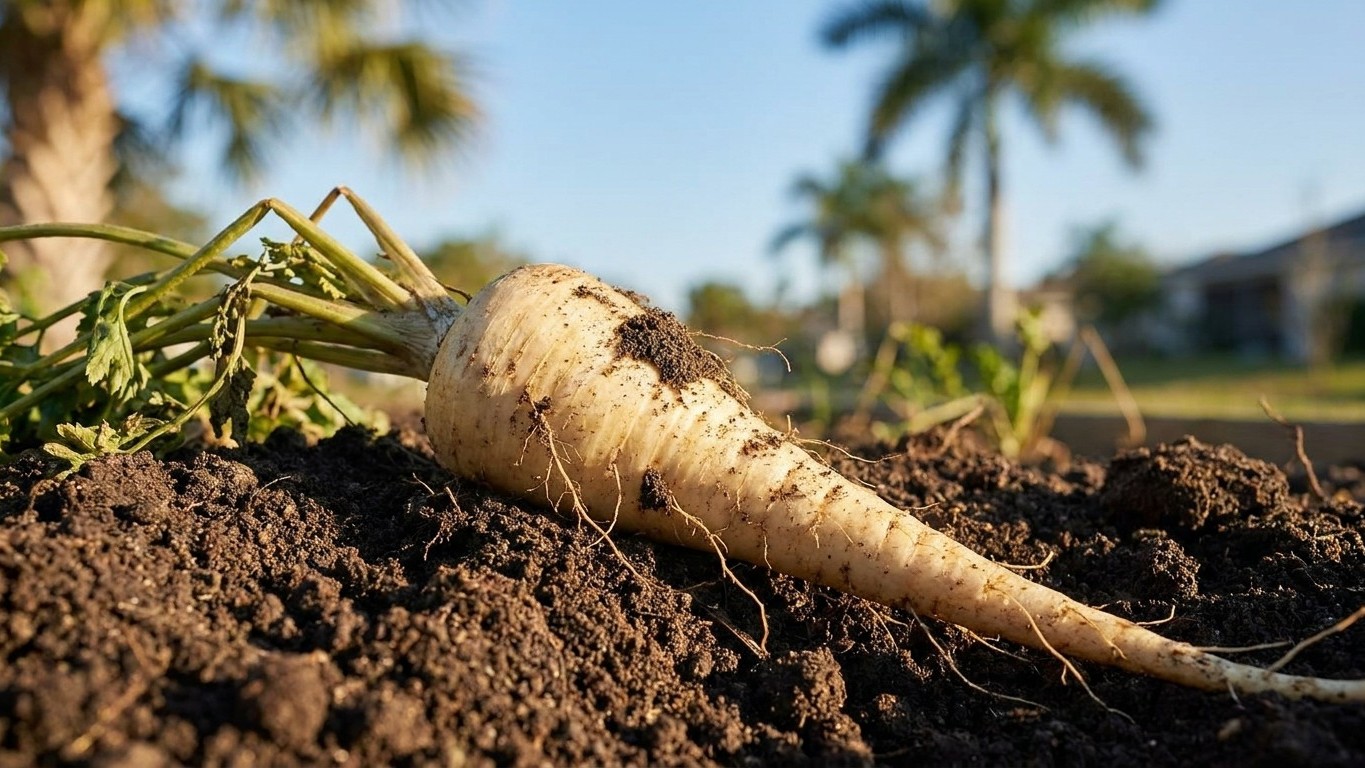

Wisconsin’s documented list of parsnip pests is short and mostly underground: aphids, flea beetles, slugs, cutworms and common stalk borer, seed corn maggot, tarnished plant bug and thrips, white grubs, and wireworms. Most feeding happens between the state’s last spring frost and its first fall frost, the same six-month stretch parsnip needs to size up and then sweeten. Root scarring points to soil insects; leaf stippling points to something above ground.
Which pests attack parsnip in Wisconsin

The University of Wisconsin-Madison Division of Extension documents a broader set of vegetable garden pests than any single crop actually hosts: aphids, asparagus beetle, cabbage looper, cabbage maggot, Colorado potato beetle, cucumber beetles, cutworms and common stalk borer, European corn borer and corn earworm, flea beetles, imported cabbageworm, onion maggot and seed corn maggot, potato leafhopper, slugs, squash bug, squash vine borer, tarnished plant bug and thrips, white grubs, and wireworms and sap beetles.
That list is built for a state’s worth of vegetable gardens, not for one root crop. A pest documented for Wisconsin is not automatically a pest of parsnip, and most of the names above belong somewhere else entirely.
Asparagus beetle stays on asparagus spears and ferns. Cabbage looper, cabbage maggot, and imported cabbageworm work brassica leaves and roots, tissue parsnip does not grow. Colorado potato beetle and potato leafhopper track potato and other nightshade foliage. Cucumber beetles, squash bug, and squash vine borer are cucurbit specialists that never reach a root vegetable row. European corn borer and corn earworm tunnel into corn stalks and ears, nothing parsnip has. Onion maggot targets onion bulbs specifically, though its list-mate seed corn maggot carries no such limit.
What survives that sorting is a shorter, more believable list for parsnip: aphids, cutworms and common stalk borer, flea beetles, slugs, seed corn maggot, tarnished plant bug and thrips, white grubs, and wireworms. These are generalist feeders that hit seedling stems, foliage, and roots across many vegetable species rather than pests locked to one host. Sap beetles round out the wireworm entry on the extension list, but they mainly feed on produce already damaged or overripe, a minor role next to wireworms chewing straight into a root.
Parsnip’s slow, in-place germination gives seedling feeders more time at ground level than a transplanted crop allows, which is part of why cutworms, seed corn maggot, and flea beetles make this shorter list instead of something more specialized.
When each one shows up, and what it does first
Seed corn maggot and cutworms are the earliest possible problem, because parsnip is sown directly in place two to three weeks before Wisconsin’s last spring frost, which NOAA’s 1991-2020 Climate Normals place between April 16 and April 29. The seed then needs 14 to 21 days underground before any seedling shows above the soil, and that gap, a row with no visible plant, is exactly when seed corn maggot larvae can tunnel into the swelling seed and cutworms can sever a stem the moment it breaks the surface. Neither leaves a trace until the row that should be green stays bare or shows a scattering of clipped stubs.
Flea beetles and slugs follow within the first few weeks after true leaves appear, when a night of slug feeding or a morning of flea beetle grazing can strip a young stand fast. Flea beetles leave a stippled, shot-hole pattern across leaves; slugs leave ragged, irregular holes and a slime trail, worse after rain.
Aphids and tarnished plant bug with thrips arrive later, as foliage fills in, feeding on sap and distorting new growth rather than chewing through it. Their damage shows as curled, yellowing leaf tips or a stippled bronze cast, easy to miss until a colony is well established on the undersides of leaves.
White grubs and wireworms work the other end of the plant, underground and mostly out of sight until harvest, when a root that looked fine from above comes up scarred with narrow tunnels or ragged feeding wounds. Wisconsin’s coldest month averages a daily minimum of only 17.2 degrees Fahrenheit at the Milwaukee reference station, mild enough that both pests overwinter in the soil rather than dying off, which is why the same bed can carry a wireworm or grub population from one season into the next. That frost window shifts across the state too: Lake Michigan keeps the lakeshore frost-free longer, while inland southern counties often freeze by early October and the north far earlier.
Telling the damage apart from everything else
Not every rough patch in a parsnip bed traces back to an insect. Parsnip’s own biology, along with Wisconsin’s soil and season, produces several look-alikes that get blamed on pests they never involved.
| What you see | Likely cause | What tells them apart |
|---|---|---|
| Row stays bare three weeks after sowing | Normal germination lag | Parsnip seed takes 14 to 21 days underground before any seedling shows; digging to check usually kills what was about to come up |
| Root splits into two or three legs at harvest | Heavy or stony soil, or overwatering | Stony or compacted ground forces the root to fork around obstructions; overwatering instead pushes extra rootlets that split the main root, a different mechanism with no chew marks or tunnels either way |
| Root pulled with narrow tunnels through the flesh | Wireworm or white grub feeding | Tunnels run through solid tissue, unlike the surface scarring stones cause |
| Foliage stippled with small round holes | Flea beetle feeding | Holes scatter across many leaves rather than concentrating on one spot |
| Roots sized well but taste starchy, not sweet | Not enough frost exposure | Sweetening needs several weeks of frosty weather after the root matures; a comfortable hardiness zone does not substitute for that exposure |
Utah State University Extension recommends deep, sandy soil, or double digging heavy ground, precisely because compacted or stony soil is one of the two common causes of forking listed above. Torn or shredded foliage with no insect in sight often traces to hail, foot traffic, or a hoe blade rather than to any pest on this list; a slime trail across the damage points to slugs, while clean tearing without slime usually does not. A county extension agent, not a guess from a photo, is equipped to separate a genuine pest problem from a soil or watering issue that only looks like one.
What actually works here, and what is a waste of time
Timing beats material on a crop that Utah State University Extension says needs 100 to 120 days from seeding, grown in a state where the frost-free window runs from mid or late April to mid or late October. Get ahead of a pest’s arrival and a simple barrier does most of the work; miss that window and no treatment applied later recovers a seedling stand that is already lost.
Floating row cover must go on at seeding, not after the first bite marks appear, since its entire value is keeping flea beetles and egg-laying adults off a row they have not yet found. Cover applied after damage starts traps the pest inside with the crop instead of keeping it out.
Cutworm collars, a simple paper or cardboard ring pushed into the soil around each emerging seedling, stop a stem-cutting larva at almost no cost and no delay in planting. Clearing mulch, boards, and other slug hiding places from around the bed does more against slugs than anything applied after a wet week of damage. Rotating parsnip away from ground that grew sod, pasture, or a cover crop the previous season cuts down wireworm and white grub numbers, since both build up in grassy roots over more than one season.
Waiting until damage is well underway wastes most of the effort available here: a pest that has already cut the seedling, tunneled the root, or established an aphid colony under leaf cover is past the point where a barrier or a rotation choice changes the outcome. County Extension offices know which treatments are labeled for use on this crop in this state; naming one without that check risks recommending something not legal to apply here.
Where to check this for your own county
The list above comes from the University of Wisconsin-Madison Division of Extension, built at the state level from reports across dozens of counties with different soils, microclimates, and planting histories. A wireworm population common in a sandy central Wisconsin county says nothing about whether it exists in a heavy-clay garden bed near the lakeshore, and a flea beetle outbreak reported one season does not repeat itself automatically the next.
The county Extension office is where that gap closes. Wisconsin counties each maintain an office connected to the University of Wisconsin-Madison Division of Extension, staffed with agents who track what is actually showing up in local gardens that season, not just what is documented statewide. A call or an email describing the damage, or better yet a sample root or leaf, gets an answer specific to local conditions rather than a statewide guess.
That local check matters more for parsnip than for a crop with a longer documented pest history, since several names on this state-level list, seed corn maggot and tarnished plant bug among them, show up more as general garden nuisances than as specialists tracked on this one root crop. A county agent who has seen this season’s reports can say whether wireworm pressure is actually up locally, whether the timing lines up with this year’s frost dates, and whether a soil test or a pest sample is the useful next step.
Common questions
Do parsnips get the same pests as carrots in Wisconsin?
The documented list here is built at the vegetable-garden level, not broken out by individual root crop, so it does not confirm a separate carrot-specific list. Given how closely the two crops are related, overlap on generalist feeders like aphids, flea beetles, and wireworms would not be surprising, but that is not something this source states directly.
Does frost hurt parsnip roots left in the ground?
The frost exposure that sweetens parsnip is the same cold the crop experiences while still in the ground, which is why growers often leave roots in place rather than harvesting early. The 17.2 degree average applies to air temperature at the coldest month, not to soil temperature at root depth, so it should not be read as a claim about how deep roots fare underground.
Why didn’t my parsnip seeds come up at all?
Before assuming a pest, rule out timing: parsnip seed takes 14 to 21 days underground before any seedling shows, and digging to check often does more damage than waiting it out. If the row stays bare well past that window, seed corn maggot or cutworm activity right at germination is a more likely explanation than a seed that simply failed.
Can I apply this state list directly to my own garden?
Only as a starting point. It tells you what is documented somewhere in Wisconsin, not what is present in a specific county or a specific bed. A local Extension office is the level equipped to confirm whether a given pest is actually active nearby this season.