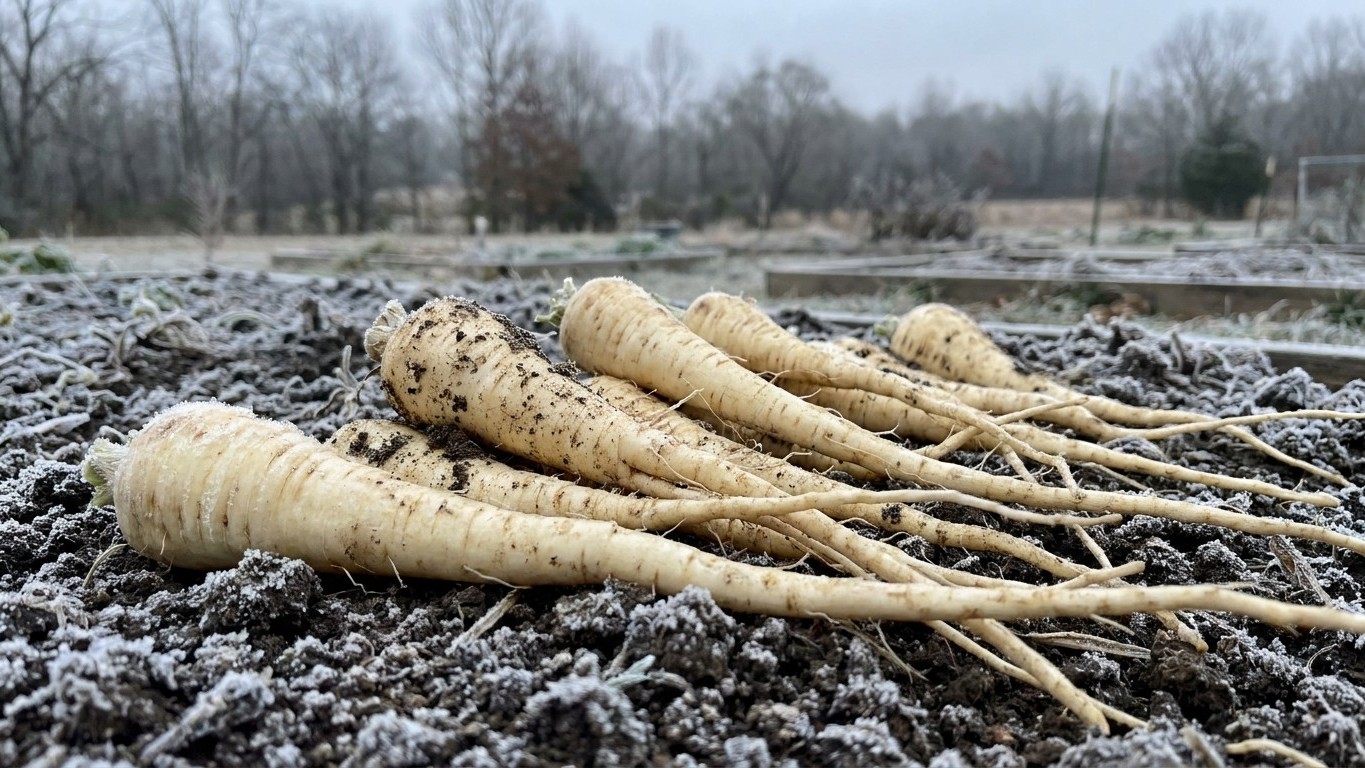

Yes, if you let the roots sit through freezing weather before pulling them. Wisconsin’s coldest month averages a nightly minimum of 17.2°F, cold enough to trigger the starch-to-sugar shift that gives parsnips their reputation. The growing season here, running from an April frost to an October one, holds a full 100- to 120-day crop with room to spare. The real risk isn’t climate. It’s harvesting too soon, before the cold has finished its work.
The short answer
Sweetening in a parsnip isn’t a genetic trait you buy with a seed packet. It’s a chemical reaction that only starts once the root sits through repeated exposure to freezing temperatures, which force the plant to break down stored starch into simple sugars as a kind of natural antifreeze. A single light frost does almost nothing. What matters is several weeks of consistently cold ground, the kind that keeps happening night after night rather than one isolated cold snap.
That’s where the 17.2°F figure earns its keep. This number comes from NOAA’s 1991-2020 Climate Normals for the Milwaukee reference station, and it measures the average daily low across the entire coldest month, not a record low, not a seasonal average. A mean minimum that far below freezing means the cold isn’t a fluke. It’s the baseline. Nights in the teens repeat over and over through the heart of winter, which is exactly the pattern parsnips need to convert.
Contrast that with a hardiness zone rating, which only tells you whether a perennial plant survives winter dormancy where it’s planted. Zone numbers say nothing about how many frosty nights a root crop experiences before harvest, and they’re the wrong tool for answering this particular question. A parsnip grown in a zone that stays comfortably above freezing all winter can still grow into a fine-looking root. It just won’t taste like much, because it never got the cold exposure that turns starch to sugar. Wisconsin doesn’t have that problem. The state’s winter minimum sits well into hard-frost territory across nearly every county, southern lakeshore included, so the sweetening mechanism has plenty to work with here.
What changes the answer isn’t the state average, it’s what happens on the ground at your specific garden. A root left exposed on a south-facing slope with poor mulch cover behaves differently than one tucked under six inches of straw in a low spot that traps cold air. The regional number confirms the opportunity exists. Your own harvest timing decides whether you cash in on it.
Does the season fit?
- Start with the sowing window. Parsnips go into the ground directly, no transplanting, and the recommended timing is 2 to 3 weeks before the last spring frost. Wisconsin’s last spring frost falls between April 16 and April 29 depending on location, so seed goes into cold soil sometime between late March and mid-April.
- Add germination time before counting anything else. Parsnip seed is slow and stubborn, taking 14 to 21 days just to sprout. That means a garden sown in late March might not show green until mid-April, and a gardener who gives up and re-sows at day 10 is working against the crop, not with it.
- Count the full 100 to 120 days from the seeding date, not from germination. That’s the figure Utah State University Extension gives for parsnips grown from seed to maturity, and it runs from the day seed hits soil, patience included.
- Run the arithmetic on both ends of the window. Sow at the earliest point, late March, add 100 days, and the crop reaches maturity around early July. Sow at the latest point, mid-April, add 120 days, and maturity lands closer to mid-August.
- Compare that against the first fall frost, October 17 to October 29. Either way the math works out, there are roughly two to three months of slack between a mature root and the first freeze, which is exactly the cushion a root crop needs to sit in the ground and take on repeated cold before you dig it.
- Conclusion: the season fits comfortably, not tightly. There’s no need to rush sowing to the earliest possible day, and no realistic scenario where the crop runs out of growing time before frost arrives, at least in the state’s central and southern counties.
What Goes Wrong here
- Forked roots from heavy or stony ground. Parsnip taproots push straight down, and any rock, clay clump, or compacted layer splits them into forked, twisted shapes. Wisconsin’s soils range from sandy outwash to dense clay depending on the county, so this failure hits some gardens far harder than others. The fix is physical: double dig the bed a full spade depth, remove stones, and work in enough coarse sand or compost to loosen heavy clay before seed goes in.
- Forked roots from overwatering. This is a separate cause from heavy soil, not the same problem wearing a different name. Waterlogged ground encourages the root to branch in search of air rather than push straight down, even in soil that’s otherwise loose. The remedy is steady, moderate moisture rather than heavy soaking, and beds that drain rather than pool after rain.
- Running out of season in the far north. Counties near Lake Superior see a shorter frost-free window than the southern lakeshore, and a late sowing there can push maturity uncomfortably close to the first hard freeze. Sowing at the earliest edge of the recommended window, right after the ground can be worked, buys back the margin that a shorter northern season takes away.
- Pulling the crop before the frost has done its job. This is the mistake that undoes everything else done right. A root harvested the week it reaches size, before several hard frosts have hit it, grows fine but stays bland, the same outcome as a mild winter that never delivers enough cold. Mulch the bed once the ground starts to freeze, leave the roots in place through repeated frosts, and dig only after the cold has clearly done its work rather than on a calendar date.
A note on handling the plant safely
Before you get anywhere near harvest, there’s a warning that most garden guides skip entirely. According to the North Carolina Extension Gardener Plant Toolbox, “All parts of this plant contain furocoumarins which can make skin sensitive to light causing burns so be sure to wear gloves, long sleeves and long pants when dealing with it.” That’s not limited to the leafy tops. All parts means the root, the foliage, the sap wherever it contacts skin.
What makes this genuinely surprising is the mechanism behind it. The burn doesn’t come from the sap alone. It comes from sap combined with sunlight, a reaction called phytophotodermatitis. Skin that gets coated in plant sap and then sits exposed to sunlight can develop a burn hours later, sometimes well after the gardening is done and the tools are put away. That delay is exactly why it catches people off guard: nothing hurts in the moment, so nobody thinks to worry until the reaction shows up later in the day.
This is also why the protection has to happen before contact, not after. Washing exposed skin once a burn starts to develop doesn’t undo a reaction that’s already been triggered by sunlight. Gloves, long sleeves, and long pants during a bright afternoon of pulling tops or digging roots are the actual defense, not a rinse afterward.
Checking this against your own county
Every figure on this page comes from a regional reference station, and Wisconsin covers a lot of ground between the Lake Michigan shoreline and the far north near Lake Superior. Local frost dates, soil texture, and even the length of a truly frost-free stretch can shift meaningfully from one county to the next, sometimes by a matter of weeks rather than days.
The most reliable way to pin down your own numbers is to contact your county office through University of Wisconsin-Madison Extension. Their county-level staff can confirm local frost timing, recommend soil amendments suited to your specific ground, and flag any microclimate quirks, a low frost pocket, a lake-effect delay, that a statewide figure can’t capture on its own.
Common questions
Can I sow parsnips directly in Wisconsin, or do they need to start indoors?
Parsnips are sown directly in the garden bed where they’ll grow. The long taproot doesn’t transplant well, so starting seed indoors and moving seedlings later isn’t the recommended approach.
How long after sowing before parsnip seed actually sprouts?
Expect 14 to 21 days before seedlings appear. That’s slower than most garden vegetables, and it’s easy to assume the seed failed when it hasn’t.
Do I need to dig up parsnips before the ground freezes solid?
No, and digging early works against the crop. Leaving roots in place through several hard frosts is what triggers the starch-to-sugar conversion that makes them worth growing in the first place.
Does Wisconsin’s soil type affect parsnip shape?
Yes. Heavy or stony ground tends to fork the taproot, while deep sandy or well-loosened soil lets it grow straight. Double digging or amending heavy clay before sowing addresses this directly.