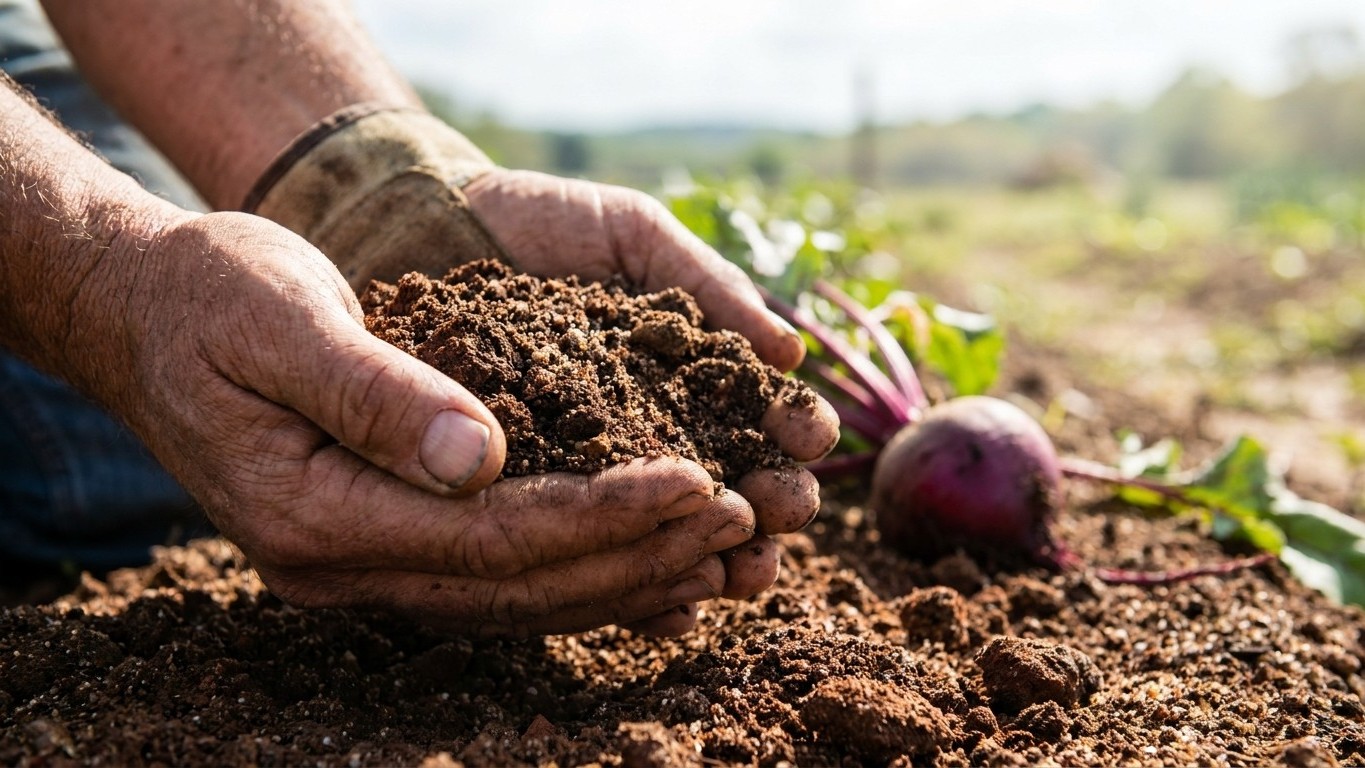

In Yukon, a beet root meets ground that’s still young by soil-survey standards: a Brunisol profile, loam to silt, 47 percent sand, 15 percent clay, 38 percent silt, with organic matter near 12.0 percent and drainage rated imperfect. Add a spring whose average last frost falls June 5, and the first six weeks of growth unfold in cool, often damp soil. That favors germination but raises the odds of early flowering if a dry stretch follows. The ground itself is workable; timing is what needs watching.
The short answer
Yukon’s dominant mapped soil is a Brunisol, a young order where horizons have only started to separate, the kind of profile common on recent or coarse parent material across the territory’s agricultural land. It covers 41 percent of the mapped surface, more than any other order, with Gleysolic ground running second. The median reading across the mapped surface components comes out loam to silt: 47 percent sand, 15 percent clay, 38 percent silt, organic matter around 12.0 percent, and a surface pH near neutral at 6.8. Drainage is classed as imperfect.
For a beet, that’s a mixed picture. Beets want deep, sandy, well-drained ground rich in organic matter, and the organic matter share here clears that bar easily. Texture leans the right way too, sand and silt together outweighing clay by more than five to one, which should let a taproot push down without much resistance. The catch is drainage. Imperfect drainage means water sits in the profile longer than it would on well-drained ground, and a bed that stays wet through a cool spring can crust at the surface or slow root elongation even while the crown stays well fed.
Yukon soil versus what a beet wants
| Factor | Yukon median soil | What beets need |
|---|---|---|
| Texture | 47% sand / 15% clay / 38% silt | Deep, sandy, well-drained |
| Organic matter | ~12.0% | Rich, amended lightly (max 1 in. per 100 sq ft) |
| Drainage | Imperfect | Well-drained |
| pH | ~6.8 (median) | Not specified in this source |
On heat, the record used for this page doesn’t publish a count of days a year the reference station passes 90°F, so no number is given here, and that gap matters less in this territory than it would farther south. Woodiness in a beet root comes from heat above 85°F arriving together with water stress, and short, cool Yukon summers rarely stack that kind of sustained heat on their own. Imperfect drainage, if anything, works against that failure by keeping more water within reach of the root through summer.
None of this describes any one garden. Yukon spans hundreds of mapped soil series, from gravelly benches to river-bottom silt to muskeg that barely drains at all, and the figures above are a starting point for reading the territory, not a stand-in for a soil test. A raised bed built with purchased mix, or a plot near a creek, can sit nowhere near that 47-15-38 median. The number worth trusting for your own ground is the one that comes back from testing your own soil.
The six weeks that decide it here
Beets go straight into the ground, never as transplants, and the standard practice is to sow two to three weeks before the last expected frost. In Yukon, the reference point is the Whitehorse A station, where the average last spring frost falls on June 5. Sow on that schedule and the first six weeks of the plant’s life, the window when water stress triggers premature flowering, land somewhere from mid-May into early July, right through the territory’s least settled stretch of spring.
That average isn’t a guarantee. It’s a mean drawn from three decades of records, which means in roughly half of all years the last frost lands later than June 5, sometimes well later. A gardener who sows to that date and sees frost two weeks after it isn’t unlucky by the numbers; that outcome sits well inside the normal range for this station. Whitehorse is also one point in a large territory. Communities farther north or at higher elevation should expect their own last frost to run behind the Whitehorse date, in some cases by weeks, which pushes the whole six-week window later still.
Once frost risk clears, Yukon spring tends toward the kind of high-latitude swing that makes a fixed watering schedule unreliable: long daylight that dries surface soil fast on clear days, interrupted by cool, damp stretches when the imperfect drainage discussed above keeps the root zone wetter than expected. For a beet, the risk isn’t one dry week so much as an uneven pattern, a run of drying days sandwiched between wet ones that lulls a gardener into skipping a watering right when the seedling needs it most. Premature flowering is triggered by water stress in those first six weeks, not by anything that happens later in the season, so the plant’s fate on this particular point is largely decided before the root has thickened at all. Keeping the bed evenly moist from mid-May through early July, whatever any single week looks like, matters more here than watering hard later on.
What goes wrong here
- Bolting from an uneven spring: a stretch of dry, sunny days inside the first six weeks after sowing pushes the plant toward premature flowering instead of a root. Mulch the bed lightly and check soil moisture every few days through mid-May to early July rather than relying on a fixed watering calendar.
- Surface crusting from imperfect drainage: silt-heavy, imperfectly drained ground can seal over after rain, blocking seedling emergence. Rake the surface lightly after a hard rain and avoid walking or working the bed while it’s still saturated.
- Over-amending soil that’s already rich: at roughly 12.0 percent organic matter, this ground starts well above what many gardens need, and piling on more compost doesn’t help beets, which want no more than 1 inch of composted organic matter per 100 square feet. Test before adding anything and skip amendment in beds already dark and crumbly.
- Woody roots from a late hot, dry stretch: if a warm, dry spell arrives once the heat above 85°F and water stress line up, the root can turn fibrous and tough well after the bolting window has closed. This is a separate failure from bolting and needs deep, less frequent watering later in the season rather than the light, even watering used earlier.
- Sowing to the average frost date without a buffer: treating June 5 as a fixed safe date ignores that frost lands later in roughly half of all years, and later still away from Whitehorse. Watch local conditions and be ready to protect young seedlings into June rather than assuming the average has already passed.
Common questions
Does Yukon’s imperfect drainage mean beets need raised beds?
Not automatically, but raised beds or worked-up rows help where the imperfect drainage rating means water lingers in the profile. Loosening the top several inches and shaping a slightly raised row gives excess spring moisture somewhere to go, which reduces the crusting and slow-root-elongation problems tied to this drainage class.
How does Yukon’s median soil compare to what beets actually want?
Closer than it might seem. The territory’s median texture, 47 percent sand, 15 percent clay, 38 percent silt, leans toward the sandy, well-drained profile beets prefer, and organic matter near 12.0 percent exceeds what most gardens start with. The mismatch is drainage: the median profile is rated imperfect, not well-drained, which is the one factor worth checking on your own ground before assuming the territorial figures apply.
When should beets be sown in Yukon?
Two to three weeks before the last expected frost, using the Whitehorse A station’s average last frost of June 5 as a reference point rather than a fixed rule. Because that date is a mean, not a guarantee, and because it applies specifically to Whitehorse, gardeners elsewhere in the territory should expect their own safe sowing window to fall later.
Can heat make Yukon beets woody?
It’s possible but less common here than in warmer regions, since woodiness requires heat above 85°F combined with water stress, and the source used for this page doesn’t publish a count of days the reference station reaches 90°F. Short, cool summers reduce the odds of that specific combination, but a late, dry, unusually warm stretch can still produce it, and it’s a separate failure from the early bolting risk tied to the first six weeks after sowing.