
Short version: in Yukon, sow pepper seed indoors roughly 8 to 10 weeks before you plan to transplant outside, which lines up with late March into mid-April given the territory’s average last frost. But that frost date is a statistical midpoint, not a promise, and pepper fruit set has its own rules once plants are in the ground.
The short answer
Yukon’s reference station at Whitehorse records 0.0 days a year at or above 90°F, per Environment and Climate Change Canada’s 1981-2010 Climate Normals. For pepper growers, that number matters more than it looks. Fruit set in peppers collapses when daytime highs push past 90°F, the flowers drop before they can pollinate, and a plant can sit there looking healthy while producing nothing for weeks. In Yukon, that failure mode is essentially off the table. A summer here almost never delivers the heat load that stalls pepper flowers in warmer states, and growers who might otherwise obsess over shade cloth or afternoon watering to cool their plants down can set that worry aside.
The other end of the fruit-set window is the one Yukon growers actually need to watch. Utah State University Extension is clear that pepper flowers also abort when nighttime temperatures drop below 55°F, and that threshold is a real risk in a territory with short, cool summers and a growing season bracketed by frost on both sides. This site does not carry summer night-time minimum data for Yukon, so there’s no published number here to hand you. That’s not an oversight, it’s a deliberate choice, because inferring a night-temperature figure from latitude or from how cold January gets would be guesswork dressed up as data, and guesswork is exactly what causes gardeners to plant with false confidence.
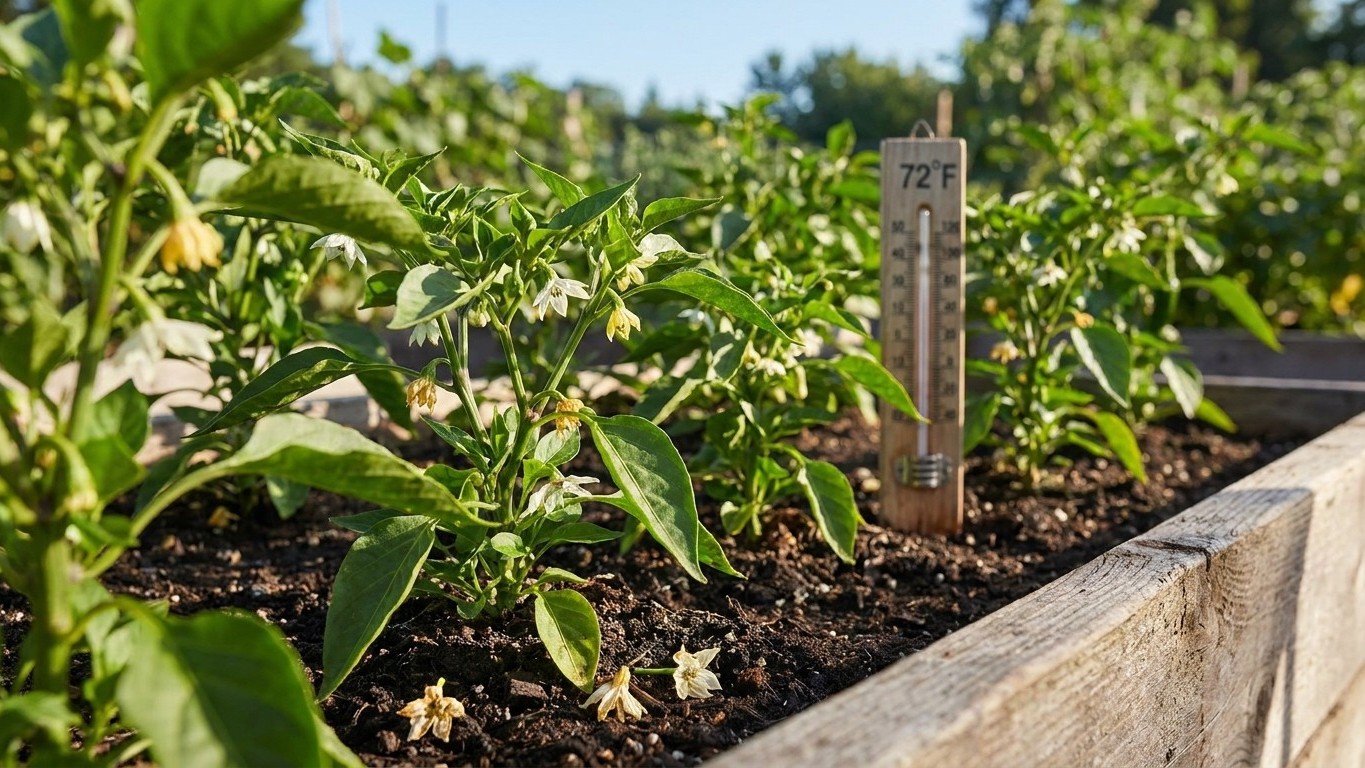
What that means in practice: track your own overnight lows once plants are set out, ideally with a min-max thermometer in the spot where the peppers actually grow, not a general area forecast. A cold snap that drops nights into the low 50s for even a few days can knock blossoms off a plant that looked fine the week before. Since Yukon’s summer heat isn’t the threat, the entire fruit-set conversation here shifts to cold management, cloches, row cover on cool nights, and picking a planting window that avoids the coldest stretches of early and late summer as much as the calendar allows.
When to start seed here
The math behind a pepper-sowing date isn’t complicated, but it only works if you do the steps in order and don’t skip the soil check. Here’s how to build your own date instead of borrowing someone else’s.
- Start from the average last spring frost. For the Whitehorse A station, Environment and Climate Change Canada’s 1981-2010 Climate Normals put that date at June 5. Treat this as a mean, not a guarantee. By definition, frost arrives later than June 5 in roughly half of all years, so planning to transplant exactly on that date means you’re gambling on a coin flip.
- Adjust for where you actually garden. Whitehorse is one station in a large, climatically varied territory. Northern communities and higher-elevation districts routinely run behind the capital’s frost timing by weeks, not days. If you’re outside the Whitehorse area, push your working frost date later before doing any of the following math.
- Confirm soil temperature before transplanting, don’t just watch the calendar. Utah State University Extension’s guidance is specific: peppers go outside once soil reaches 60°F and frost danger has passed, whichever comes later. A cheap soil thermometer pushed 4 inches into the bed tells you more than any date on a chart, especially in a territory where cold ground can lag well behind the air warming up.
- Count back 8 to 10 weeks from your realistic transplant date to find your indoor sowing window. Working from June 5 as a starting point, 8 weeks back lands on April 10, and 10 weeks back lands on March 27. That gives a sowing window of late March into early April for growers near Whitehorse who are comfortable transplanting close to the average frost date.
- Shift later if you’re planning around a later, safer frost estimate. If you’d rather transplant two or three weeks after June 5 to reduce risk, or if your district runs behind Whitehorse, move your indoor sowing date back by the same number of weeks. Seedlings held a bit longer under lights are far easier to manage than plants sitting outside through a cold snap.
The net result for most Yukon gardeners near Whitehorse is a sowing window somewhere between late March and mid-April, with later start dates favored for anyone outside the immediate capital area or anyone who’d rather transplant safely into warmer soil than race the average frost date.
What goes wrong here
Yukon’s climate removes some of the failure modes that plague pepper growers farther south, but it introduces its own, and they’re worth planning around before you’re troubleshooting a struggling plant in July.
- Blossom drop from a cool night. This is the dominant risk in Yukon. Nights dipping below 55°F cause flowers to abort before pollination, even on plants that otherwise look vigorous. Since this site doesn’t carry night-time minimum data for the territory, the fix starts with observation: track your own overnight lows with a thermometer at plant height, and when a cold night is forecast, cover plants with row cover or a cloche to trap ground heat. Waiting until blossoms have already dropped means losing that fruiting cycle entirely.
- Blossom drop from a rare hot spell. Given Yukon’s 0.0 average days a year above 90°F, this is a low-probability event, but not an impossible one in an unusually hot stretch. If daytime highs do spike, the same rule applies as in warmer climates: flowers can abort at the hot end just as they do at the cold end. Light shade cloth during an isolated heat spike and consistent watering reduce the stress, though this is very much the exception rather than the rule here.
- Sunscald on fruit. Even without extreme heat, Yukon’s long summer daylight hours mean pepper fruit gets extended direct sun exposure, and unprotected fruit can develop pale, papery patches on the side facing the sun. Keeping foliage full and healthy so leaves naturally shade developing peppers is the simplest prevention, along with avoiding heavy, sudden pruning that exposes fruit all at once.
- Blossom-end rot. This shows up as a sunken, dark patch on the bottom of the fruit and traces back to inconsistent watering disrupting calcium uptake, not a soil calcium shortage in most cases. In a short growing season where every fruit counts, even watering, mulching to hold soil moisture steady, and avoiding the classic Yukon pattern of a dry stretch followed by a heavy soak make the biggest difference.
Common questions
Can I direct-sow pepper seed outdoors in Yukon instead of starting indoors?
Direct sowing isn’t practical here. Utah State University Extension recommends 8 to 10 weeks of indoor growth before transplant, and Yukon’s frost-free window, bracketed by a June 5 average last frost and an early return of fall cold, doesn’t leave enough time for peppers to germinate, mature, and fruit if started from seed outdoors.
What if my soil hasn’t hit 60°F by the time frost danger passes?
Wait for the soil, not the calendar. Utah State University Extension ties the transplant date to both frost passing and soil reaching 60°F, whichever comes later. In Yukon, cold ground can lag behind air temperature, so holding seedlings a little longer indoors under lights beats setting them into cold soil that will stall growth regardless of air temperature.
Does Yukon’s lack of 90°F days mean I never need to worry about heat stress?
Not entirely. The territory’s 0.0 average days a year at or above 90°F, per Environment and Climate Change Canada’s 1981-2010 normals, means heat-driven blossom drop is rare, but an unusual hot spell can still happen. The bigger and more consistent risk in Yukon runs the opposite direction, toward cool nights dropping fruit set below 55°F.
How do I know if a cold night actually cost me fruit?
Watch for flowers or small buds dropping off the plant within a day or two of a cool night, particularly one where you suspect temperatures fell below 55°F. Since this site doesn’t publish summer night-time minimums for Yukon, the only reliable way to connect a cold night to blossom loss is tracking your own thermometer readings at the plant alongside what you observe on the plant itself.