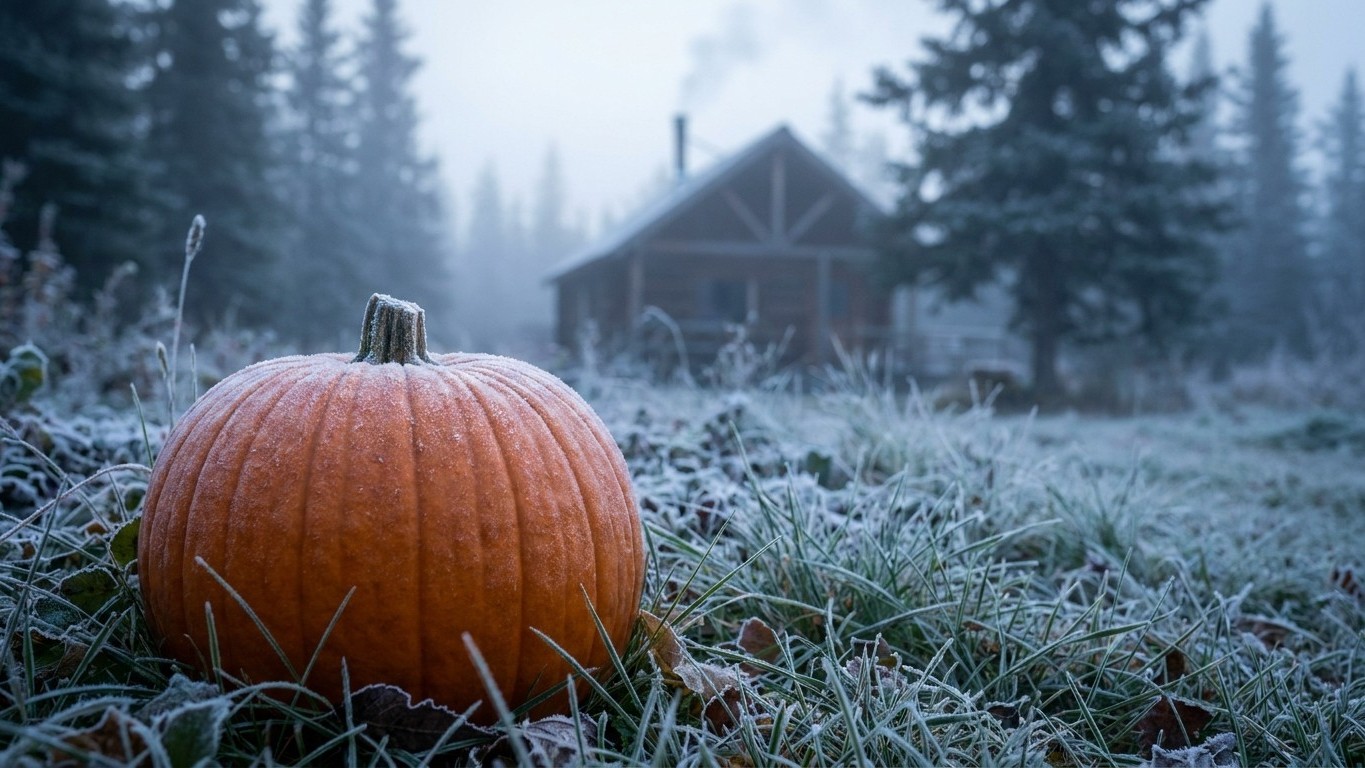

Frost in Yukon arrives around August 25, on average, more than two months before Halloween. That’s the opposite of the usual worry: instead of racing to carve before an early freeze ruins the display, the real question here is how a pumpkin survives weeks of already-freezing weather before anyone even picks up a knife.
The short answer

Environment and Climate Change Canada’s climate normals put the mean first fall frost at the Whitehorse A station around August 25. That’s an average drawn from three decades of records, not a guarantee, and in roughly half of those years frost came later than that date. But even allowing for that spread, October 31 sits so far past the mean frost date that by Halloween, Yukon has typically been through weeks, sometimes a full month or more, of nights below freezing.
That reshapes the whole timing question. Elsewhere, the worry is whether frost arrives before Halloween and damages a pumpkin left out too soon. In Yukon, frost has almost certainly already happened by the time trick-or-treaters are thinking about costumes. The pumpkin itself needs protecting from ongoing cold well before it ever gets carved, not just on the one night it’s set out.
So the window isn’t “carve before frost hits.” It’s “keep the pumpkin whole and cool as long as you can, then carve as close to Halloween as your schedule allows.” A whole, uncarved pumpkin stored properly holds for three to six months in a cool, dark spot between 45 and 50 F, according to University of Illinois Extension. That storage life is what buys the room to shop early, maybe even weeks ahead, without losing the pumpkin before Halloween arrives. The carving itself is best pushed to the final stretch before the holiday, since a carved pumpkin has no published shelf life from any extension service and starts breaking down the moment the skin is opened.
Practically, that means: buy any time in October with confidence the pumpkin will keep, store it whole and cool, and save the actual carving for the last few days before Halloween rather than the first ones. Given how early frost already came and went, there’s no pressure to carve early to beat the cold. If anything, carving early just adds more days of exposure while the pumpkin sits out in a climate already running well below the comfortable range for a cut piece of produce.
Frost or heat: which one gets it here
The cold end of the range
A whole pumpkin keeps best between 45 and 50 F. Yukon’s coldest month averages a daily minimum of -2.6 F at the Whitehorse reference station, which tells you how far this territory sits below that storage band once winter sets in. That figure describes deep winter, not late October specifically, but it makes the direction of the problem clear: this is a place where things get colder than a pumpkin wants, not warmer. By the time frost has already arrived in late August, the trend for the following two months is downward, and outdoor storage risks pushing well past the cold edge of that 45-50 F window long before Halloween.
A pumpkin left somewhere that dips into hard freezing repeatedly won’t just get chilly. Freezing and thawing breaks down the cell walls inside, and the flesh turns soft and weepy even though the shell may look fine from outside. That’s a different failure than the porch heat problem people watch for in southern states.
The warm end of the range
Heat basically isn’t the concern in Yukon. There’s no scenario here where a pumpkin sits out in warm fall air and rots from excess warmth before Halloween, the way it might somewhere with mild, humid October weather. The entire climate profile points one direction: cold arrives early, stays, and deepens. Anyone shopping guidance written for warmer states and applying it here risks the opposite mistake, worrying about heat when the actual threat is a hard freeze.
Where to keep it until you carve
- Skip the open porch by mid-fall. Given how far Yukon runs below the 45-50 F storage band once the season turns, an exposed porch or step risks hard freezing well before Halloween, not just a light frost.
- Choose an unheated interior space instead. A mudroom, enclosed entryway, or attached garage that stays above freezing but doesn’t get warmed by the furnace is closer to the target range than most outdoor spots this far north.
- A cool basement works if it’s dark. Basements often sit naturally in the 45-50 F band even when the ground floor is heated, and darkness slows the pumpkin’s own ripening process.
- Keep it away from ripening fruit. Apples, potatoes, and tomatoes give off ethylene gas that speeds up aging in a stored pumpkin, so don’t share a shelf or crate with them.
- Leave the stem alone. University of Illinois Extension notes a pumpkin should have one to two inches of stem intact; once that stem breaks, the exposed spot becomes an entry point for spoilage. Never lift or carry a pumpkin by the stem itself. Set it down and pick it up from underneath.
- Move it to a slightly warmer spot only right before carving. Bringing the pumpkin indoors for the final day or two, once you’re ready to cut it, avoids long stretches in temperatures that swing between freezing and thawing.
Checking this against your own county
Yukon doesn’t divide into counties, and it stretches across a wide range of terrain, from the Whitehorse valley to higher, more exposed districts further north and at elevation. The Whitehorse A station is the only reference point behind the frost figure in this article, so a community sitting higher or further from that valley floor should expect frost, and the cold that follows it, to arrive even earlier than the territory-wide average suggests.
For a closer read on local conditions, Agriculture and Agri-Food Canada is the federal resource worth checking, since the territorial site currently blocks automated access from tools like this one: agriculture.canada.ca. Local knowledge from neighbors who garden or grow pumpkins in the same community is often the fastest way to confirm how the territory-wide numbers play out on a specific street or valley.
Common questions
Does an early frost in August mean pumpkins can’t be grown in Yukon at all?
No. Growers here work around the short season, but that’s a separate question from storage and carving timing for a pumpkin already picked or bought. Once harvested, a whole pumpkin’s survival depends on where it’s kept, not on when frost first touched the ground.
Is it safe to carve a pumpkin weeks before Halloween in Yukon?
Nothing prevents it, but a carved pumpkin has no published storage window from any extension service, and cutting it open starts decay immediately. Carving closer to Halloween, once the pumpkin has spent most of its time whole and cool, gives the best chance it still looks good on the day.
Should a pumpkin be brought inside overnight once temperatures start dropping?
If overnight temperatures are already dipping toward or below freezing, an unheated indoor space that still stays cool, like a mudroom or basement, protects the pumpkin better than leaving it exposed outside.
What’s the single biggest mistake to avoid with a Yukon pumpkin?
Treating the stem as a handle. University of Illinois Extension is clear that the stem is a seal, not a grip; once it snaps off, that spot on the pumpkin is exposed and spoilage moves in faster.