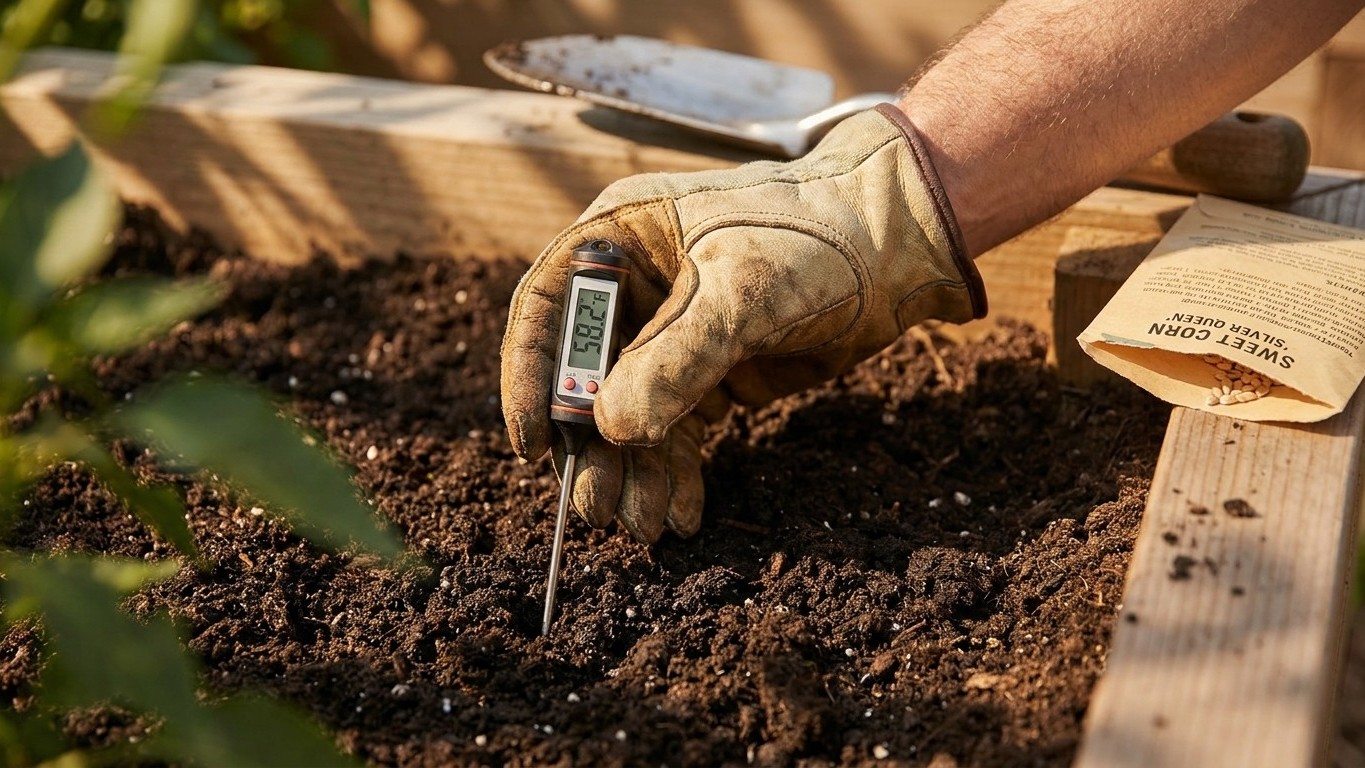

The soil in Yukon gardens rarely reaches the 60 F mark sweet corn needs until well after the average last spring frost of June 5 passes. Once it does, the window to the average first fall frost of August 25 leaves roughly two to three months, tight but workable if the variety and planting date line up. A 60-day type has a real shot; a 90-day type does not.
The short answer
Start with the two dates that frame everything here: an average last spring frost of June 5 and an average first fall frost of August 25, both drawn from the Whitehorse A station records. That gives a frost-free stretch of roughly 81 days in a typical year. Sweet corn, though, doesn’t care about frost-free days on a calendar. It cares about soil temperature. Utah State University Extension is clear that the soil needs to be above 60 F before seed goes in, and that maturity then takes 60 to 90 days from that planting date, not from the frost date.
Here’s where the math gets uncomfortable. Soil warms up slower than air. It sits several feet below where the thermometer on the porch reads, insulated by moisture and shade, and it typically doesn’t cross 60 F until well after the last frost has come and gone. That gap between June 5 and whenever the soil actually clears 60 F is not published for this territory, so the only honest way to know is to check with a soil thermometer pushed a few inches into the bed, rather than trusting a date on a seed packet calendar.
What that gap does is eat into the 81-day frost-free window before planting even happens. If soil warmth arrives, say, two or three weeks after the last frost, the remaining stretch to August 25 shrinks to somewhere around 60 to 70 days. That’s a workable runway for the fast end of the sweet corn scale, and a hard no for the slow end.
One more number changes how much margin there is inside that runway: Yukon averages 0.0 days a year above 90 F. That means almost no heat spikes to push corn through its growth stages quickly. Sweet corn’s day counts assume decent heat accumulation, so without hot stretches, a variety rated at, say, the fast end of its range may run closer to the slow end in practice. That’s not a reason to panic, but it is a reason to treat the published day count as a minimum, not a guarantee, and to plant as soon as the soil genuinely reads 60 F rather than waiting for a “safer” week that eats into an already short runway.
Does a late variety fit here?
A 60-day variety
A variety maturing in 60 days from planting is the one that has a realistic path through Yukon’s growing season. Suppose soil crosses 60 F sometime in the back half of June, a reasonable estimate given how far behind air temperature soil tends to run. Planting then and counting 60 days forward lands in the third or fourth week of August, right around that average first fall frost of August 25. There’s not much cushion. A cooler-than-normal stretch, and with 0.0 days a year above 90 F there’s little heat banked to make up for it, could push actual maturity past the frost date rather than before it. Still, of the two options, this is the one worth building a season around, and it rewards planting the moment soil temperature confirms 60 F rather than a week or two later “just to be safe.”
A 90-day variety
A 90-day variety does not fit this territory, and it’s worth saying plainly rather than hedging. Even in the best case, if soil hit 60 F the same week as the last frost on June 5, 90 days forward lands around September 3, more than a week past the average first fall frost of August 25. In practice, soil warms later than the frost date, not on it, so the real gap between a realistic planting date and August 25 is shorter than 90 days before the corn is even in the ground. There’s no averaged data on a second, softer frost threshold to lean on here, and none is published for this territory, so there’s no cushion to borrow from. A 90-day variety in a Yukon garden is a bet against both the calendar and the near-total absence of hot days that might otherwise speed things along.
What goes wrong here
- Soil sown too cold. Planting by the frost date instead of by soil temperature is the most common misstep in this territory, because the two dates are not the same and the gap between them can be substantial. Utah State University Extension sets the threshold at soil above 60 F, not air above freezing. The remedy is simple: push a soil thermometer into the bed before planting, and wait for a real reading rather than a date on a packet.
- A variety too late for the season. A 90-day type asks for more frost-free runway than this territory reliably offers between a realistic planting date and the average first fall frost of August 25. The remedy is choosing toward the fast end of the 60-to-90-day range published by Utah State University Extension, and treating that number as a floor rather than a target given how few hot days there are to speed maturity along.
- Sweetness lost to a neighbor, nothing to do with climate. Su, se and sh2 types cross when they tassel at the same time, and the result is corn that tastes starchy instead of sweet, regardless of how well the season went. Utah State University Extension gives no isolation distance for this, so the fix isn’t measured in feet; it’s managed by timing plantings so different types don’t tassel together, and by keeping to the recommended block shape of three or more rows rather than a single thin row, which also helps pollination succeed within a variety.
Common questions
Is June 5 a safe date to plant sweet corn in Yukon?
No. It’s an average last frost date from Environment and Climate Change Canada’s Whitehorse A station, meaning frost falls later than that in about half of all years. It also has nothing to do with soil temperature, which is the figure sweet corn actually depends on.
How do I know when the soil has reached 60 F?
The only reliable way is a soil thermometer pushed a few inches into the bed, checked over several days rather than once. No specific date for when Yukon soil crosses 60 F is published here, so a direct reading replaces a calendar guess.
Can I grow more than one type of sweet corn in the same garden?
Yes, as long as su, se and sh2 types are timed so they don’t tassel at the same window. Utah State University Extension does not publish a distance to keep them apart, only the condition that simultaneous tasseling is what ruins the sweetness.
How do I know sweet corn is ready to pick?
Look for three signs together: silks that have dried and turned brown, husks that are still moist and green, and a milky liquid when a kernel is punctured. Any one sign alone isn’t enough to judge ripeness.