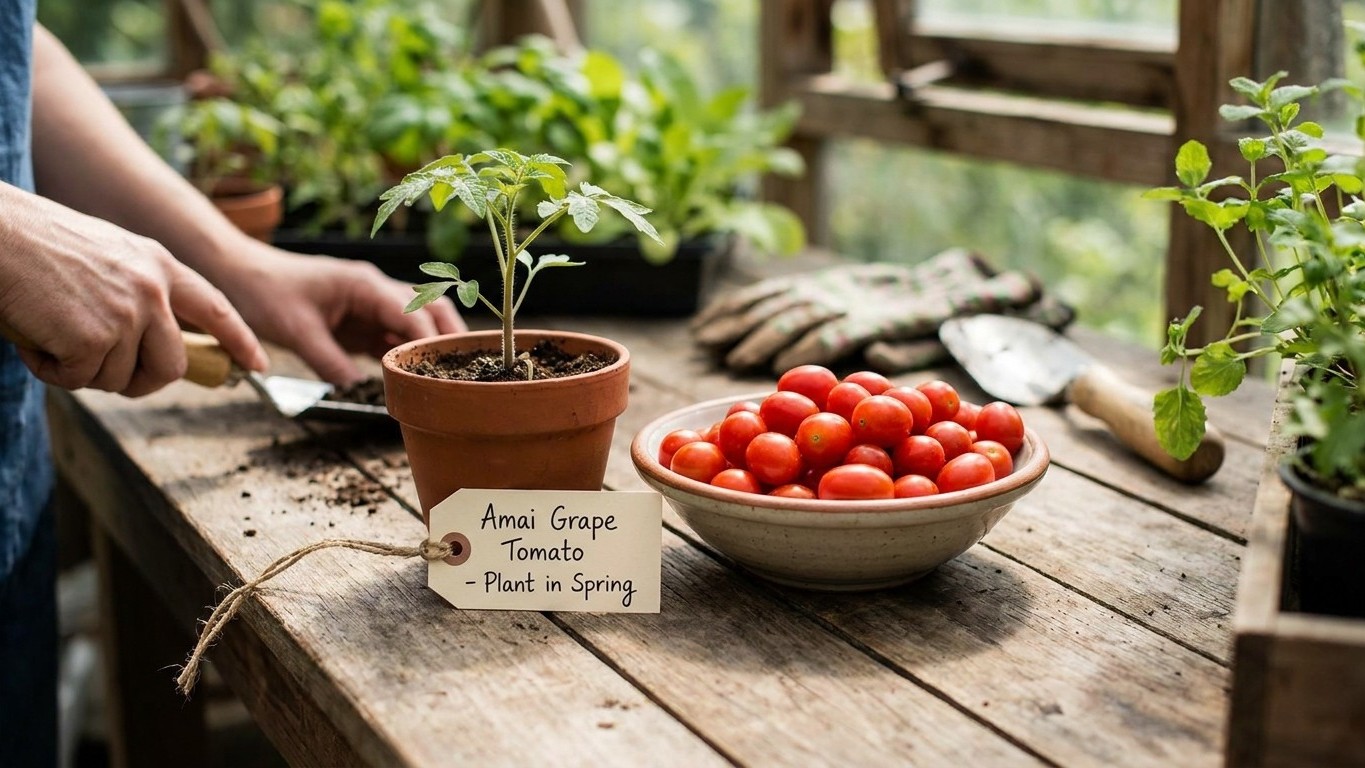

Amai is a grape tomato bred for a high sugar content, an indeterminate vine that keeps setting fruit through the whole warm season, with small oblong fruit running 15 to 20 grams each. Its seed packet lists about 60 days to maturity, counted from transplant, not from the day you sow seed indoors. That short window makes it a reasonable pick for gardeners working with a tight frost-free season, but you still need to check your own last-frost date against the numbers below before you order seed.
What Amai actually is

Amai belongs to the grape tomato class, smaller and denser than a cherry tomato, bred specifically for eating sugar rather than sauce yield. The fruit runs 15 to 20 grams, oblong, deep red at full ripeness, and holds well on the vine without splitting the way some thin-skinned cherries do. That size and shape mean the crop is for the table and the lunchbox, not for canning in volume.
The catalogue figure most sellers list is about 60 days to maturity, and that count starts at transplant into the garden, not at the day the seed goes into a tray. If you start seed indoors five to six weeks before your last frost, as most tomato guidance suggests, the 60-day clock only begins once the seedling is hardened off and in the ground. That distinction matters more for Amai than for a slow beefsteak, because a short-season grower is often counting every week.
Amai is indeterminate. The vine keeps growing and setting new trusses until frost or heat stress stops it, unlike a determinate variety that sets one concentrated flush and finishes. That habit puts Amai closer to indeterminate heirlooms like the Cherokee Purple tomato in terms of the staking and season-long care it demands, even though the fruit itself is nothing alike. If you have not grown an indeterminate variety before, it’s worth reading a general primer on tomato varieties before you commit bench space to one.
What Amai is good for
A grape tomato’s flesh-to-skin ratio and moderate water content are why the category works out of hand and disappoints in a stockpot. The wall of each fruit is thick enough that it doesn’t collapse into liquid the way a slicing tomato’s does, but there isn’t enough interior volume in a 15 to 20 gram fruit to reduce into anything worth a sauce pot’s time. Amai’s shape and density put it squarely in that camp: it is built to be picked, rinsed, and eaten, not simmered down.
That same high skin-to-flesh ratio, which cooks down thin and sauce-shy, is why grape tomatoes like Amai route to salads and snacking rather than cooking. The bite-sized fruit needs no knife, and the skin-to-flesh proportion that makes it unhelpful for sauce is exactly what gives it a firm, snappable bite raw. Halved into a salad, Amai will hold its shape under dressing and toss without weeping the way a wetter, thinner-skinned cherry can. Whole, it’s the tomato that gets eaten standing at the plant before it ever reaches a bowl, which is common for the category and not a flaw specific to this variety.
Beyond the shape and eating style, no further flavor detail for Amai is published. The catalogue description points to a sweet, classic grape-tomato profile, but sugar content, acidity, and any specific tasting notes beyond “addictive” aren’t documented, so nothing more precise can be stated here.
Amai belongs in the kitchen as a fresh-eating tomato, not a processing one. It belongs in a salad bowl, on a snack tray, or halved into a grain dish where its shape holds, not in a pan reducing toward paste. If a cook wants both a snacking tomato and a sauce tomato from the same garden, Amai covers only the former, and a separate paste variety would be needed for the latter.
Where it ripens in time, and where it is a gamble
The question that actually decides whether Amai belongs in your garden is not “does it get warm enough” but “how many days are left between the first ripe fruit and the first fall frost.” That margin is what’s left after you take your frost-free window, subtract the couple of weeks the soil needs to warm before you can safely set transplants out, and subtract the roughly 60 days Amai needs to size and ripen. A margin under thirty days means one flush of fruit, and a cool year takes even that.
The tight end
At the tight end of that arithmetic sits Yukon, where the reference station at Whitehorse gives growers a set-out window in mid June and a first ripe date in mid August, a margin of just 9 days before frost closes the season. Nunavut is only slightly better: Rankin Inlet’s numbers put transplant in early July, first ripe fruit in late August, and 14 days of margin. Both are graded a gamble even for a fast variety like Amai, because there is barely time for one wave of fruit to color before the season ends.
The middle ground belongs to the prairie provinces, where a greenhouse start makes the difference rather than the variety choice. Saskatchewan, measured at Saskatoon, gives a set-out in early June, first ripe fruit by late July, and 51 days of margin. Manitoba, at Winnipeg, comes in close behind with 50 days. Alberta, at Calgary, and the Northwest Territories, at Yellowknife, sit around 44 to 46 days. These are workable seasons for Amai’s 60-day clock, but they still lean on transplants started early indoors and, often, a tunnel or cold frame to push the effective set-out date forward.
The comfortable end
At the other end, Nevada, measured at Las Vegas, offers a set-out window from late January to mid February and first ripe fruit by mid April, a margin of 238 days. Louisiana, at New Orleans, is close behind at 240 days. In gardens like these, the limiting factor stops being frost altogether and becomes something else entirely, which the next section covers.
| Territory | Reference station | Set out | First ripe | Margin |
|---|---|---|---|---|
| Yukon | Whitehorse | Mid June | Mid August | 9 days |
| Nunavut | Rankin Inlet | Early July | Late August | 14 days |
| Saskatchewan | Saskatoon | Early June | Late July | 51 days |
| Manitoba | Winnipeg | Early June | Early August | 50 days |
| Nevada | Las Vegas | Late January to mid February | Mid April | 238 days |
| Louisiana | New Orleans | Early to late February | Late April | 240 days |
The two ways a season goes wrong
A long frost-free window on paper does not guarantee a good crop, and a short one does not automatically doom it either. Two separate limits sit underneath the margin numbers, and a frost table alone cannot show either of them.
Not enough accumulated warmth
In the far north, the problem is often not days but heat. Whitehorse accumulates only about 600 degree-days across the growing year, and Rankin Inlet just 159. Fruit needs a running total of warmth above a base temperature to size and ripen, and tomato flowers generally will not set fruit at all once nights fall consistently below 50F. That means even a technically adequate frost-free window in Yellowknife (905 degree-days) or Calgary (1171 degree-days) can still leave Amai short on ripening heat, which is why growers in these territories lean on a tunnel or greenhouse rather than relying on the open frost dates alone.
Too much heat, not enough pollen
At the other extreme, heat itself becomes the limit. Above roughly 86F, tomato pollen goes sterile and flowers drop without setting fruit, regardless of how many frost-free days remain on the calendar. In South Carolina, measured at Charleston, that shutdown runs from June through August. Florida and Texas see the same collapse across similar summer months, and Nevada and Louisiana lose the same stretch to heat despite their enormous frost-free margins. Growers in these states plant a spring crop and a second autumn crop rather than expecting one continuous harvest.
For Amai specifically, the cold-summer limit matters more in the prairie and northern territories, since its 60-day clock is already fast enough to dodge frost there. It’s the accumulated heat, not the calendar, that decides the outcome. In the hot South, the heat-sterility gap matters more, and a fast variety like Amai is actually an advantage there: it can complete a full crop in the spring window before the mid-summer shutdown, then repeat in the fall.
What it resists, and what it does not
Amai’s catalogue resistance is narrow and worth stating plainly rather than dressing up. It carries high resistance to Fusarium wilt races 1 and 2, which means the plant strongly suppresses that soil-borne fungus rather than merely slowing it. That’s a meaningful protection if you’re replanting tomatoes in the same bed year after year, since Fusarium persists in soil for years and is one of the more common reasons a healthy-looking plant collapses mid-season.
The catalogue lists five resistances in total, with high protection against Tomato Mosaic Virus, Fusarium Wilt races 1 and 2, and Leaf Molds A-E, plus intermediate protection against Nematodes and Gray Leaf Spot, and it would be wrong to imply otherwise. Amai is not documented as resistant to the diseases that most commonly hit grape and cherry tomatoes in a home garden:
- Early blight, which shows as dark rings on lower leaves and spreads upward in wet weather
- Late blight, which can take a planting down in days under cool, damp conditions
- Verticillium wilt, a soil fungus with symptoms that look similar to Fusarium but needs different management
- Root-knot nematodes, a soil pest more common in warm, sandy southern gardens
Crop rotation, good airflow between staked plants, and watering at the soil line rather than overhead all matter more for Amai than they would for a variety carrying broader resistance codes. Treat the Fusarium resistance as one solved problem, not a general health guarantee.
Growing it without the usual mistakes
Support and spacing
Because Amai is indeterminate, it needs a stake, cage, or trellis tall enough to carry a vine that keeps growing past head height in a long season. Space plants with that mature size in mind rather than the small transplant you’re setting out. This is a different plan from a determinate variety like the Unity tomato, which ripens in one concentrated flush, needs a shorter cage, and can be planted closer since the plant stops growing once it sets its fruit load.
Feeding through the season
Because the vine keeps producing new trusses, you should not stop feeding Amai the way you might a determinate variety once it sets its main flush. Continue a balanced feed through the growing season rather than tapering off after the first harvest, or the later trusses will size down noticeably compared to the first.
The mistake its timing invites
The most common mistake with a fast, indeterminate grape tomato is treating the early maturity date as license to skip early staking. Growers assume a 60-day variety will be small and manageable, then find themselves tying up a sprawling vine loaded with green fruit in high summer, often with branches already broken under their own weight. Stake or cage Amai at transplant, not after it needs it. Water consistently once fruit sets, since irregular watering on a thin-skinned grape tomato is the fastest route to split fruit right before harvest.
Common questions
Is Amai a cherry tomato or a grape tomato?
Grape tomato. The fruit is oblong rather than round, and denser, which is why the 15 to 20 gram weight runs smaller than most round cherry varieties of similar size.
Can I grow Amai in a container?
Yes, but size the container to an indeterminate vine, not a compact patio type. A five-gallon container is workable for a season if you stay on top of watering and staking, but a larger pot reduces how often you need to water in hot weather.
Why are my Amai flowers dropping without setting fruit?
Almost always heat or cold, not disease. Nights below 50F or daytime temperatures above roughly 86F both interrupt pollen viability, and the plant drops the flower rather than setting fruit. Check your local overnight and daytime temperatures before assuming a pest or nutrient problem.
Does the 60-day figure change if I direct-sow instead of transplanting?
The catalogue figure only applies to transplants. Direct-sown seed needs additional time to germinate and grow to transplant size before that 60-day clock even starts, which makes direct-sowing a poor fit for any garden already working with a tight frost-free margin.