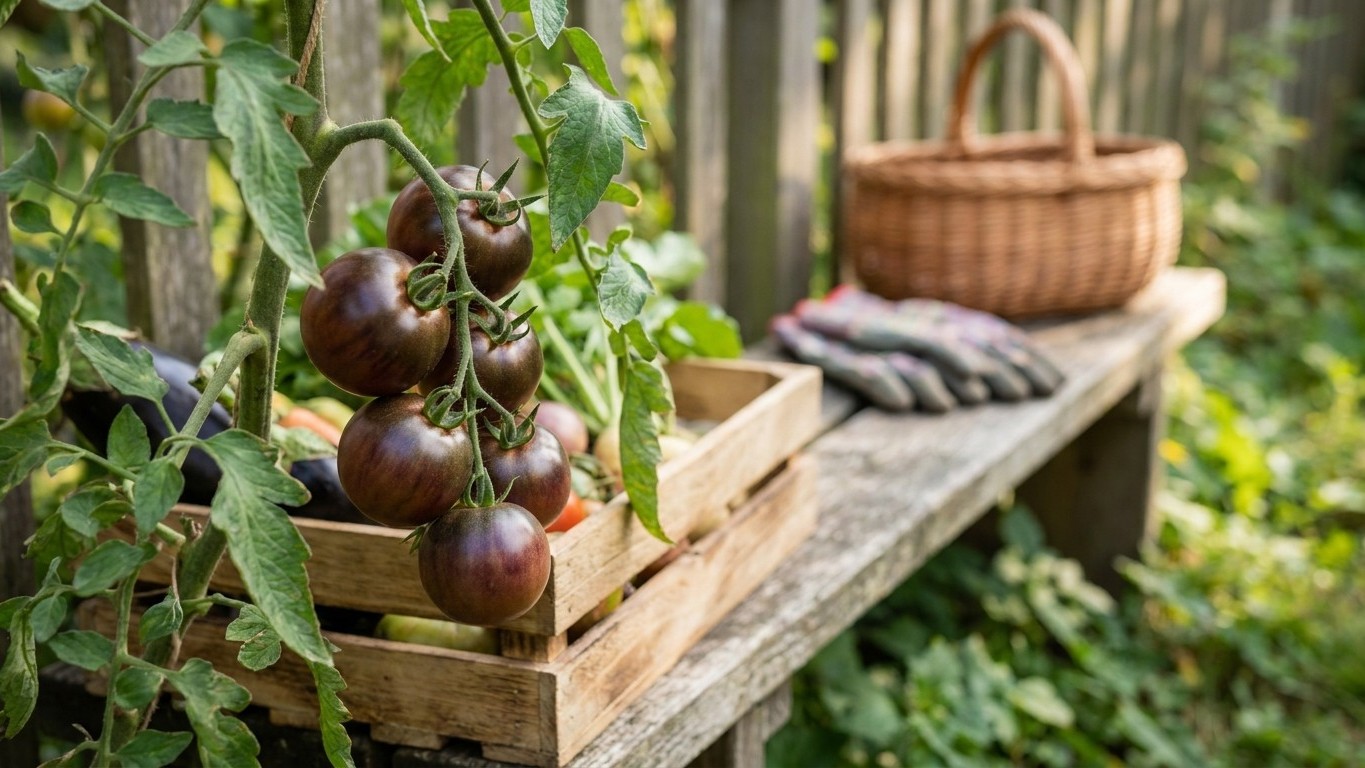

Black Krim is a dark-skinned slicing heirloom, grown for fresh eating rather than canning, and seed catalogues list it at about 80 days from transplant to first ripe fruit. That number is the whole question this page answers: does your growing season leave room for 80 days plus picking time before frost, or does the tomato run out of season before it runs out of fruit. Check your local frost-free window against that 80-day figure before you buy the seed packet.
What Black Krim actually is

Black Krim is a slicing heirloom with dusky, purplish-red-black skin and dark, brick-colored flesh, grown for the table rather than for sauce or storage. Seed catalogues list it at about 80 days from transplant to first ripe fruit, not from the day the seed goes into starting mix. That figure shifts by a week or two depending on how much sun the plant gets and how warm the soil is when it goes into the ground, so treat it as a range rather than a fixed date.
The plant is indeterminate, which means it keeps setting new flower trusses and growing taller until frost, disease, or the gardener stops it, rather than ripening one flush and finishing. That habit calls for a tall cage, stake, or trellis strong enough to carry vines that commonly reach five feet and more, along with the kind of ongoing feeding and pruning an indeterminate needs across a full season. A determinate variety sets its fruit in a shorter window and needs none of that; Black Krim is not that plant.
Fruit runs medium to large, a flattened globe with shoulders that stay slightly green even at full ripeness, a trait of the variety rather than a sign the fruit is unfinished. It is eaten fresh, sliced for sandwiches and salads, not bred for a tough skin or a long shelf life. If that fruit size or season length does not fit your garden, the full lineup on our Tomato Varieties page has shorter and longer options to compare it against.
What Black Krim is good for
Black Krim is built for the cutting board, not the stockpot. Its flesh carries enough water that a saucepan full of it would take a long simmer to reduce to anything worth spooning over pasta, and that same juiciness is exactly what makes a slice worth eating on its own. Cut a ripe fruit into thick rounds and the texture holds together rather than collapsing into mush, so it stands up on a plate, in a sandwich, or layered with mozzarella and basil without needing anything else done to it.
The flavor is where this variety earns its reputation: a bold, smoky depth that reads as less sweet and more savory than a standard red tomato, paired with a texture that stays firm enough to bite through cleanly rather than falling apart in the hand. That combination is why it gets served raw and salted rather than cooked down. Heat mutes the smokiness that makes it distinctive, so reducing it to sauce or roasting it into a paste wastes the trait that makes people grow it in the first place.
The dark, near-black skin and brick-red interior also matter at the table beyond flavor. Sliced open, the color contrast makes it a standout in a mixed heirloom platter next to yellow or standard red tomatoes, which is a large part of why cooks reach for it specifically rather than any other slicer.
What it is not suited for is canning or freezing in bulk. As a slicing heirloom rather than a paste type, it lacks the thick walls and low moisture that let paste tomatoes cook down efficiently without a long stretch on the stove, and no published guidance treats it as a candidate for that use. If the goal is jars of sauce for winter, this is not the plant to grow for it; if the goal is a tomato eaten the day it is picked, it is.
Where it ripens in time, and where it is a gamble
To check whether Black Krim finishes where you garden, start with the frost-free window your nearest weather station reports, subtract the roughly two weeks growers wait after the last frost for soil to warm enough for tomato transplants, then subtract the variety’s 80 days to maturity. What is left is the margin, the number of days between the first ripe fruit and the first fall frost. Under thirty days of margin means a single flush of fruit, and a cool year can take even that.
Where the margin runs out
In Yukon, Whitehorse’s numbers put the variety 13 days short even before frost, meaning the first ripe fruit would arrive after the season has already closed, and the region’s accumulated heat for the year runs far below what a tomato needs regardless of frost timing. Nunavut, tracked at Rankin Inlet, is 8 days short on the same math, with total seasonal warmth low enough that neither a greenhouse-free planting nor a longer frost-free stretch would fix it. Both call for a greenhouse or tunnel, not a different sowing date.
Move south a band and the picture turns to risky rather than impossible. Northwest Territories, at Yellowknife, comes out with 22 days of margin, and Alberta, measured at Calgary, comes out with 24 days. Both leave time for one wave of ripe fruit, but a cold snap or an overcast summer erases the harvest along with it. Manitoba (Winnipeg) and Saskatchewan (Saskatoon) fare a little better at 28 and 29 days respectively, with accumulated heat for the season sitting right at the edge of what the plant needs. An earlier-maturing variety and black plastic mulch to warm the soil both shift that edge in the grower’s favor.
Where the margin is wide
Contrast that with Washington, where Seattle’s numbers give a 146-day margin, and with South Carolina, Florida, Texas, Nevada and Louisiana, all running margins between 154 and 218 days at their reference cities of Charleston, Jacksonville, Houston, Las Vegas and New Orleans. None of these gardens are racing frost. Their limit is a different one, covered next.
| Territory | Reference station | Margin | Verdict |
|---|---|---|---|
| Yukon | Whitehorse | -13 days | Impossible outdoors |
| Nunavut | Rankin Inlet | -8 days | Impossible outdoors |
| Northwest Territories | Yellowknife | 22 days | Risky, single flush |
| Alberta | Calgary | 24 days | Risky, single flush |
| Manitoba | Winnipeg | 28 days | Risky, tight on heat |
| Saskatchewan | Saskatoon | 29 days | Risky, tight on heat |
| Washington | Seattle | 146 days | Comfortable |
| South Carolina | Charleston | 154 days | Comfortable, two seasons |
| Florida | Jacksonville | 170 days | Comfortable, two seasons |
| Texas | Houston | 181 days | Comfortable, two seasons |
| Nevada | Las Vegas | 216 days | Comfortable, two seasons |
| Louisiana | New Orleans | 218 days | Comfortable, two seasons |
The two ways a season goes wrong
A long frost-free window does not automatically mean a good tomato season, and a frost table alone cannot show either failure mode. In the north, a region can have enough frost-free days on paper and still fall short on accumulated warmth across the season, the kind of heat a tomato needs to actually build and ripen fruit rather than just survive. Yellowknife and Calgary both sit in that gap: their frost-free windows leave a slim but real margin, yet their seasonal heat totals run tight against what an 80-day heirloom needs to finish reliably. On top of that, nights below 50°F stop fruit set outright even when the days are warm enough, which is what turns a marginal spring into a season with vines but no tomatoes.
In the south, the failure runs the other direction. Once daytime temperatures push past roughly 86°F, tomato pollen goes sterile and flowers drop without setting fruit, which is why growers in Charleston, Jacksonville, Houston, Las Vegas and New Orleans do not treat their long frost-free window as one unbroken season. They plant a spring crop, lose fruit set through the hottest stretch of summer, and plant again for a fall crop once temperatures come back down.
For Black Krim specifically, the northern limit matters more. At 80 days to maturity it is a mid-to-late heirloom, not a quick 55-day slicer, so it needs the full run of a region’s accumulated warmth to fill out its fruit before frost. In the risky northern territories, that is the constraint to watch, not the calendar date of first frost alone. In the hot southern states, the wide margins mean a spring planting still has time to ripen fully before the sterile stretch arrives, and a second planting can follow it in early fall.
What it resists, and what it does not
Black Krim is an open-pollinated heirloom, and catalogues do not list it with the disease-resistance codes bred into hybrids like Early Girl. That means there is no bred-in resistance to report here, not a modest one. Where a hybrid packet might carry letters for verticillium, fusarium, or nematode resistance, Black Krim’s listing is blank, and the plant relies entirely on the gardener’s spacing, watering, and airflow to keep disease pressure down.
In practice that means it is as vulnerable as any unprotected tomato to early blight and late blight, both of which spread fastest on wet foliage and crowded plants, and to the soil-borne wilts, fusarium and verticillium, that hybrids are often bred to shrug off. Heirloom growers who have grown resistant hybrids before sometimes underestimate this gap, assuming a healthy-looking transplant will hold up the way a bred variety does. It will not, and a bad blight year can defoliate a Black Krim plant well before its 80 days are up.
The other practical weakness is fruit cracking. Heirlooms with thinner skin, Black Krim included, tend to split around the stem end after a heavy rain or deep watering follows a dry stretch, especially as the fruit nears full color. That is a physiological response to uneven moisture, not a disease, and it is manageable with steady watering rather than a fungicide.
Growing it without the usual mistakes
Because Black Krim is indeterminate, the plan for it looks nothing like the plan for a determinate that ripens in one short window, and treating it the same way costs fruit. It needs support built to last the whole season, not a short stake meant for a compact plant, and it needs consistent pruning of suckers to keep airflow moving through vines that will otherwise turn into a dense, disease-friendly tangle by midsummer.
What to actually do
- Set a cage or stake at planting time, not after the vine has sprawled; retrofitting support on a five-foot indeterminate is a fight.
- Water on a steady schedule rather than letting the soil dry out between soakings, which is what drives the cracking this variety is prone to.
- Feed through the early stages of fruit set, then taper nitrogen once the plant has set its last trusses for the season, especially in regions with a tight margin to frost.
- Mulch to keep soil moisture even and, in short-margin northern gardens, to warm the soil earlier in spring.
- Prune lower foliage that touches the soil, since Black Krim carries no built-in resistance to the blights that spread from splashed soil onto leaves.
Gardeners working a tight margin, the kind reported for Calgary or Yellowknife, sometimes do better pairing Black Krim with a faster-finishing variety to guarantee a harvest either way. The Early Girl page covers a slicer bred to ripen well ahead of an 80-day heirloom, useful insurance in a season that might turn cool early. Gardeners looking for a different use for a long vine, rather than a different timeline, might compare Black Krim’s fresh-eating habit against the paste type covered on the Tiren page.
Common questions
Is Black Krim the same tomato as Cherokee Purple?
No. They are both dark-skinned heirlooms and get confused often, but they are separate varieties with different origins, fruit shapes, and catalogue maturity figures. Check the seed packet name rather than going by color alone.
Why do my Black Krim tomatoes still have green shoulders when they’re ripe?
That is normal for this variety, not a sign the fruit needs more time. Judge ripeness by the fruit softening slightly and the color deepening toward its full dusky red-black rather than by the shoulders turning solid red.
Can I grow Black Krim in a pot on a patio?
It is a poor fit for most containers because of its size and vigor. An indeterminate vine that regularly runs five feet and needs a full-season stake does much better in a garden bed or a very large, well-supported container than in a standard patio pot.
Do I need more than one plant for it to set fruit?
No, tomatoes are self-pollinating and a single Black Krim plant will set fruit on its own. Planting more than one only increases total yield, and can help fruit set slightly in gardens with little wind or few pollinating insects to shake pollen loose.