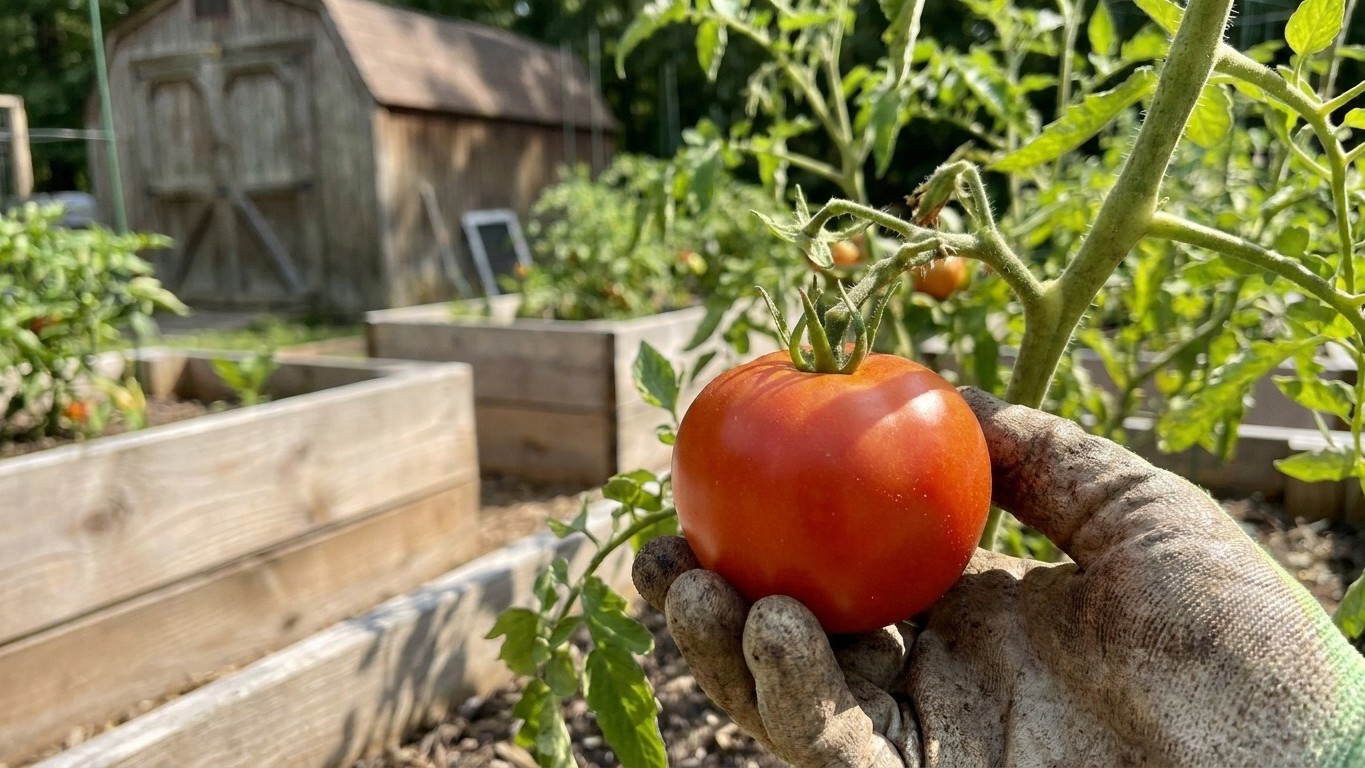

Seventy to seventy-two days, counted from transplant, not from the seed tray — that’s the number that governs a Celebrity Plus, and it’s easy to miscount if you’re working off a seed packet’s timeline instead of the day seedlings actually went into the ground. The plant is determinate, bred to stop at a set size and ripen its 7 to 9 ounce slicers in one concentrated push rather than a slow trickle all summer.
What Celebrity Plus actually is

Celebrity Plus matures in about 70 to 78 days from transplant, not from the day you sowed seed indoors. That distinction matters because seed packets sometimes get read as a sowing-to-harvest count, and the six to eight weeks a Celebrity Plus seedling spends under lights before it goes in the ground add real time to the calendar. If you started seed in early spring and set transplants out after your last frost, count the 70 to 78 days from that transplant date, not from the seed tray.
The plant itself is determinate, sometimes labeled semi-determinate in seed catalogues. That means it grows to a set size, stops extending new stems once flower clusters form at the tips, and ripens most of its crop over a compressed window rather than trickling out fruit for months. A determinate plant still benefits from a cage or stake, because a Celebrity Plus loaded with fruit is top-heavy and prone to splitting branches in wind, but it does not need the constant pruning and tying that an indeterminate vine demands.
Fruit is a classic slicer: red when ripe, round, smooth-skinned, and weighing in the 7 to 9 ounce range per the catalogue description. That size makes it good for sandwich slices and general kitchen use, and the concentrated ripening of a determinate plant suits a grower who wants a batch of tomatoes for canning or sauce rather than a handful every few days all summer. If you’re weighing it against other tomatoes for the garden, the broader Tomato Varieties guide breaks down habit and maturity across dozens of cultivars side by side.
What Celebrity Plus is good for
Celebrity Plus is bred and sold as a slicing tomato, and that classification tells you how the flesh is built before you ever cut into one. Slicers carry more water in the fruit and looser, more open interior walls than a paste tomato, which packs its cells with dense flesh and comparatively little juice. That density is what lets a paste tomato collapse into a thick sauce on its own; the water cooks off fast because there wasn’t much to begin with. A slicer like this one runs the opposite way: cut it and juice releases immediately, which is exactly why it makes a good sandwich or burger topping but a poor candidate for the stockpot. Put a few pounds of it in a saucepan and you’ll spend an hour boiling off water before anything thickens, and you’ll still be working around seed gel and skin that a paste variety sheds more easily.
That same open, juicy structure is what makes it work raw. A round slice holds together on a plate or between bread without collapsing, and the fruit’s 7 to 9 ounce size means one slice can cover a full sandwich without cutting a second tomato. It also works diced into a salad, where the juice that’s a liability in a sauce pot is just part of the bite.
No specific flavor claims are published for Celebrity Plus beyond its classification as a standard red slicer, so treat sweetness or acidity as unknown until you’ve grown and tasted it yourself rather than assuming a house flavor profile from the catalog description.
What it is not suited for is canning down into paste or sauce as a primary crop; the yield of usable solids per pound will be low compared to a dedicated paste tomato, and the extra stovetop time isn’t offset by better flavor from this variety specifically.
Where it ripens in time, and where it is a gamble
A 70-day tomato needs a frost-free window that covers three things: the two or so weeks after the last frost before soil is reliably warm enough to set transplants without a setback, the roughly 70 days to first ripe fruit, and then whatever days remain for actually picking before the first fall frost. Subtract the first two from your area’s frost-free window and what is left is your picking margin. A margin under thirty days means a single flush of fruit, and a cool year can wipe it out before you get much of a harvest.
Where the margin runs thin
In Yukon, the Whitehorse station shows a margin of negative 11 days for a full-season tomato, meaning the first ripe fruit would land after the first frost has already hit. Celebrity Plus, being a week or two faster than many slicers, narrows that gap slightly, but it does not close it, and Whitehorse also falls well short of the accumulated seasonal warmth a tomato plant needs regardless of frost timing. This is a greenhouse or high tunnel crop there, not an open-garden one.
Northwest Territories, measured at Yellowknife, and Alberta, measured at Calgary, both come out with a margin in the mid twenties: 24 days at Yellowknife and 26 days at Calgary. That is enough for one solid flush of fruit from a plant set out in early June and first ripening in late August, but not enough cushion for a cold snap that delays ripening by a week. Manitoba’s Winnipeg station and Saskatchewan‘s Saskatoon station land in similar territory, both graded a greenhouse-leaning verdict because accumulated warm-season heat runs short even though the frost-free window itself is workable.
Where the margin is generous
Further south the arithmetic stops being the limiting factor at all. Washington, measured at Seattle, shows a 148-day margin with transplants going out in mid March to early April and first ripe fruit by mid June. Texas, measured at Houston, and Nevada, measured at Las Vegas, run margins past 180 and 200 days respectively, transplanting as early as mid February in Houston and late January in Las Vegas. At that point the question stops being whether the season is long enough and becomes whether the middle of it gets too hot, which the next section covers.
| Territory | Reference station | Margin | Verdict |
|---|---|---|---|
| Yukon | Whitehorse | -11 days | Impossible outdoors |
| Northwest Territories | Yellowknife | 24 days | Risky, one flush |
| Manitoba | Winnipeg | 30 days | Greenhouse-leaning |
| Washington | Seattle | 148 days | Comfortable |
| Texas | Houston | 183 days | Comfortable, two seasons |
| Nevada | Las Vegas | 218 days | Comfortable, two seasons |
The two ways a season goes wrong
A frost table only tells you when the killing cold arrives. It says nothing about two other limits that can end a tomato season just as effectively.
Not enough accumulated warmth
In the far north, a frost-free window can look adequate on paper while the total heat accumulated over that window still falls short of what a tomato plant needs to grow and ripen fruit at all. Yellowknife and Calgary both fall into this category: the calendar days between frosts are workable, but the plant spends much of that window in cool conditions that slow growth regardless of frost risk. Fruit set also stops when nighttime temperatures drop below 50°F, which happens more often at the shoulders of a short northern season than gardeners expect. For Celebrity Plus, whose main advantage is a fast 70-day maturity, this cold-slowdown risk matters more than frost timing itself in these regions, because the plant can be racing a season that never gets warm enough to let it finish, not just one that ends too soon.
Too much heat in the middle
Further south, the opposite problem takes over. Once daytime temperatures push past roughly 86°F, tomato pollen loses viability and flowers drop without setting fruit, which is why growers in South Carolina, Florida, and Texas plan for a spring crop and a separate autumn crop rather than one continuous summer of harvest. Celebrity Plus’s short 70-day maturity is actually an advantage here: a grower in Houston or Charleston can get a full crop off the plant before the hottest weeks shut down flowering, then set a second round of transplants for a fall harvest once temperatures ease. In these regions, heat sterility is the limit that matters, not frost or accumulated warmth, and matching your transplant date to dodge the hot stretch is worth more than any other single decision.
What it resists, and what it does not
Celebrity Plus carries high resistance to Fusarium Wilt races 1 and 2 and to Fusarium Crown and Root Rot, both graded high by the breeder rather than intermediate. That distinction is worth understanding even when both ratings on this variety happen to be high: an intermediate rating on any tomato means the plant slows a disease’s progress and reduces its severity, not that the plant is immune to it. A high rating is the stronger of the two, and it is the reason Celebrity Plus performs well in soil with a known fusarium history where other slicers decline mid-season.
What the catalogue does not list matters just as much. Celebrity Plus’s published resistance covers those two fusarium pathogens and nothing else, so common foliar diseases like early blight, late blight, and septoria leaf spot are not addressed by the plant’s genetics at all. In a wet season or in a garden with a history of foliar disease, this variety needs the same fungicide rotation, mulching, and lower-leaf pruning that any unprotected tomato needs.
- Protected: Fusarium Wilt races 1 and 2, Fusarium Crown and Root Rot
- Not protected: early blight, late blight, septoria leaf spot, bacterial spot
Growers dealing with soilborne disease pressure sometimes compare this variety against heirlooms with little to no built-in resistance, such as the Cherokee Purple, which trades that protection for flavor and a longer indeterminate season.
Growing it without the usual mistakes
Because Celebrity Plus is determinate, the support and feeding plan needs to look different from what works for an indeterminate vine. Cage it early and cage it wide rather than tying it to a single stake, since the plant branches out rather than climbing, and a narrow support forces stems to bend and break once fruit weight builds up. Space plants with enough room for that lateral spread, tighter spacing than an indeterminate variety needs is one of the more common mistakes gardeners carry over from other tomatoes.
Feeding and the concentrated harvest
Stop heavy nitrogen feeding once the first fruit clusters have set. A determinate plant that gets pushed with nitrogen late in the season puts energy into leaf growth it no longer needs, at the expense of the fruit it is already carrying, and Celebrity Plus’s whole appeal is a full, timely flush rather than a longer season of smaller pickings. A balanced feed at planting and one follow-up once fruit is sizing is usually enough.
The timing mistake specific to this variety is treating it like a season-long producer and planting only one round. Because the harvest arrives in a compressed window rather than trickling out, a single planting gives you a big batch of tomatoes over a couple of weeks and then a plant that is largely finished. Where the season allows it, as it does across the warmer margins discussed above, a second staggered planting two to three weeks after the first extends fresh slicers further into the season instead of leaving a gap. Gardeners who want a variety built for that steady trickle instead of a concentrated flush might look at an indeterminate option like Blue Tonic, which keeps producing until frost rather than finishing in one main harvest.
Common questions
Is Celebrity Plus the same as regular Celebrity?
No, Celebrity Plus is a distinct release from the standard Celebrity hybrid, marketed with the same general fruit size and determinate habit but sold as its own line by seed companies. Check the specific seed packet for that season’s listed days to maturity and disease resistance codes, since catalogue descriptions can shift slightly between releases.
Can I grow Celebrity Plus in containers?
Yes, its determinate, compact habit makes it a reasonable container candidate compared to a sprawling indeterminate variety. Use the largest container practical, since root volume still drives fruit size and yield even on a compact plant, and expect to water more often than an in-ground planting through hot stretches.
Why did my Celebrity Plus stop setting fruit in midsummer?
The most likely cause is heat, not disease. If daytime temperatures in your area regularly climb past the mid-80s Fahrenheit during that stretch, pollen viability drops and flowers fail to set fruit until temperatures ease, which is exactly the pattern growers in hot Southern regions plan around with separate spring and fall plantings.
Do I need two Celebrity Plus plants to get fruit?
No, tomatoes are self-fertile and a single Celebrity Plus plant will set fruit on its own without a second plant nearby. Poor fruit set is almost always a temperature or pollination-activity issue, such as too few pollinators or nighttime temperatures below the range fruit set needs, rather than a lack of a second plant.