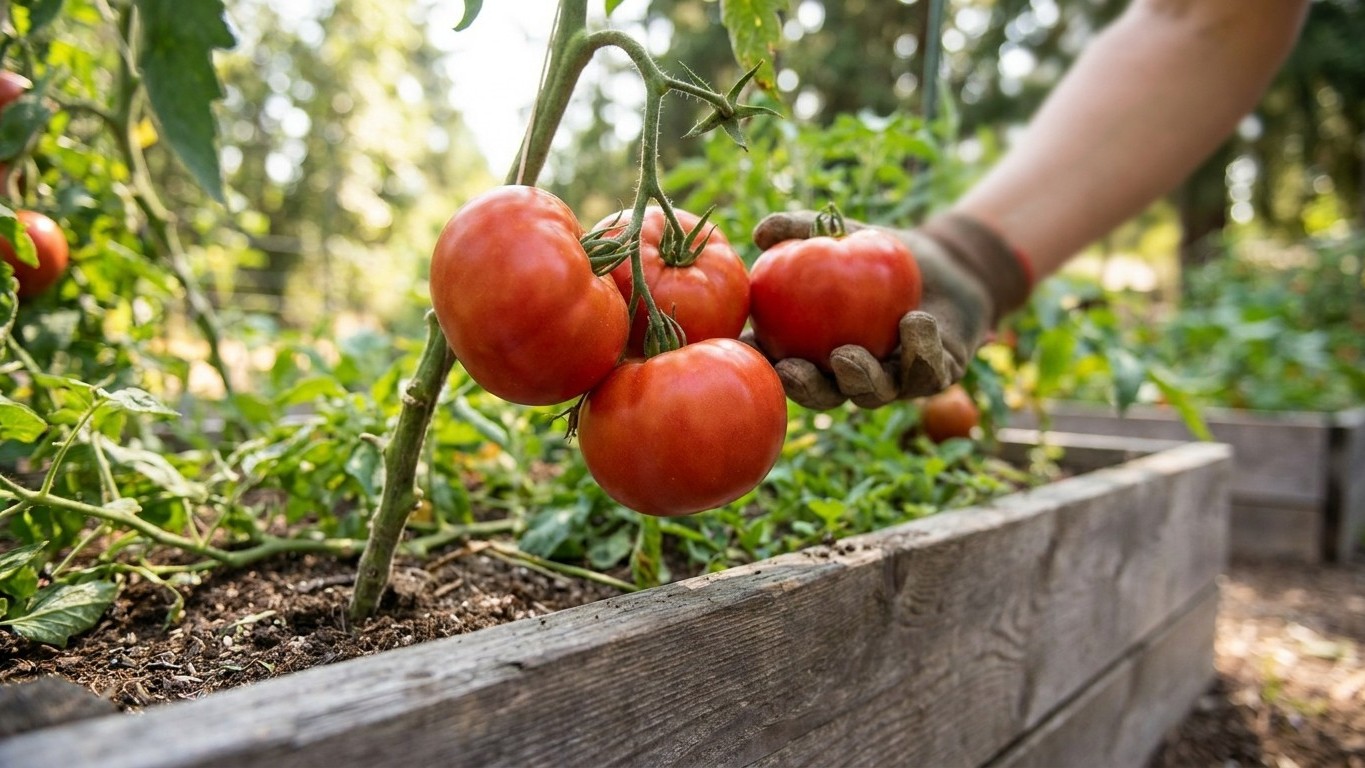

Siletz is a determinate slicing tomato bred for cool, short summers, and most seed catalogs list it at about 75 days from transplant to first ripe fruit. Because the plant sets nearly all its crop in one flush rather than trickling fruit until frost, getting the transplant date right decides whether you get a full basket or a handful of green tomatoes. Check your area’s frost-free window before you pick a transplant date, and count the 75 days from the day you set plants in the ground, not from the day you started seed.
What Siletz actually is

Siletz is a determinate tomato, meaning the plant grows to a set size, roughly three to four feet, sets its flower clusters over a few weeks, and then largely stops producing new growth once fruit is set. That habit is the whole reason it exists: it was bred to get a full-size slicing tomato ripe before a short growing season runs out. Most catalog listings put Siletz at about 75 days from transplant to first ripe fruit, and that count starts the day you move seedlings into the garden, not the day you sowed seed indoors. Catalog day counts also shift by a week or so depending on how warm the season runs, so treat 75 days as a target, not a guarantee.
Habit and fruit
The fruit is a true slicer: round, deep red at maturity, smooth-skinned, and running eight to twelve ounces, big enough for a sandwich without the watery texture some early varieties have. Because the plant is determinate, it puts most of its energy into that one wave of fruit rather than sending out new flowering branches all season. Unlike indeterminate slicers such as Stupice, which keeps producing new trusses until frost, Siletz concentrates nearly its whole harvest into a window of two to three weeks. That makes it a good choice for a gardener who wants one big canning or slicing push rather than a trickle of tomatoes all summer. For a wider comparison of habit and days to maturity across other slicers, the full guide to tomato varieties lays out how determinate and indeterminate types differ in practice.
What Siletz is good for
Siletz is built for the cutting board, not the sauce pot. A slicing tomato carries its seeds in open, juice-filled cavities surrounded by wide bands of flesh, and that structure is exactly what you want under a knife: a clean round disc that sits flat on bread or in a stack without collapsing. The same structure works against you in a saucepan. High water content means a batch of Siletz reduces slowly, releasing liquid that has to simmer off before the sauce thickens, so it will make a workable sauce but not a fast or economical one compared to a paste tomato bred for dense, dry flesh and few seed cavities.
The 8-to-12-ounce size and smooth skin suit the obvious raw uses: sandwiches, burgers, a plain plate with salt, gazpacho where you want body rather than a jammy melt. It’s large enough that one fruit covers a slice of bread with little waste, which is the main practical advantage size gives you over a cherry or small salad tomato.
Because the plant is determinate and ripens most of its crop in a two-to-three-week window, the kitchen decision Siletz forces on you isn’t really about texture, it’s about volume: you get a short stretch of many ripe tomatoes at once rather than a trickle across the summer. That favors canning, freezing, or giving fruit away in that window over planning meal-by-meal use, even though the flesh itself is better suited to fresh eating than to cooked-down preserves.
No flavor profile for Siletz is documented in available variety descriptions, so nothing beyond what the slicing category implies — juicy, moderate acidity typical of a red slicer — can be stated here.
Where it ripens in time, and where it is a gamble
A 52-day tomato does not need a long season, but it still needs the season to line up correctly. The number that matters most is not the length of your frost-free window on its own, it is what is left after you subtract two things: the two weeks or so most gardeners wait after last frost to let the soil warm before setting tomato transplants, and the 75 days Siletz needs to ripen its first fruit. Whatever days remain after that is your margin, the buffer between your first ripe tomato and your first fall frost. A margin under thirty days means one bad, cool year and you lose the crop before it ripens at all.
The tight margins
At the tight end, the arithmetic simply does not work. In Yukon, using Whitehorse as the reference station, gardeners transplanting in mid June see first ripe fruit only in early September, which lands about eight days after that station’s average first frost. That is a negative margin: the tomato would still be green when frost hits. Nunavut, reckoned from Rankin Inlet, is only slightly better, short by about three days even with a July transplant. Neither location gets enough accumulated summer heat to finish the job even where the calendar window looks close, which is why open-ground tomatoes are not a realistic project there without a greenhouse or high tunnel.
Move one province over and the picture improves but stays uneasy. Alberta, measured at Calgary, gives Siletz about 29 days of margin after an early June transplant, enough for one real flush of ripe fruit but not much insurance if the summer runs cool. Manitoba, at Winnipeg, does slightly better at 33 days, but the accumulated heat over the season there runs close to the edge of what a tomato needs regardless of how many frost-free days are on the calendar, which is why growers in that band often start Siletz under plastic mulch or row cover rather than relying on the open frost-free window alone.
The comfortable margins
At the wide end, the margin stops being the limiting factor at all. Washington, using Seattle as the reference station, carries about 151 days of margin after a mid-March to early-April transplant, more than enough room for Siletz to ripen and then keep cropping through the rest of a mild summer. Further south, Texas, at Houston, and Louisiana, at New Orleans, post margins above 180 days. In those regions the question is not whether Siletz has time to ripen, it is whether the middle of the season gets too hot for it to keep setting fruit, which the next section covers.
| Territory | Reference station | Set out | First ripe | Margin | Verdict |
|---|---|---|---|---|---|
| Yukon | Whitehorse | Mid June | Early September | -8 days | Impossible outdoors |
| Nunavut | Rankin Inlet | Early July | Mid September | -3 days | Impossible outdoors |
| Alberta | Calgary | Early June | Mid August | 29 days | Risky, one flush |
| Manitoba | Winnipeg | Early June | Mid August | 33 days | Greenhouse or mulch helps |
| Washington | Seattle | Mid March to early April | Mid June | 151 days | Comfortable |
| Texas | Houston | Mid February to mid March | Late May | 186 days | Comfortable |
| Louisiana | New Orleans | Early February to late February | Early May | 223 days | Comfortable |
The two ways a season goes wrong
A long frost-free window does not guarantee a good tomato season, and a short one does not always rule it out either. Two limits sit underneath the frost calendar that a simple date range cannot show.
Cold summers: heat that never adds up
Tomatoes need a running total of warm days, not just an absence of frost, to move from flower to ripe fruit, and that total is usually measured in growing degree-days. The Northwest Territories, at Yellowknife, and Alberta both post positive frost-free margins on paper, yet their season-long heat totals, around 905 and 1171 degree-days respectively, sit well below what a tomato needs to finish reliably. Nights below roughly 50°F also stop pollen from working properly, so even a plant that survives the season may set poorly through a run of cool nights. This is the limit that matters most for a variety like Siletz in the northern half of its range, more than the calendar date of first frost.
Hot summers: pollen shuts down
Above roughly 86°F, tomato pollen stops working and flowers drop without setting fruit, which is why gardeners in South Carolina, Florida, Texas, Nevada, and Louisiana run a spring crop and a separate fall crop rather than one continuous season. Siletz’s short 52-day count actually works in its favor here. A gardener in Houston who transplants in the middle of the February-to-March window sees ripe fruit in late May, weeks before the June-to-September stretch when Gulf Coast heat routinely shuts pollen down. The determinate habit that limits Siletz to one flush in the north becomes an advantage in the deep South, where finishing fast means dodging the worst of the heat rather than sitting through it.
What it resists, and what it does not
Siletz is an open-pollinated variety, and most seed catalogs list no disease-resistance codes for it, unlike hybrid slicers that carry letters such as V, F, or N for verticillium, fusarium, or nematode resistance. That does not mean it is unusually fragile, it means the catalog record simply does not credit it with the bred-in resistance that some newer hybrids carry, and you should not treat it as protected against anything it has not been tested for.
What the catalog does list
What catalogs do note consistently is Siletz’s tolerance for cool, wet spring conditions, which lines up with its origin as a variety bred for the cool coastal summers of the Pacific Northwest. That tolerance is about fruit set and growth in cool weather, not about resistance to a named pathogen, so do not confuse the two.
What it does not
In practice this means Siletz is exposed to the same common foliage diseases as any unprotected slicer, including early blight and septoria leaf spot, both of which spread fastest in wet, humid conditions with poor airflow. Since the plant is determinate and relatively compact, staking it to keep foliage off the soil and spacing plants for airflow does more practical good than any resistance the plant does not have. If foliage disease has been a recurring problem in your garden, rotate the bed and avoid overhead watering rather than counting on the variety itself to shrug it off.
Growing it without the usual mistakes
Siletz’s determinate habit changes the plan compared with a sprawling indeterminate slicer, and the mistakes gardeners make with it are specific to that habit rather than generic tomato trouble.
Staking and spacing
Because the plant tops out at a modest three to four feet and sets its fruit over a few weeks rather than all season, a standard cage handles it fine. You do not need the heavy stake-and-tie system a six-foot indeterminate demands, but you do want a cage in place before the plant fills out, since determinate varieties branch densely and a cage set on afterward means fighting through foliage. Do not prune suckers the way you would on an indeterminate variety. Removing side shoots on a determinate tomato cuts into the branching that carries most of its single flush, and the usual advice to keep pinching side growth all season actively reduces your harvest on this plant.
Feeding and the one mistake
Stop heavy nitrogen feeding once the first fruit sets. A determinate plant is not going to reward extra feeding with a longer season the way an indeterminate one might, since it has already committed to one wave of growth, and pushing more nitrogen after fruit set tends to produce leafy growth at the expense of the fruit already sizing up. The other mistake worth naming is treating the harvest window as flexible. Because nearly the whole crop ripens over two to three weeks, a gardener who is away or unprepared during that stretch can lose a meaningful share of the season’s tomatoes to overripe fruit splitting on the vine. If you want to spread the workload and the eating season, pair Siletz with a later slicer like Harvest Moon, whose golden fruit ripens on its own schedule and fills the gap after Siletz’s flush is done.
Common questions
Is Siletz determinate or indeterminate?
Siletz is determinate. It grows to a set size, sets nearly all its fruit within a few weeks, and then tapers off rather than producing new trusses until frost the way an indeterminate variety does.
Can I start Siletz from seed and still hit the days-to-maturity number?
The days-to-maturity figure is counted from the transplant date, not the sowing date, so seed-starting time is separate. Most tomato seedlings need several weeks indoors before they are ready to transplant, and that time does not count against the 52-day figure, it happens before the clock starts.
Why did my Siletz plants stop setting fruit in the middle of summer?
In hot regions, pollen stops functioning properly once temperatures climb above roughly 86°F, and flowers drop without setting fruit. This is normal in the deep South during peak summer, which is why growers there plant a spring crop and a fall crop instead of expecting one continuous harvest.
Does Siletz need a greenhouse in a short-season climate?
Not necessarily, but it depends on how much accumulated summer warmth your area gets, not just how many frost-free days you have. In places where the season is long enough on the calendar but the total heat runs low, a greenhouse, high tunnel, or black plastic mulch can make the difference between a full flush and a handful of green tomatoes.