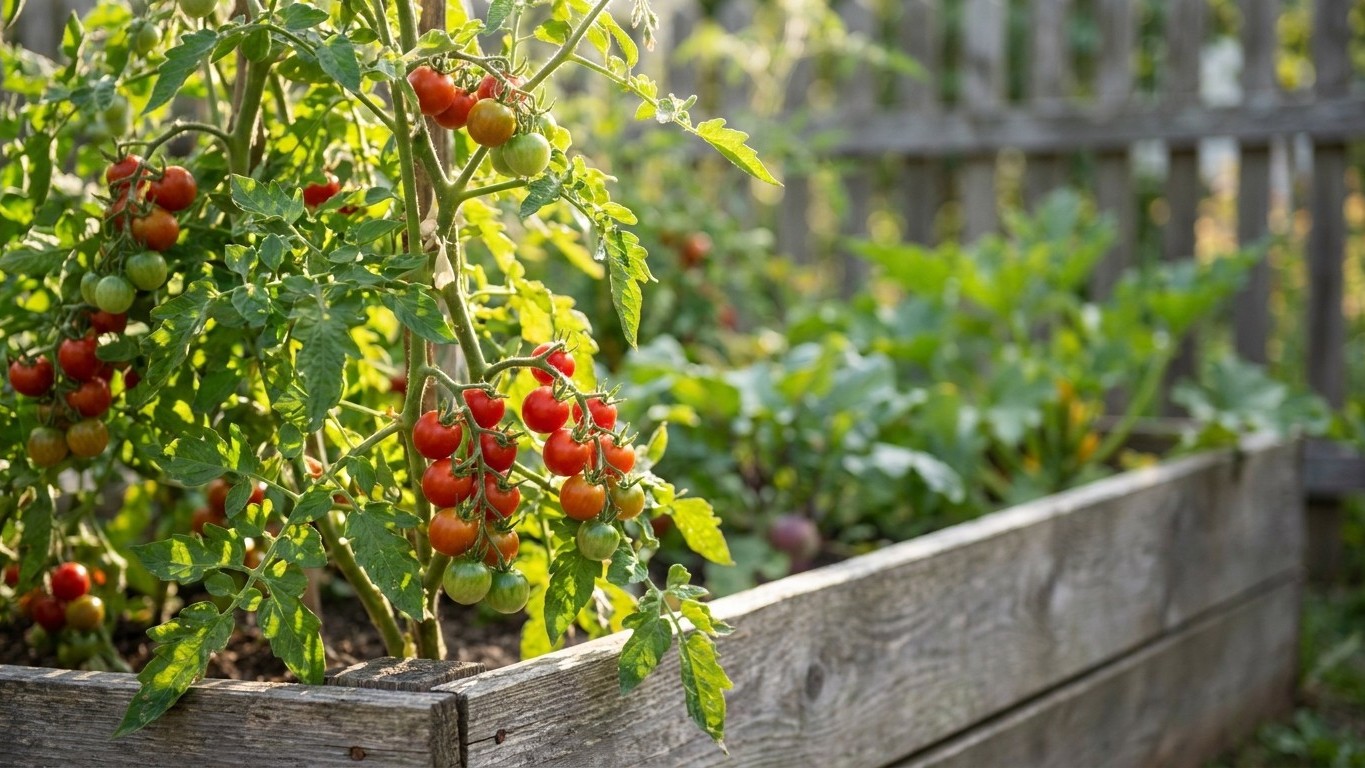

Stupice is an heirloom slicing tomato bred for short, cool seasons, and it ripens in roughly 55 to 65 days from transplant depending on the seed source. That speed is the whole point of growing it: few slicers set fruit and color up as fast once the plant is in the ground. If you garden somewhere with a short frost-free window, check your local last-frost date against that 55 to 65 day window before you choose a later slicer instead.
What Stupice actually is

Stupice is an open-pollinated heirloom, originally selected for cool climates, with an indeterminate growth habit. That means the vine keeps growing and setting new trusses all season instead of ripening in one flush, which is exactly what lets it “Keep Coming Until Frost” rather than dump its whole crop in a two-week window. The foliage is the regular-leaf type on most stock, and the plant sprawls if you let it, so it needs the same staking or caging you’d give any indeterminate vine, just started earlier because the fruit shows up sooner.
Seed catalogs list Stupice at roughly 55 to 65 days to maturity, counted from transplant, not from the day you sowed seed indoors. That distinction matters more here than on a slow beefsteak, because the whole appeal of this variety is shaving weeks off the calendar in a marginal season. The fruit itself is small to medium, round, red when ripe, running about 2 to 3 ounces. What the slicing type implies is thin walls and a high water content, which is why fruit of this shape goes into a salad rather than a pan. It is not a paste tomato and it will not fill a canner the way a San Marzano type will. For a broader look at how different habits and maturities stack up against each other, the Tomato Varieties overview is a useful place to compare Stupice against slower or bushier types before you commit bench space to it.
What Stupice is good for
The flesh here is watery and open rather than dense and meaty, which is the defining trait of a slicing tomato rather than a paste one. Cut it open and juice runs rather than clings, so it needs no reduction time in the pan to lose that water — but that same looseness means it won’t concentrate into a sauce or paste without hours of simmering to boil off liquid a San Marzano never had in the first place. If you put it in a pot expecting it to break down into something thick, you’ll be disappointed; that’s a mechanical limit of the fruit, not a flaw in the plant.
Where that same low density works in its favor is on a plate raw. Cut into rounds, it releases its juice onto bread or into a bowl instead of holding it in, which is exactly what you want for a sandwich or a salad, where you’re eating the tomato as-is rather than cooking the water out of it. The 2- to 3-ounce size already noted means each slice is closer to sandwich-sized than the wide single slab a beefsteak gives you, so plan on a couple of slices per serving rather than one.
Beyond raw eating, no specific culinary use — canning yield, drying behavior, roasting results — has been documented for this variety, and nothing here should be read as implying it excels at those. What can be said reliably follows straight from the category: a slicing tomato’s value is in fresh use, not in the pot, and Stupice fits that pattern rather than departing from it. If your kitchen leans toward sauce and canning, the harvest from this vine is better swapped into salads and sandwiches than forced into a role its flesh isn’t built for.
Where it ripens in time, and where it is a gamble
The arithmetic that decides whether Stupice works in your garden is simple in principle: take the frost-free window, subtract the two or so weeks the soil needs to warm before you can safely set out transplants, then subtract the 55 to 65 days the fruit needs to color up. What’s left is your picking margin, the number of days between first ripe fruit and the average first fall frost. Under thirty days of margin, you’re betting on one flush of fruit surviving whatever the season throws at it, because a cool August or an early frost erases the rest of the crop before it ripens.
Where the margin is thin
In the Yukon, using Whitehorse as the reference station, growers set transplants out in mid-June and see first ripe fruit by late August, which leaves a margin of only about 2 days before frost. That’s not a season, it’s a single wave of fruit that a cool year erases entirely. In Nunavut, Rankin Inlet’s numbers are only slightly better: transplant early July, first ripe fruit early September, a margin of about 7 days. In both places the frost-free window itself isn’t even the whole problem, since accumulated heat over the season falls far short of what a tomato plant wants regardless of how many frost-free days there are, which is why a greenhouse or high tunnel changes the outcome more than any variety choice does.
Where it is comfortably early enough
Move south and the math flips. In Washington, Seattle’s data puts transplant dates from mid-March to early April with first ripe fruit by early June, a margin of roughly 161 days, more than enough to run the plant until frost with room to spare. In South Carolina (Charleston), Florida (Jacksonville), Texas (Houston), Nevada (Las Vegas) and Louisiana (New Orleans), margins run from about 161 to 233 days, verdicts all comfortable. But comfortable margin doesn’t mean uninterrupted production in those states, which the next section explains.
In between sit places like Alberta (Calgary), Manitoba (Winnipeg) and Saskatchewan (Saskatoon), where margins of roughly 39 to 44 days look workable on paper but the verdict still comes back “greenhouse” territory. That’s because a long-enough frost-free window doesn’t guarantee enough cumulative warmth for the plant to actually use it, which the next section covers.
| Territory | Reference station | Margin (days) | Verdict |
|---|---|---|---|
| Yukon | Whitehorse | 2 | Risky, one flush only |
| Nunavut | Rankin Inlet | 7 | Risky, one flush only |
| Alberta | Calgary | 39 | Greenhouse recommended |
| Manitoba | Winnipeg | 43 | Greenhouse recommended |
| Washington | Seattle | 161 | Comfortable |
| Louisiana | New Orleans | 233 | Comfortable, but split by summer heat |
The two ways a season goes wrong
A frost table only measures one thing, the gap between the last spring freeze and the first fall one. It says nothing about whether the days in between actually have enough warmth in them, and it says nothing about heat that’s too intense for pollination. Both limits apply to Stupice, but in opposite directions.
In the northern Territories, the frost-free window can look adequate while the accumulated warmth underneath it is short. Alberta and Manitoba both carry a “greenhouse” verdict despite margins of nearly six weeks, because the season’s cumulative heat runs thin even where frost holds off long enough on paper. Below roughly 50°F at night, tomato flowers stop setting fruit regardless of how many frost-free days remain on the calendar, so a string of cool nights in July can cost a Prairie garden more fruit than an early frost would.
In the hot southern states, the opposite problem shows up in mid-summer. Once daytime temperatures push past roughly 86°F for a stretch, tomato pollen goes sterile and blossoms drop without setting fruit, which is why Gulf Coast and desert Southwest growers plant twice, once for a spring crop and again for a fall one, instead of running one long season through the hottest months. Charleston, Jacksonville, Houston, Las Vegas and New Orleans all carry this caveat even with margins well over 150 days.
For Stupice specifically, given how early it matures, the northern cold-set problem matters more than the southern heat problem. A 55 to 65 day tomato is exactly the tool you want to dodge a short warm season, but it can’t manufacture heat units that aren’t there, and a grower in Calgary or Winnipeg gets more out of a cold frame or plastic mulch than out of switching varieties again.
What it resists, and what it does not
Stupice is an heirloom, and heirlooms mostly predate the disease-resistance breeding that put letter codes like V, F, N or T on modern hybrid seed packets. Seed catalogs generally list no formal disease-resistance codes for Stupice, and you should read that as an honest gap rather than an oversight: this variety was selected for earliness and cold tolerance in its native Czechoslovakia, not for resistance to the fungal and bacterial diseases that trouble American gardens.
What growers do report, informally rather than as a graded resistance, is decent tolerance of cool, damp spring conditions during establishment, which fits its breeding history. That is not the same thing as resistance to early blight or late blight, both of which can hit an unprotected Stupice plant just as hard as they hit any other tomato once the foliage stays wet for long stretches. If your garden has a history of foliar disease, plan on the same fungicide rotation, drip irrigation and pruning for airflow you’d use on any susceptible variety, because this one won’t cover for you.
The practical risk to flag for new growers is assuming an heirloom with a good early-season reputation is automatically tougher than a modern hybrid. It usually isn’t. Varieties bred more recently, like Jolene, carry graded resistance to specific diseases printed right on the packet. Stupice earns its keep on speed and flavor, not on a disease-resistance package, so treat leaf spotting or wilting on this plant as seriously as you would on any unprotected variety.
Growing it without the usual mistakes
Support and spacing
Because Stupice is indeterminate, it needs the same ongoing support an indeterminate vine always needs: a stake driven at planting time, or a sturdy cage, tall enough to hold a plant that keeps adding height and trusses all summer. The mistake growers make with early varieties is treating them like a determinate bush because the first fruit shows up so fast, then watching the unsupported vine collapse under its own weight in July once it’s still growing strong two months after the “early” fruit already ripened.
Feeding and the timing trap
Stop heavy nitrogen feeding once flowering starts in earnest, the same rule that applies to any tomato, but it matters more here because Stupice’s whole advantage is early fruit set. Pushing leafy growth with extra nitrogen right when the plant should be setting its first trusses delays the one thing you grew this variety for. A balanced feed at transplant, then a lighter hand afterward, keeps the plant setting fruit on schedule instead of bulking up foliage.
The particular trap of an early variety
The timing mistake specific to Stupice is planting it out too early because it’s marketed as cold-tolerant. Cold-tolerant at the seedling stage does not mean frost-proof, and a late cold snap after transplant can still set the plant back weeks, erasing the earliness advantage you planted it for in the first place. Wait for the same soil-temperature and frost signals you’d use for any tomato, and let the variety’s speed do the work after that rather than trying to force it earlier. Growers comparing habit and timing across varieties, including slower heirlooms like San Marzano II, will notice the same rule holds across the board: earliness on the seed packet is not the same as frost tolerance in the ground.
Common questions
Is Stupice determinate or indeterminate?
Indeterminate. It keeps growing and setting new fruit trusses through the season rather than ripening all at once, which is why it needs staking or caging like any vining tomato rather than the shorter support a bush type needs.
How does Stupice compare to Early Girl for a short season?
Both are marketed as early tomatoes, but Stupice’s catalog range of 55 to 65 days from transplant sits at or below most Early Girl listings, and Stupice is open-pollinated rather than a hybrid, so you can save seed from it. Check the specific packet in hand, since maturity figures shift a little between seed houses and seasons.
Can I grow Stupice in a container?
Yes, but give it a large container and a tall stake or cage, since the indeterminate vine doesn’t stop growing just because its roots are confined. A cramped pot without support tends to produce a sprawling, disease-prone tangle rather than the upright, early-yielding plant the variety is known for.
Why did my Stupice plants stop setting fruit in midsummer?
Most likely heat, if you garden somewhere that regularly tops the mid-80s Fahrenheit in summer, since tomato pollen goes sterile above that threshold and blossoms drop without setting. Cooler nights, especially in the 40s Fahrenheit, cause the same blossom drop from the opposite direction. Either way, the plant usually resumes setting fruit once temperatures come back into its comfort range.