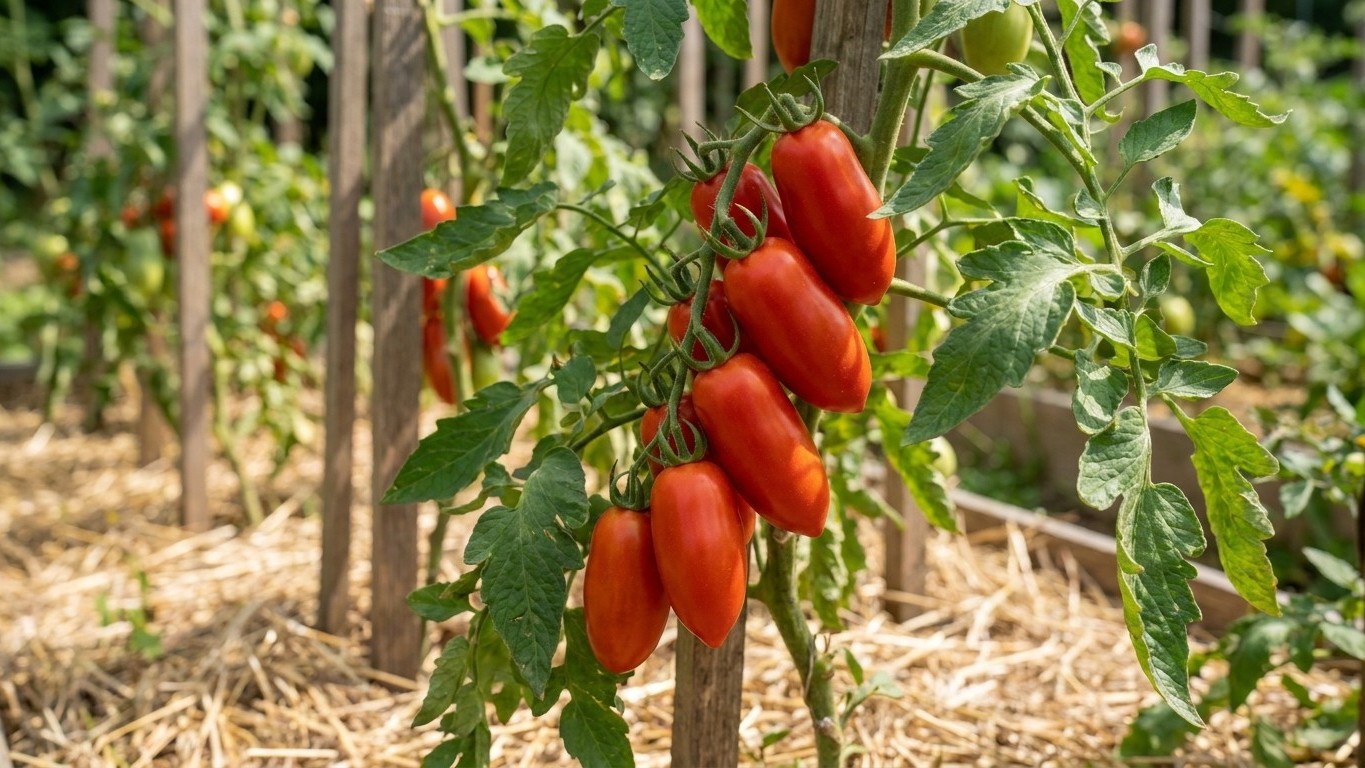

Eighty-five days from transplant, not from seed — that’s the number San Marzano II runs on. Start seed indoors three to five weeks before your last frost date, then move seedlings out once nights hold steady warmth, and count the harvest clock from that moment forward. This is an indeterminate vine, so it won’t stop at one flush: it keeps flowering and setting fruit clear through summer until frost, disease, or neglect finally shuts it down.
What San Marzano II actually is

San Marzano II is a modern selection of the classic Italian canning tomato, kept as an indeterminate vine that keeps growing, flowering and setting new trusses of fruit until frost, disease or neglect stops it. That is a different plant to manage than a determinate variety that sets one flush and quits. Before comparing it to anything else, it helps to see where it sits among the wider spread of tomato varieties by habit and maturity, since that decides how much staking, feeding and picking you are signing up for.
Seed catalogues list the days to maturity at around 85 days, and that figure is counted from the day you transplant a started seedling into the garden, not from sowing. Sowing indoors typically adds three to five weeks before a plant is ready to go out, so the real span from seed packet to first ripe fruit runs closer to four months. Catalogue figures also shift by a week or two either side depending on the season, so treat 85 days as a working estimate rather than a fixed countdown.
The fruit itself is the classic paste shape: elongated, blunt-ended, thick-walled and meaty with relatively little seed cavity, which is exactly what makes it good for sauce, canned whole or as a paste base rather than for slicing. Unlike a determinate slicer such as Celebrity Plus, San Marzano II does not ripen a single heavy crop and stop. It trickles fruit over the whole warm season, which changes both how you plan your canning days and how much support the vine needs by August.
What San Marzano II is good for
The fruit’s thick walls and small seed cavity mean there is less water to cook off and more solid flesh left behind once it is. That is the whole reason paste tomatoes exist as a category: a sauce made from them thickens on its own, without an hour of simmering to boil away liquid, and canning jars fill with flesh rather than juice. San Marzano II was bred for exactly that job, and the shape and structure described in the fruit itself are what deliver it, not any special trick of variety.
That same density works against it raw. A tomato with little water and a small seed cavity is a tomato with less of the juice and gel that carry sweetness and acidity to the tongue in a fresh slice, which is why paste types are rarely the ones anyone reaches for in a salad or on a sandwich. If you want a tomato to eat raw, that is a different structural problem, solved by a different shape of fruit, and San Marzano II is not built to solve it. Treat it as a cooking tomato and it will not disappoint you; treat it as a slicer and it will.
Beyond sauce and canning, the same qualities extend to anything that concentrates the fruit rather than serving it fresh: oven-roasting, passata, paste itself. As an heirloom, it also carries the seed-saving and open-pollination traits that go with that category, which matters if you plan to grow it again from your own seed rather than buy new stock each year, though how it will taste against other paste varieties side by side is not something documented here and should not be assumed one way or the other.
What it means for the kitchen: buy or grow this if the destination is a pot on the stove, not a cutting board.
Where it ripens in time, and where it is a gamble
An 85-day tomato needs a frost-free window generous enough to hold three things: the two or so weeks the soil needs to warm before it is worth transplanting, the roughly 85 days to first ripe fruit, and a stretch of picking days afterward before frost cuts the vine down. Subtract those from your local frost-free season and what is left is your margin. Under about thirty days of margin means one flush of fruit and a single cool year takes the rest of the crop with it.
Where the margin runs out
At the tight end, Yukon, measured at the Whitehorse station, comes up eleven days short: the first ripe fruit would arrive after the first frost, so the arithmetic never closes in open ground. Nunavut, at Rankin Inlet, is short by about six days on the same math. In both places the deeper problem is not just the frost date but accumulated warmth over the season, which sits far below what a fruiting tomato needs regardless of how long the frost-free stretch runs. A greenhouse or high tunnel is what closes that gap, not a different planting date.
Alberta, measured at Calgary, and the Northwest Territories, measured at Yellowknife, both land around 24 to 26 days of margin with a June setout and a late-August first ripe fruit. That is enough to get a crop most years, but it is a single wave and a cold August takes a chunk of it. Manitoba (Winnipeg) and Saskatchewan (Saskatoon) sit just past that, around 30 to 31 days of margin, but their season’s accumulated heat is described as marginal even so. Growers there lean on plastic mulch to warm the root zone faster and often pick the earliest-maturing strain of a variety rather than the standard one.
Where the season is generous
Further south the arithmetic stops being the limiting factor at all. Texas, at Houston, shows about 183 days of margin with setout in mid-February to mid-March and first ripe fruit by early June. Louisiana, at New Orleans, runs even wider at roughly 220 days. In both places the frost window is never the problem. Something else becomes the limiting factor instead, and that is the subject of the next section.
| Territory (station) | Verdict | Margin | Set out | First ripe |
|---|---|---|---|---|
| Yukon (Whitehorse) | Impossible in open ground | -11 days | Mid June | Early September |
| Nunavut (Rankin Inlet) | Impossible in open ground | -6 days | Early July | Mid September |
| Alberta (Calgary) | Risky, one flush | 26 days | Early June | Late August |
| Saskatchewan (Saskatoon) | Marginal, greenhouse helps | 31 days | Early June | Mid August |
| Texas (Houston) | Comfortable | 183 days | Mid Feb to mid March | Early June |
| Louisiana (New Orleans) | Comfortable | 220 days | Early to late February | Mid May |
The two ways a season goes wrong
A long frost-free window on paper does not guarantee a good tomato season, and San Marzano II’s 85-day habit runs into two different failure modes depending on where you garden.
The cold-country problem
In short-season territories, the number that matters most is not the count of frost-free days but the total accumulated warmth across the season. A stretch of mild but not hot days can hand you a long frost-free window with too little cumulative heat to push an 85-day paste tomato to ripeness. On top of that, tomato flowers generally will not set fruit once night temperatures drop below 50F, which happens early in the season and again late in short-summer territories, effectively narrowing the real fruiting window on both ends even though the calendar shows a longer gap between frosts. For an 85-day vine like San Marzano II, this is the dominant risk in the northern part of its range, more than the frost date itself.
The hot-country problem
Further south, the limit flips. Once daytime and nighttime temperatures push past roughly 86F, tomato pollen goes sterile and flowers drop without setting fruit, which is why territories like Texas, Louisiana and South Carolina effectively run two tomato seasons, a spring crop and an autumn crop, rather than one continuous run. For a vine that keeps flowering all summer the way San Marzano II does, that midsummer gap means a real drop in fruit set for a stretch of months, even though the plant itself survives the heat fine and resumes setting fruit as temperatures ease. Because San Marzano II’s margin in these territories is wide enough to absorb a dead stretch and still finish a second flush before frost, heat sterility costs yield here rather than the crop entirely, which is the opposite trade-off from the cold-country problem.
What it resists, and what it does not
Seed catalogues list San Marzano II with resistance to Fusarium wilt and Verticillium wilt, the two soilborne fungal diseases that otherwise show up as yellowing, wilting foliage working up the plant from the bottom, often on one side first. That resistance is a real, useful trait if you are replanting tomatoes in the same bed year after year, since both pathogens persist in soil for years and a susceptible variety in infected ground can collapse mid-season.
What the catalogue listing does not cover is late blight, early blight or Septoria leaf spot, none of which are listed as resisted traits for this variety. Paste tomatoes with dense foliage and a long indeterminate habit are, if anything, more exposed to these foliar diseases than a compact determinate plant, simply because the canopy stays wet longer and the season gives spores more months to build up. Do not treat the Fusarium and Verticillium resistance as blanket protection: it addresses two specific soil pathogens and says nothing about what happens to the leaves in a wet August. Watch for the classic concentric-ringed spots of early blight starting on lower leaves, and if you garden somewhere humid, plan a fungicide rotation or resistant companion planting the same way you would for any unprotected variety.
Nematode resistance and tobacco mosaic virus resistance, which do appear on some other San Marzano-type listings, are not part of the standard San Marzano II catalogue description either. If nematodes are a known problem in your soil, that is worth checking against your own seed source’s exact listing before you commit a whole bed to this variety.
Growing it without the usual mistakes
San Marzano II’s indeterminate habit means it needs a support structure built for a plant that keeps getting taller and heavier all season, not the short stake that works for a determinate bush. A sturdy cage, a Florida weave, or a single stake retied every couple of weeks all work, but whatever you choose, put it in at transplant, not once the plant has flopped. Roots that have already spread sideways get damaged badly by a stake driven in later.
Staking and spacing
Space plants generously, since a full-season indeterminate vine with dense paste-tomato foliage needs airflow to keep foliar disease down given that it carries no listed resistance to blight or Septoria. Crowded plants in humid climates are the ones that lose their lower leaves to fungal spotting by midsummer, well before the vine has finished its run.
Feeding and the picking window
Feed for steady growth early, then ease off nitrogen once fruit starts setting, the same mistake that costs yield on almost every indeterminate tomato: too much late nitrogen buys you leaves at the expense of fruit. Because this variety fruits continuously rather than in one flush, plan to pick every few days rather than waiting for a single harvest day, and expect the final weeks before frost to bring a rush of fruit that needs canning or freezing quickly rather than sitting on the counter. If you are gardening somewhere with a tight margin, that last flush is exactly the fruit a sudden cold snap can take, so picking slightly underripe and finishing tomatoes indoors is a reasonable trade against losing them outright. If your garden favors a determinate habit instead, something closer to Big Beef‘s support needs will feel more familiar, since that variety carries fruit weight differently across its season.
Common questions
Can I grow San Marzano II in a container?
You can, but its indeterminate habit means it keeps growing all season, so it needs a large container, at least 15 to 20 gallons, and the same sturdy staking or caging it would need in the ground. A smaller pot restricts the root system enough to cut yield noticeably by midsummer.
Why are my San Marzano II fruits cracking?
Cracking on paste tomatoes is almost always uneven watering, usually a dry spell followed by a heavy soak or rain. Keep moisture consistent with mulch and regular watering rather than letting the soil swing between bone dry and saturated.
Is San Marzano II the same as the original San Marzano?
No. San Marzano II is a modern selection bred to add disease resistance, specifically to Fusarium and Verticillium wilts, that the older heirloom San Marzano does not carry. The fruit shape and use are the same, but the plant is more forgiving in soil where those wilts are established.
How many plants do I actually need for a season of sauce?
That depends more on your household’s canning habits than on the variety, but because San Marzano II fruits continuously rather than in one big flush, most gardeners plant more vines than they would of a determinate paste tomato to get a comparable volume on any single canning day. Four to six vines is a common starting point for a family doing multiple batches over a season, adjusted up or down from there.