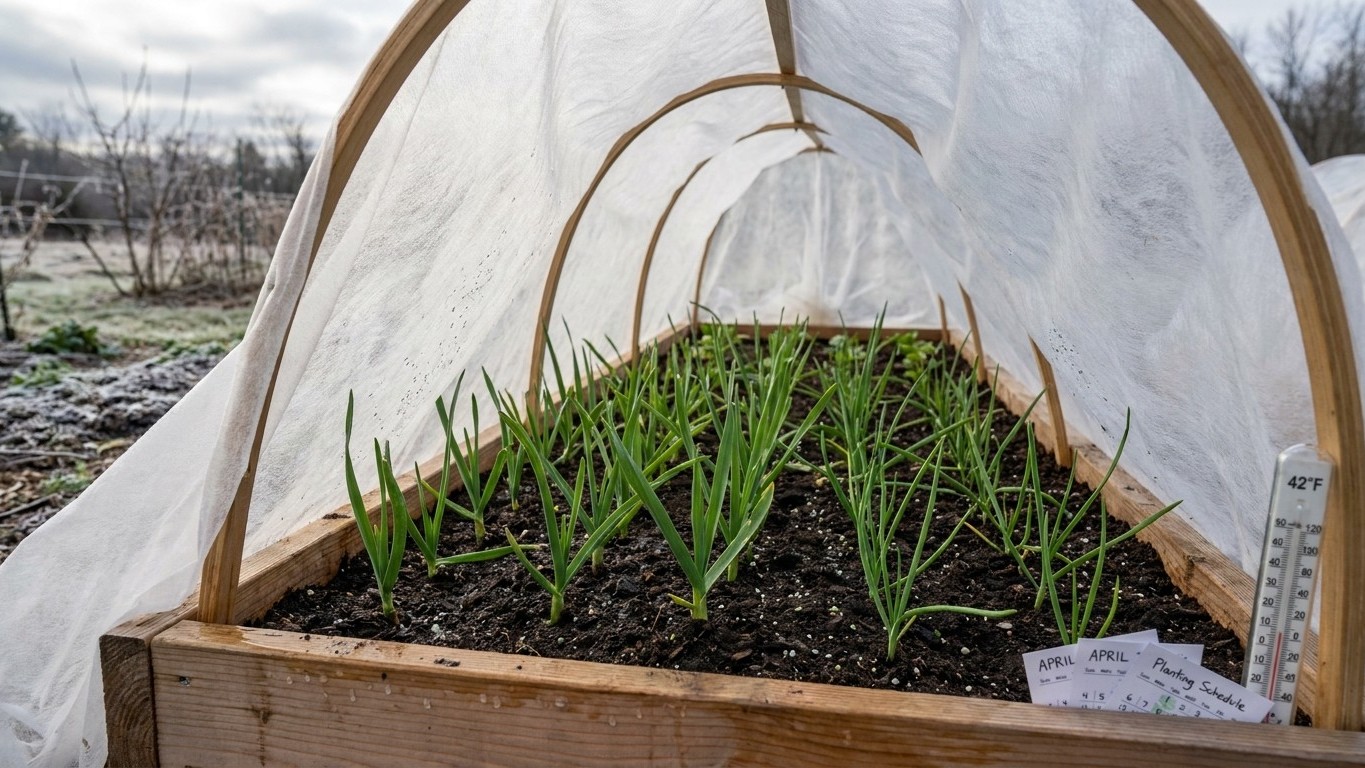

Leek moth shows up in Vermont gardens once the soil warms enough for adult moths to fly and lay eggs, typically a few weeks after the last frost. University of Vermont Extension tracks it locally, and the fix that actually works is timing: row covers installed before the first flight, removed only when the risk window closes.
Reading the calendar from your last frost

Vermont gardeners plan around one date every spring: the last frost. At the Burlington station (USW00014742), NOAA’s 1991-2020 Climate Normals put that date somewhere between April 30 and May 10, based on the 30 to 70 percent probability band for a 32°F freeze. That’s a normal, not a promise. Some years the last frost lands earlier, some years later, and the leek moth doesn’t care what the calendar says anyway.
This insect answers to soil warmth, not to a printed date. A cold, wet April pushes the first spring flight back by a week or two. A warm, dry March can pull it forward. That’s why counting backward or forward from a frost range only gives you another range, never a single day you can circle on the wall calendar.
For most Vermont gardeners, the practical marker isn’t the frost date itself but what follows it. After transplants go into the ground, the first sign of leek moth feeding usually appears within three to four weeks, once the adults have mated, laid eggs, and the larvae have hatched into the leaf tissue. That window is when covers need to already be in place, not when the damage is first noticed. Waiting until you see leaf damage to install a cover means the moth already won that round.
One more wrinkle worth naming: Burlington sits on Lake Champlain, the mildest corner of the state. Gardens in the Green Mountains or the Northeast Kingdom run on a shorter, cooler season, so both the frost date and the moth’s first flight arrive later there than the Burlington normals suggest.
What it attacks, and what the damage looks like
Leek moth targets the allium family almost exclusively: leeks first, followed by onions, garlic, shallots, and chives. If you’re not growing any of those, this isn’t your problem.
The damage announces itself before the insect does. On leeks, you’ll spot thin, papery “windows” in the leaves where the surface tissue has been scraped away but the outer skin left intact, like a leaf someone tried to erase with sandpaper. On onions and garlic, the tell is a wilting or collapsing central leaf, sometimes with a small entry hole near the base, because the larvae tunnel down into the stem and, in bad cases, into the bulb itself. Scallions and chives show similar pinholing along the leaf blade.
Why the larval stage matters most
The feeding damage, all of it, comes from the larval stage, not the adult moth. Adults are small, grayish-brown, and mostly nocturnal, easy to miss entirely. It’s the caterpillar that does the eating, and it does so in two ways depending on age: young larvae mine between the leaf layers, leaving those translucent windows, while older larvae bore straight down into the stem or neck of the plant, where they’re protected from almost anything sprayed on the surface.
That distinction decides what a gardener can still do. A young larva feeding inside a leaf layer is exposed enough that removing and destroying the affected leaf tissue can stop it cold. An older larva that has already tunneled into the stem is essentially untouchable from the outside. By the time you see a collapsed leek or a wilting onion top, the insect responsible has usually already moved past the point where surface treatment does much good.
How Vermont sits in this pest’s range

This site currently documents leek moth in 2 territories, and Vermont is one of them, with University of Vermont Extension serving as the local reference point rather than a borrowed one. That matters, because it means the guidance for Vermont gardeners comes from observations and recommendations built for Vermont conditions, not adapted secondhand from somewhere else.
With the pest confirmed in more than one territory on this site, the real difference between them isn’t whether leek moth shows up: it’s when. A moth that flies in early May in a milder valley might not take wing until late May or early June at higher elevation or further north, simply because it’s responding to soil and air temperatures that arrive on their own schedule in each place. Two gardeners growing the same leek variety a hundred miles apart, one in the Champlain Valley and one in the Northeast Kingdom, could be dealing with the same insect on two different calendars.
None of this tells you how severe an infestation might be in one spot compared to another, and it shouldn’t be read that way. What it does tell you is that a planting or cover-timing schedule built for one part of Vermont, or for a neighboring state, needs adjusting before you apply it to your own garden. Local extension guidance exists precisely to narrow that gap.
What actually works against it
Cheapest defenses first, because they’re also the ones that work best if you get the timing right.
- Row covers: a fine mesh laid over allium beds before the first adult flight physically blocks moths from reaching the leaves to lay eggs. It works only as a barrier installed early; once larvae are already inside the leaf or stem, a cover does nothing, since the problem is now underneath the surface it was meant to block.
- Planting timing: shifting transplant dates to avoid the peak of adult flight reduces the number of eggs laid on young, vulnerable plants. This only helps before eggs are laid; it can’t undo damage from a flight that already happened.
- Hand-picking and leaf removal: pinching off leaves showing the early translucent window damage removes young larvae before they migrate toward the stem. Effective only while the larva is still mining the leaf; once it has bored into the stem or bulb, removing outer leaves won’t reach it.
- Crop rotation: moving alliums to a different bed each year, ideally with several years between plantings in the same spot, interrupts the pest’s ability to find host plants near where it overwintered. It reduces pressure over seasons, not within a single growing season.
- Clearing plant debris: pupae overwinter in old leaf litter and plant residue left in or near the garden bed, so removing and destroying spent allium plants after harvest cuts down the population that emerges the following spring. This is a between-season measure; it has no effect on moths already active in the current year’s crop.
Notice the pattern: every one of these measures works by denying the moth access, either to lay eggs or to survive the off-season, and every one of them stops working the moment a larva is already tunneling inside plant tissue. There’s no home method that reaches inside a stem once the insect is there. That’s the entire case for acting on the calendar rather than reacting to the damage.
Common questions
Does leek moth kill the whole plant, or just part of it?
Damage severity depends on how deep the larvae tunnel. Feeding limited to outer leaves usually leaves the plant able to keep growing, while larvae that reach the central stem or bulb can cause the whole plant to collapse, since that’s the growing point.
Can I still eat leeks or onions with leaf damage?
Surface feeding on outer leaves is typically cosmetic and doesn’t affect the edible part of the plant. Damage that has reached the bulb or the base of the stem is a different situation, since that’s where rot and secondary decay tend to follow the tunneling.
Is one bad year a sign it will keep getting worse?
Not necessarily. Leek moth populations respond to local weather and to how consistently row covers and residue cleanup are practiced from one season to the next, so a rough year doesn’t by itself predict the next one.