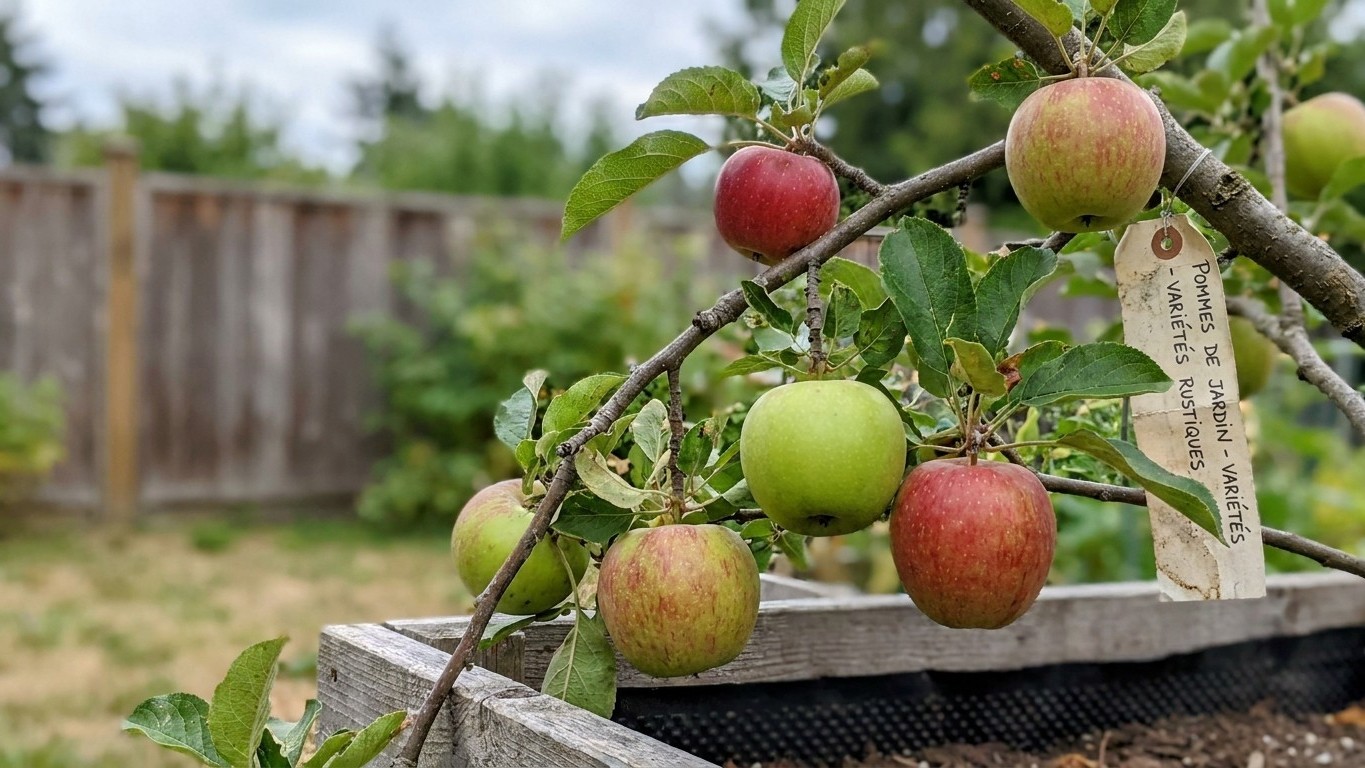

British Columbia grows apples well, particularly along the mild, wet coast near Vancouver, where Environment and Climate Change Canada’s 1981-2010 Climate Normals put the coldest month’s mean daily minimum at 0.8 °C. That figure alone rules out almost nothing: nearly every apple cultivar sold in Canada tolerates winters far colder than this. The action that actually matters is picking a variety matched to this region’s cool, damp winter chill and to its March 18 average last frost, then watching the buds rather than the calendar once bloom season starts, a progression laid out in The British Columbia Apple Calendar, Stage by Stage.
Which varieties suit this climate

Coastal British Columbia’s winters are mild by Canadian standards but long and consistently cool, and that combination matters more for apples than raw cold tolerance does. Nearly every standard apple cultivar sold through Canadian nurseries, including ‘Honeycrisp’, ‘Liberty’, ‘Cox’s Orange Pippin’, ‘Spartan’ and ‘Gravenstein’, is commonly listed by nurseries as hardy well into the range this territory’s winters actually reach, so cold survival is rarely the deciding factor here.
The filter that does the real work is winter chill, the number of hours a tree spends in the cool range roughly between freezing and the mid-40s Fahrenheit before it will break dormancy cleanly. A variety bred for a short, mild winter and given a long, cool one wakes unevenly, and the reverse happens too: a high-chill variety planted where winters are short and warm blooms thin and ragged over weeks instead of in one flush. Vancouver’s winter, cool and overcast for months rather than briefly cold, sits at the high end of what most standard apple cultivars need. That is good news for a grower here: it means the low-chill varieties bred for warm winters, the kind a grower in California would reach for on the Growing Apples in California page, are the wrong choice on this coast, and it points instead toward The Best Apple Varieties for British Columbia. They can break dormancy early during a mild stretch and then sit exposed when a cold snap or the region’s own late frost follows.
‘Spartan’ is worth naming on its own, since it was bred at the federal research station in Summerland, in BC’s interior, and its chill and hardiness needs were selected with a Canadian winter in mind from the start. ‘Gravenstein’ is an old, widely grown European variety with a long history in coastal gardens, but it is a triploid, meaning its pollen is sterile, a point that matters for the next section. ‘Liberty’ was bred at Cornell for scab resistance, a useful trait in a climate as wet as this one. Treat the choices above as catalogue-standard cultivars whose hardiness and chill figures fit this coastal climate, and check the extension service below before ordering if you are planting in the drier interior rather than near the coast.
| Variety | Published hardiness | Typical chill need | Note |
|---|---|---|---|
| ‘Honeycrisp’ | Zone 3 to 8 (nursery catalogues) | High, roughly 800 to 1,000 hours | Widely available, stores well |
| ‘Liberty’ | Zone 4 to 7 (nursery catalogues) | Moderate to high, roughly 800 hours | Scab-resistant, good for wet coasts |
| ‘Cox’s Orange Pippin’ | Zone 5 to 8 (nursery catalogues) | Moderate, roughly 600 to 700 hours | Classic English variety, partially self-sterile |
| ‘Spartan’ | Zone 4 to 8 (nursery catalogues) | Moderate to high, roughly 800 hours | Bred at Summerland, BC |
| ‘Gravenstein’ | Zone 4 to 8 (nursery catalogues) | Moderate, roughly 700 hours | Triploid, sterile pollen, needs two pollinizers nearby |
Planting a pair that works here
An apple tree needs a second variety nearby that flowers at the same time and carries fertile pollen. Plant only one tree and you may get blossom with no fruit behind it, or a light, patchy set most years. Among the varieties that suit this coastal climate, ‘Liberty’ and ‘Honeycrisp’ bloom in overlapping midseason windows and both carry viable, compatible pollen, which makes them a realistic backyard pair. ‘Spartan’ also blooms midseason and works as a pollinizer for either.
‘Gravenstein’ is the one to watch. As a triploid, its own pollen cannot fertilize another tree’s blossom, so it needs two other varieties planted nearby rather than one: itself gets pollinated by them, but it does nothing for them in return. ‘Cox’s Orange Pippin’ is partially self-sterile too, and its own pollen is only moderately reliable, so pair it with a strong, generous pollen source like ‘Liberty’ rather than with another shy bloomer.
The general mechanics of matching bloom time and pollen type are covered in more depth on the pollination pages for Growing Apples in Manitoba, where the same rule applies under a much harsher winter, and the underlying logic does not change with climate: bloom overlap and fertile pollen are what decide whether blossom becomes fruit, wherever the tree is planted. If you already have an old tree of unknown identity on the property, the safest fix is to add a known, fertile, midseason variety like ‘Liberty’ nearby rather than guess at what the existing tree needs.
The frost that costs a crop here

What the average date actually means
Environment and Climate Change Canada’s 1981-2010 Climate Normals put the average last spring frost at Vancouver International Airport on March 18. That is a mean, not a guaranteed cutoff: in one year out of two, frost arrives after that date, sometimes well after. Vancouver’s mild coastal air is also not the whole province. Interior valleys and higher districts run their own, colder schedule, and a grower there should treat the March 18 figure as a rough guide from the coast rather than a local date.
Why bloom-stage frost is the real threat
The tree itself is rarely killed by a spring frost in this climate. The flowers are what die. Once buds reach the pink stage and open into bloom, the flower tissue can be killed by a freeze that the woody parts of the tree shrug off without damage. A grower can walk out afterward, see a perfectly healthy-looking tree, and still lose the entire year’s crop because the blossoms browned and dropped before they were pollinated.
What a grower can actually do about it
- Watch the buds, not the calendar: track bud stage from dormancy through pink and act on what the tree is showing.
- Delay dormant pruning slightly in a season that is running warm, since heavy pruning can push bloom earlier.
- Cover small trees overnight with frost cloth when a freeze is forecast during bloom, and remove it by morning.
- Choose a later-blooming variety if frost regularly arrives after March 18 in your specific location.
Of those options, variety choice does the most reliable work. ‘Enterprise’, a scab-resistant cultivar bred for disease tolerance, is also known for blooming later than early cultivars like ‘Yellow Transparent’, which pushes its flowers past the window when a late freeze is most likely. In a location where the coastal March 18 average clearly runs late for the specific site, a later bloomer is a better long-term answer than nightly frost watching every spring.
The apple year in British Columbia
Stage by stage, anchored on this territory’s frost dates
Apple timing is better read off the tree’s stage than off a month on the calendar, because the same stage can land two or three weeks apart from one year to the next. Dormancy runs through the coldest stretch of winter, when the coastal reference point for the last frost, ECCC’s average of March 18 at Vancouver, still lies weeks or months ahead. This is the window for dormant pruning and for planting bare-root trees while they are not actively growing.
Green tip, when the first leaf points emerge from the bud scales, usually shows up as the days lengthen through late winter into early spring, still well ahead of that March 18 average in most years. Pink follows as the flower buds swell and colour but have not yet opened, and this is the stage where frost risk turns serious, since open or nearly open flower tissue is what a freeze actually kills. Bloom itself, when the pollinators need to be active and the second variety needs to be flowering at the same time, is the single most frost-sensitive stage of the whole year in this climate.
Petal fall and fruit set follow bloom by a couple of weeks, and this is when a grower can finally see how much of the crop actually took. Through summer the fruit sizes up, and the tree needs steady water rather than the alternating wet-dry stress that stunts and cracks the skin. Harvest timing depends entirely on the variety: early types like ‘Yellow Transparent’ come off in mid-to-late summer, while ‘Spartan’ and ‘Cox’s Orange Pippin’ hang on toward the average November 10 first fall frost that ECCC records at the same Vancouver station, though a grower should pick by fruit firmness and background colour rather than by that date. A full month-by-month version of this same stage-based calendar, built around a very different set of frost dates, is worked through on the Growing Apples in Manitoba page, useful mainly for seeing how much a colder inland climate compresses the whole season compared to this coast.
Local help
For variety lists suited to specific parts of the province and for current spray and disease guidance, the British Columbia Ministry of Agriculture and Food is the right first stop, particularly if you are planting away from the coast, in the drier interior, or at elevation, where both the frost dates and the winter chill picture differ from the Vancouver reference figures.
Common questions
Can I grow apples on Vancouver Island or is it too wet?
Wet is not the problem, disease pressure from that wet is. Coastal humidity favours apple scab, which is why scab-resistant cultivars like ‘Liberty’ and ‘Enterprise’ are worth choosing over an unresistant variety like ‘Cox’s Orange Pippin’ if you don’t want to spray on a schedule.
Do I really need two trees or will one apple tree ever fruit alone?
A few varieties are marketed as partially self-fertile, but fruit set is heavier and more reliable with a second, compatible variety nearby. Treat “self-fertile” as a fallback, not a plan.
My tree bloomed but set almost no fruit, what happened?
The most common causes are a frost during or right after bloom, a pollinizer that wasn’t actually flowering at the same time, or poor pollinator activity during a cold, wet bloom period. Check bloom overlap with your second tree first.
Is the interior Okanagan region different?
Yes, meaningfully so. Check with the BC Ministry of Agriculture and Food for that region specifically.
When should I prune my apple trees in British Columbia?
Prune during dormancy, before green tip appears, rather than by a fixed date. Pruning too early in a mild winter can encourage growth that then gets caught by a later cold spell.