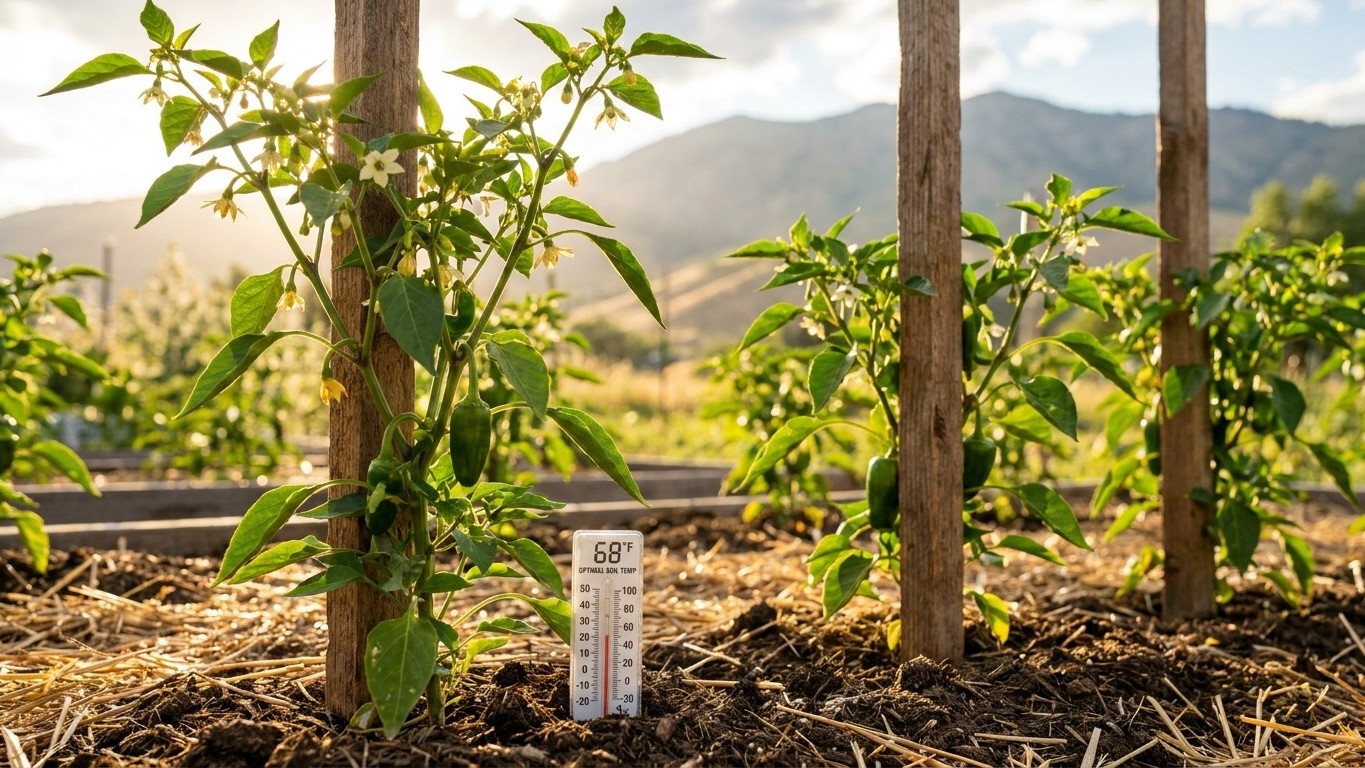

British Columbia’s coastal and valley gardens rarely face the punishing heat that shuts down pepper fruit set elsewhere, but the growing season itself is short, and cool nights can limit a crop just as fast as heat does. Utah State University Extension’s guidance on pepper fruit set applies directly here: get transplants started early, track your own nighttime lows, and choose varieties built for a compact window rather than counting on a long, hot summer to bail out a late start.
The short answer

Start with the number that actually describes a British Columbia summer for pepper growing: at the Vancouver reference station, the mean count of days per year reaching 90 F or higher is 0.0, based on Environment and Climate Change Canada’s 1981-2010 Climate Normals. That figure is not an average summer temperature. It measures heat load, the thing that stresses plants, drives water demand, and, in peppers specifically, causes blossom drop when daytime highs climb past 90 F. A season with essentially zero days at that threshold means the hot-end failure mode that plagues pepper growers in hotter states is, for practical purposes, off the table in a typical British Columbia year.
That sounds like good news, and it is, but it comes with a trade-off worth sitting with. A climate that never pushes past 90 F also rarely delivers the accumulated warmth that pushes peppers through flowering and into ripe fruit quickly. Without that heat, the calendar becomes the limiting factor rather than fruit drop from excess temperature. A gardener here is less likely to lose flowers to a heat wave and more likely to lose the whole crop to running out of season before the fruit colors up.
The other end of the fruit-set equation matters just as much, and it works against you rather than for you. Utah State University Extension is direct on this point: pepper fruit set fails at both ends, meaning nights below 55 F stop the process just as reliably as daytime highs above 90 F. This site tracks days at or above 90 F for each territory, but it does not carry summer overnight low temperatures. That is not a small omission. Coastal, valley, and upland sites within the same province can differ by many degrees on a given night, and nothing about latitude or the coldest month of the year lets you back into a safe estimate for a summer night low. If cool nights are a concern for your garden, the only honest move is to watch your own thermometer, or pull nightly low readings from the closest weather station to your actual plot, rather than assume a number based on where the province sits on a map.
When to start seed here
Working out a seed-starting date is arithmetic, not guesswork, once you have the two anchor points Utah State University Extension provides: transplant after frost and once soil reaches 60 F, and start seed 8 to 10 weeks before that transplant date. Here is how that math runs for British Columbia gardens, using the mean frost date on record.
- Find the mean last spring frost date for your reference station. At Vancouver Int’l A, Environment and Climate Change Canada’s Climate Normals for 1981-2010 place the average last spring frost on March 18.
- Treat that date as a midpoint, not a guarantee. A mean date means frost arrives later than March 18 in roughly one year out of two. Planning a transplant for exactly that date leaves you exposed half the time. Build in a buffer of one to two weeks past the mean before you trust the ground is frost-free.
- Confirm soil temperature separately from air temperature. Frost passing does not mean the soil has caught up. Peppers need soil at 60 F before transplant, and cool spring soil in low-lying or shaded ground can lag well behind the calendar date. A basic soil thermometer, checked at planting depth in the morning, settles the question faster than any calendar guess.
- Set your transplant date at the later of the two conditions. If soil hits 60 F before your buffered frost-free date, wait for the frost-free date. If frost passes before soil warms, wait for the soil. Whichever comes last is the real transplant date for your specific plot.
- Count back 8 to 10 weeks from that transplant date to find your seed-starting date indoors. A transplant date in the second half of May, for instance, pushes seed-starting into the second half of March at the earliest, or the first half of March if you take the full 10 weeks.
- Adjust for your actual location, not the reference station. Vancouver Int’l A is one station. Interior valleys, higher elevations, and inland districts across the province commonly run one to several weeks behind coastal timing. Gardeners outside the immediate Lower Mainland should nudge every date in this sequence later rather than assume the coastal figure applies unchanged.
Utah State University Extension also notes that the 35 to 45 days often cited for pepper fruiting run from flowering, not from sowing or transplanting. Keep that distinction in mind when you’re penciling in a harvest date: the clock that matters for ripening starts once flowers appear on the plant, not when the seed goes into the tray.
What goes wrong here
- Blossom drop from a hot spell or a cool night. Even with zero days typically reaching 90 F, an unusual short heat spike can still push flowers off the plant, and a cool night below 55 F does the same from the other direction. Since this site does not track nighttime lows, the practical remedy is to monitor your own overnight temperatures during flowering and be ready to cover plants with row cover on an unexpectedly cool night, or provide light afternoon shade during a rare hot stretch, rather than assume either extreme is off the table.
- Sunscald on exposed fruit. Where foliage thins from over-pruning, disease, or wind damage, fruit left in direct sun can develop pale, papery patches that later rot. Keep the plant’s leaf canopy intact through the season, avoid stripping leaves to “let light in,” and stake or cage plants so foliage stays upright and covering the fruit rather than falling open.
- Blossom-end rot. This shows up as a dark, sunken spot on the fruit’s bottom end and traces back to inconsistent water supply disrupting calcium uptake, not a lack of calcium in the soil itself. Even watering, ideally with mulch to buffer the soil against swings between soaked and dry, addresses the root cause far more reliably than adding calcium products after the fact.
Common questions
Can peppers ripen fully in a British Columbia backyard without a greenhouse?
Yes, provided the transplant timeline is respected and the plant reaches flowering with enough weeks left before fall cooling sets in. Since the region essentially never sees days at or above 90 F, heat is not the barrier; the barrier is starting late and running out of season before fruit colors up after the 35 to 45 days from flowering.
Do I need to worry about heat stress on peppers in British Columbia?
Based on the mean count of 0.0 days per year at or above 90 F at the Vancouver reference station, heat-driven blossom drop is not a realistic concern in a typical season here. The bigger risk runs the other direction, toward cool nights limiting fruit set, which is why watching your own overnight lows matters more than watching for a heat wave.
Is March 18 a safe date to transplant peppers outdoors?
No. That date is the mean last spring frost recorded at Vancouver Int’l A for 1981-2010, meaning frost arrives later than that date in about half of all years. Treat it as the middle of a window, add a buffer of one to two weeks, and confirm soil has reached 60 F before moving transplants outside.
Why does my county’s timing differ from the coastal frost date cited here?
Because a province is not one climate. The March 18 figure comes from a single station, Vancouver Int’l A, and interior, upland, and northern districts across British Columbia routinely run weeks behind coastal timing. Use the coastal date as a reference point only, and adjust based on your own local frost history or nearby station data.