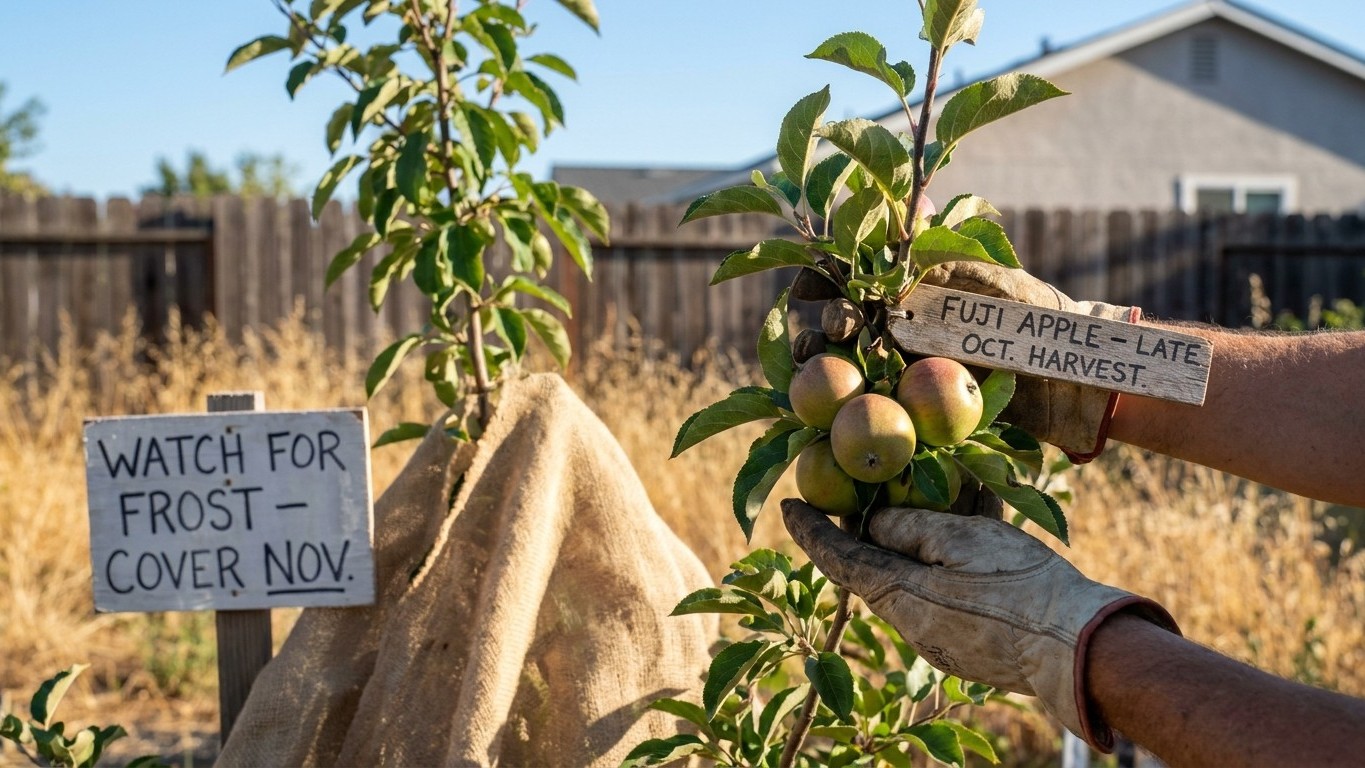

Los Angeles apple trees have one real enemy, and it isn’t winter — it’s the lack of one. Your mild coastal climate never gets cold enough to satisfy a standard apple’s chill-hour requirement, so a tree can survive perfectly fine and still bloom thin, spotty, and barely fruit. The fix isn’t hardiness at all: check a variety’s chill-hour rating before you plant, and choose something bred low, like ‘Anna’ or ‘Dorsett Golden’, instead of whatever your local nursery stocks for the rest of the country.
Can you grow apples in California
Apples grow in California, and the USDA Plant Hardiness Zone Map’s 2023 update, built on the 1991-2020 climate normals, puts the state across an unusually wide span: zone 5a to zone 11a. That range covers everything from Sierra Nevada elevations that see real winter cold to coastal basins that barely see winter at all. A single statewide number can’t tell you whether an orchard in your county will fruit properly, so treat the zone map as a starting filter and look at the reference city closest to your own conditions before buying a tree.
Los Angeles is the reference station behind the other figures in this piece, and it sits at the mild end of that range. NOAA’s National Centers for Environmental Information puts the Los Angeles area’s 1991-2020 coldest-month mean minimum at 48.7°F, and its 30-year daily record shows zero days at or below freezing in an average year. An apple tree has no trouble surviving a winter that mild. The problem is the opposite one: cold hardiness measures what a tree can tolerate, not what it needs, and an apple planted in a winter this gentle may barely flower at all.
That’s a winter-chill problem, not a frost problem, and it belongs to the coastal basin around Los Angeles and much of coastal and southern California generally. Move away from that mild coastal band and the picture changes. The Central Valley, the Sierra foothills, the high desert and most of northern California get real winter cold, cold enough that standard apple varieties bred for the rest of the country perform there without much fuss. If you garden in one of those colder interior regions, hardiness is rarely the limiting factor either, since apples tolerate far colder winters than California typically delivers even inland.
So the honest answer is regional rather than statewide: apples work almost everywhere in California, but which apples work depends on where you are. Coastal and southern gardeners need to hunt down low-chill cultivars bred for mild winters — see this rundown of California apple Best varieties for options suited to these conditions, and check the California apple Calendar to time planting and care around your local season. Gardeners in the colder interior and north have the easier job, since most of the apple varieties sold nationally were bred for a winter colder than Los Angeles sees and will perform closer to catalog expectations there.
Which varieties suit this climate

Hardiness answers whether a tree survives winter. Winter chill answers whether it flowers on schedule, and in California the second question usually matters more than the first. Chill hours are the number of hours a tree spends below roughly 45°F while dormant, and nurseries publish a chill requirement for every cultivar the same way they publish a disease resistance code. Plant a variety that needs more chill than your winter delivers and you get a thin, straggling bloom spread over weeks instead of a proper flush, with poor fruit set to match.
Los Angeles and the coastal basin sit at the low-chill end of what apples need, so the varieties that actually perform there are the same low-chill cultivars developed for the Deep South and for Southern California nurseries specifically: ‘Anna’, ‘Dorsett Golden’, ‘Beverly Hills’ and ‘Einshemer’. Moving inland, ‘Fuji’ and ‘Granny Smith’ sit in the middle of the chill scale and tolerate the milder interior valleys reasonably well. Once you’re up into the Sierra foothills or northern California’s colder winters, the whole nursery catalog opens up: ‘Gala’, ‘Golden Delicious’, ‘Jonagold’ and high-chill favorites like ‘Honeycrisp’ all get the cold they were bred for.
The table below groups these cultivars by roughly where their chill requirement puts them, using the ranges nurseries typically publish. Treat the numbers as relative rather than exact, since different catalogs round differently.
| Variety | Approx. chill hours needed | Where it fits in California |
|---|---|---|
| ‘Anna’ | 200-300 | Coastal basin, Los Angeles and similar low-chill areas |
| ‘Dorsett Golden’ | 100-200 | Coastal basin, pairs with ‘Anna’ |
| ‘Fuji’ | 300-400 | Mild interior valleys, some coastal sites |
| ‘Granny Smith’ | 400-500 | Interior valleys with moderate winter cold |
| ‘Gala’ | 500-600 | Central Valley, foothills |
| ‘Golden Delicious’ | 600-700 | Foothill and northern California gardens |
| ‘Honeycrisp’ | 800-1000 | Sierra foothills and colder northern counties |
For the high-chill end of that scale, growers in genuinely cold states plant these varieties without a second thought. Growing Apples in Colorado: Varieties, Timing and Frost Risk covers an orchard climate where ‘Honeycrisp’ and ‘Golden Delicious’ get their full chill every winter, worth a look if you’re gardening in California’s colder counties and want to see what an easier chill budget looks like. No statewide list of California-recommended apple varieties was available from a named source for this piece, so use the chill-hour ranges above as your filter and confirm locally before buying.
Planting a pair that works here
Apples need two trees to fruit reliably, blooming at the same time, with at least one of them producing pollen that actually works. Most cultivars are diploid and pollinate each other fine. A handful, including ‘Mutsu’, ‘Jonagold’ and ‘Gravenstein’, are triploid, meaning their own pollen is sterile, and they need two other varieties nearby, one to pollinate them and a second to pollinate each other. Plant a single triploid tree alone, or pair it with only one other variety, and you can end up with flowers but no fruit.
In the coastal basin, where ‘Anna’ and ‘Dorsett Golden’ are the realistic low-chill choices, you’re in luck: the two bloom together and cross-pollinate well, and both set some fruit on their own if a neighbor’s tree isn’t close enough, though a true pair does better than either tree alone. That makes them the standard beginner pairing for a Los Angeles-area backyard.
Further inland, where ‘Fuji’ and ‘Gala’ both get enough chill to perform, the two bloom close enough in timing to work as a pair, and both carry fertile pollen. ‘Granny Smith’ blooms a little later and pairs well with either. In the higher-chill counties, ‘Golden Delicious’ is a reliable, heavy pollen producer and a common partner for pickier cultivars, one reason it shows up in so many backyard pairings even where it isn’t the fruit anyone particularly wanted.
Bees do the actual work of moving pollen between the two trees, so keep them within an easy flight of each other rather than at opposite ends of a large lot, and skip any insecticide spray while the flowers are open. Whatever pair you choose, check the bloom window each supplier lists before buying. Two excellent apples that flower three weeks apart won’t pollinate each other, no matter how healthy both trees are.
The frost that costs a crop here

In the coastal basin around Los Angeles, frost is close to a non-issue. NOAA’s NCEI couldn’t compute a spring or fall freeze date at all for the 1991-2020 normals there, coded as no measurable freeze, and NOAA’s regional daily records show zero days at or below 32°F across the same 30 years, with a frost-free season listed as the full 365 days of the year. If you garden in that band, frost isn’t the thing to plan around. Heat, drought and water restrictions are.
That’s not true for most of the rest of the state. The Central Valley, the Sierra foothills and much of northern California still get a real spring frost, and apples are vulnerable at a very specific moment: once the buds crack open to show pink, a frost kills the flowers, not the tree. The tree itself shrugs it off and leafs out fine a few weeks later. The crop for that year is simply gone, because there’s nothing left to pollinate.
Growers in colder, frost-prone climates deal with this every spring. States with a genuine hard freeze, like the far end of the range covered in Growing Apples in Alberta: Varieties, Timing and Frost Risk, build their whole planting and protection routine around exactly this window, worth a look if your California orchard sits somewhere with real spring frost risk rather than the frost-free coastal band.
Where frost is a real risk, a few things help:
- Choose a later-blooming variety where local frost lingers into the season, since a tree that flowers after the danger window has passed loses nothing.
- Hold off on heavy pruning in late winter, since pruning can push a tree toward earlier bloom.
- Cover small trees with frost cloth on a clear, calm, cold-forecast night during the pink-to-bloom window.
- Avoid planting in the lowest point of a yard or slope, since cold air pools there on a still night.
None of this applies to the coastal basin itself, where the risk simply doesn’t exist in an average year. It matters most for the same interior and northern regions that also carry the higher-chill varieties from the table above, a reasonable trade: colder winters bring better bloom and more frost risk in the same package.
The apple year in California
An apple tree’s year runs by stage, not the month, and the stage that matters is read off the buds. In the frost-free coastal basin around Los Angeles, timing is driven almost entirely by winter chill accumulation and by heat later in the season rather than by frost. Inland and northern growers watch the same stages but also have to weigh them against a real local frost window, which the section above covers.
Stage by stage
| Stage | What’s happening | What to do |
|---|---|---|
| Dormancy | Tree is leafless, accumulating winter chill hours below roughly 45°F | Prune while bare, apply dormant oil for Overwintering pests |
| Green tip | First green shows at the bud tip | Finish any remaining pruning, watch soil moisture as growth resumes |
| Pink | Bud shows pink color before opening | In frost-prone regions, this is when a late freeze does the most damage |
| Bloom | Flowers fully open | Skip insecticide, let pollinators work, confirm a pollen partner is blooming too |
| Petal fall | Petals drop, tiny fruit begins to swell | Thin excess fruit once size is visible, step up watering if the ground is dry |
| Fruit set | Fruit sizing up through the growing season | Regular watering, watch for codling moth and other pests through summer heat |
| Harvest | Fruit reaches mature color and firmness for the variety | Pick and store, timing varies by cultivar rather than by a fixed date |
The coastal basin’s frost-free record means green tip, pink and bloom can arrive early some years with no frost penalty for it, since NOAA’s climate normals for that station show no freeze at all in an average year. Inland and northern gardeners don’t get that freedom. An early bloom pushed by a warm spell there can walk straight into a frost the coast never has to think about, the main reason a later-blooming cultivar matters more the further inland and north you plant.
Local help
For a variety list actually vetted for your county, and for current spray timing against pests like codling moth, contact the University of California’s statewide extension network at ucanr.edu. Local county offices under that same system publish the most specific guidance available, since chill hours, pest pressure and frost risk all shift from the coastal basin to the Central Valley to the Sierra foothills. Bring your rough elevation and nearest town when you call or search, since county-level advice beats any statewide rule of thumb.
Common questions
Can I grow apples in Los Angeles without any winter cold at all?
Yes, but only with a low-chill cultivar bred for it, such as ‘Anna’ or ‘Dorsett Golden’. A standard variety like ‘Honeycrisp’ or ‘Golden Delicious’ will survive the mild winter fine but bloom poorly, since it never gets the chill hours it was bred to expect.
Do I need two apple trees, or will one produce fruit by itself?
Most apples need a second variety nearby for full pollination, though a few low-chill cultivars like ‘Anna’ set some fruit alone. Plant a second tree if you have room. A single triploid variety such as ‘Mutsu’ won’t pollinate itself at all and needs two other trees around it.
My tree bloomed heavily but set almost no fruit. What went wrong?
The most common causes are a pollination partner that bloomed at the wrong time, cold or rainy weather during bloom that kept bees away, or an insecticide spray applied while the flowers were open. In frost-prone inland counties, a late freeze right at the pink or bloom stage can also wipe out the flowers while leaving the tree itself undamaged.
Can I grow an apple tree in a container in California?
A dwarf tree on dwarfing rootstock works in a large container, and it’s often easier to manage in the coastal basin’s warm winters since you can move it to a cooler, shadier spot to help chill accumulation. It still needs a chill-matched variety and, in most cases, a second tree nearby for pollination.
How soon will a new apple tree actually bear fruit?
A dwarf or semi-dwarf tree on the right rootstock usually starts bearing within its first few years, while a full-size standard tree takes noticeably longer to mature into fruiting. A chill-matched variety in a favorable region tends to reach that first crop sooner than a mismatched one that struggles to bloom cleanly every spring.