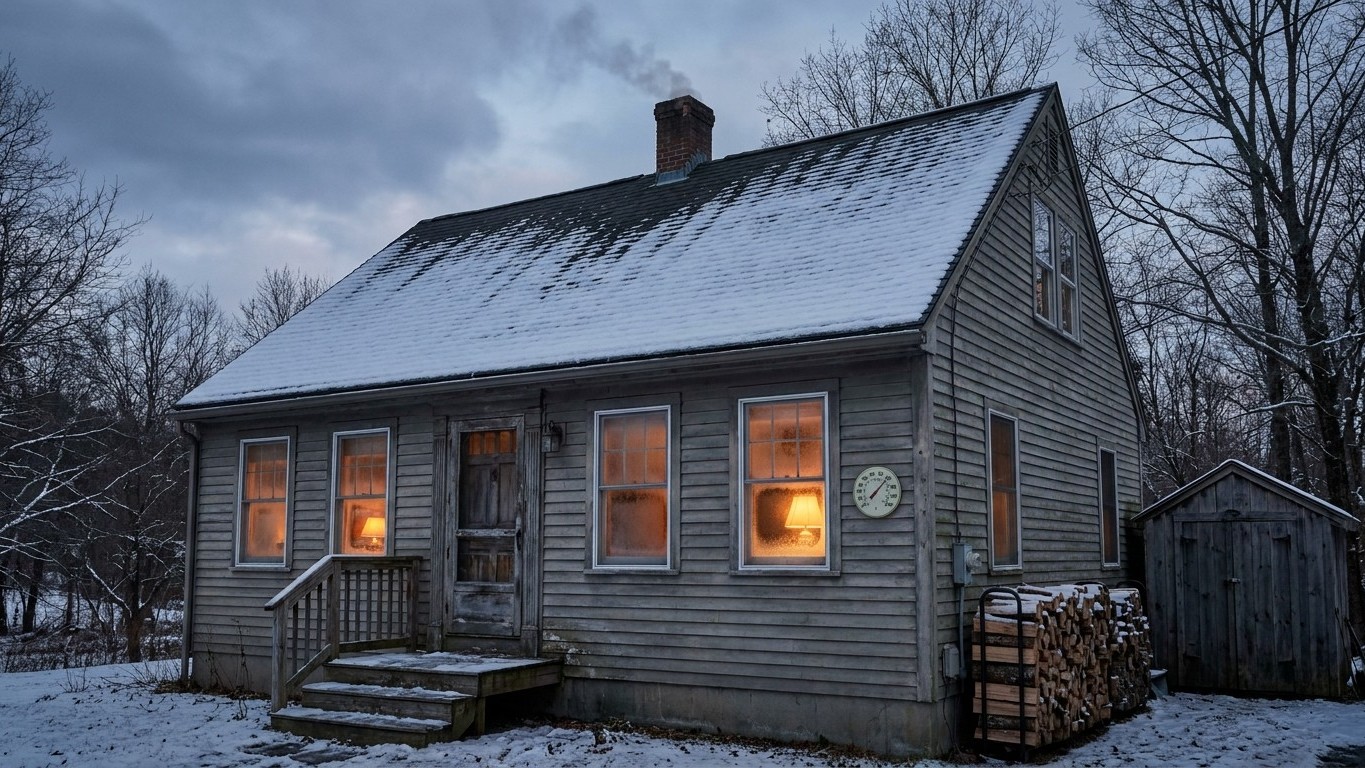

Connecticut winters hover close to freezing for months at a stretch rather than plunging into deep-freeze territory for a few brutal weeks. That single fact shapes everything from how long your furnace runs to how much wood you need stacked by the shed. Here’s what the season actually demands from a heating system, and from the fuel that feeds it.
How cold it gets, and for how long

The average daily low in Connecticut’s coldest month sits at 24.4°F, based on NOAA’s 1991-2020 climate normals for the Bridgeport reference station. That’s not a record low, and it’s not some rare cold snap. It’s the typical nighttime floor, month after month, through the heart of winter.
What that number means in practice is a long, grinding heating season rather than a short, sharp one. A furnace or wood stove in Connecticut isn’t fighting occasional Arctic blasts that drop to single digits for three days and then break. It’s holding a house above freezing for roughly four months running, night after night, with temperatures that rarely dip catastrophically low but also rarely give the system a break.
That distinction matters for anyone comparing heating strategies across regions. A climate that drops to -10°F for two weeks and then moderates puts a different kind of stress on equipment than one that sits in the mid-20s from December through March. The first scenario demands a system sized for extreme peaks. The second demands endurance: a furnace that can run efficiently for thousands of cumulative hours, or a wood-burning setup with enough fuel on hand to feed a fire night after night without running short in February.
For wood burners specifically, this steady-cold pattern means the burn season stretches long enough that fuel supply planning isn’t optional. Running out of seasoned wood in the middle of a Connecticut winter usually means either burning wood that hasn’t dried properly, or buying kiln-dried wood at a premium, or falling back on backup heat. None of those are ideal. The math on how much wood a household needs starts with this seasonal length, not with a single cold night.
What a cord of wood is worth here
A cord of well-seasoned hardwood delivers about 20 million BTU, according to Michigan State University Extension. That figure is an average, and species plus moisture content move it substantially in either direction. But as a baseline, it’s useful: MSU notes that one cord is roughly equivalent to the heat output of 145 gallons of #2 fuel oil, or 215 gallons of LP gas.
The word “cord” itself is where a lot of firewood buyers get taken advantage of. A cord is a volume measurement, not a weight, and it has an exact definition: a stack measuring 4 feet by 4 feet by 8 feet, which works out to 128 cubic feet of stacked wood. Anything sold as a “cord” that doesn’t match those dimensions, loosely thrown rounds in the back of a pickup, for instance, isn’t a cord. It’s whatever the seller decided to call it.
The numbers in one place
| Measurement | Value |
|---|---|
| Standard cord dimensions | 4 ft x 4 ft x 8 ft |
| Total volume | 128 cubic feet |
| Heat output (seasoned hardwood) | about 20 million BTU |
| Oil equivalent | roughly 145 gallons of #2 fuel oil |
| LP gas equivalent | roughly 215 gallons |
Because a cord is a volume, not a weight, the density of the species stacked inside it changes how much actual heat you’re getting. Denser hardwoods pack more mass into the same 128 cubic feet, which is why oak and hickory outperform softer, lighter species even when the stack looks identical from across the yard. In a state where the heating season runs four months deep, that difference adds up fast: a poorly chosen cord can mean an extra trip to the wood dealer before spring, or a stove that never quite keeps the living room warm on the coldest nights.
Moisture content matters just as much as species. Wood that hasn’t dried, sometimes called green wood, can run over 60 percent moisture. Before that wood gives off any usable heat, it has to boil that water out of its own cell structure first, and that boiling consumes energy that should have gone into warming the house. A cord of green wood and a cord of properly seasoned wood can carry the same species and the same 128 cubic feet, and still deliver a very different winter.
How long wood takes to dry in Connecticut
Seasoning isn’t a fixed calendar number. It depends on humidity, summer heat, and how the wood was handled after it was cut, which is exactly why the same species can season faster in a dry inland climate than in a damp coastal one. MSU Extension puts the target at 20 percent moisture or less before burning, down from a green-wood starting point that can exceed 60 percent.
Split, green hardwood usually reaches that 20 percent target after one full summer of proper stacking, meaning split into pieces and stacked in a way that lets air move freely through the pile. Wood left in whole rounds, or piled in a heap without airflow, dries far more slowly, sometimes not reaching burnable moisture levels even after a full season. Splitting exposes more surface area to air, and stacking (rather than dumping in a pile) is what actually lets that air do its job.
Red oak is worth calling out by name here. MSU notes it dries more slowly than most other hardwoods because of its cell structure, so a single summer of seasoning often isn’t enough. Anyone counting on red oak for a Connecticut winter should plan on cutting and splitting it a full year, not just a few months, before they intend to burn it.
Burning wood before it’s properly seasoned doesn’t just waste heat. Green wood produces more smoke and more creosote buildup inside the chimney flue, since the incomplete combustion leaves behind more unburned particulate that condenses as it cools on the way up the flue. Over a season, that means a chimney that needs sweeping more often, and a real (if often underestimated) chimney fire risk. It’s not an emergency after one damp log tossed on the fire. It’s a pattern that builds up over a winter of burning wood that never really dried.
Where to check before you buy
Connecticut isn’t flat, and it isn’t uniform. Elevation, coastal exposure, and inland cold pockets vary enough across the state that the Bridgeport-based figures above are a reference point, not a guarantee for every address. A property in the northwestern hills is going to run colder and season wood more slowly than one along the Sound.
For guidance specific to your part of the state, including which species are locally available and any seasonal burn restrictions, the University of Connecticut Extension is the resource to check. Burn rules, when they exist, are set at the local or municipal level and can change from year to year, so it’s worth confirming current restrictions before assuming last winter’s rules still apply.
None of the figures here replace that local check. They’re a starting point for understanding what a Connecticut winter demands, and what a cord of wood is actually worth once it’s stacked in your yard.