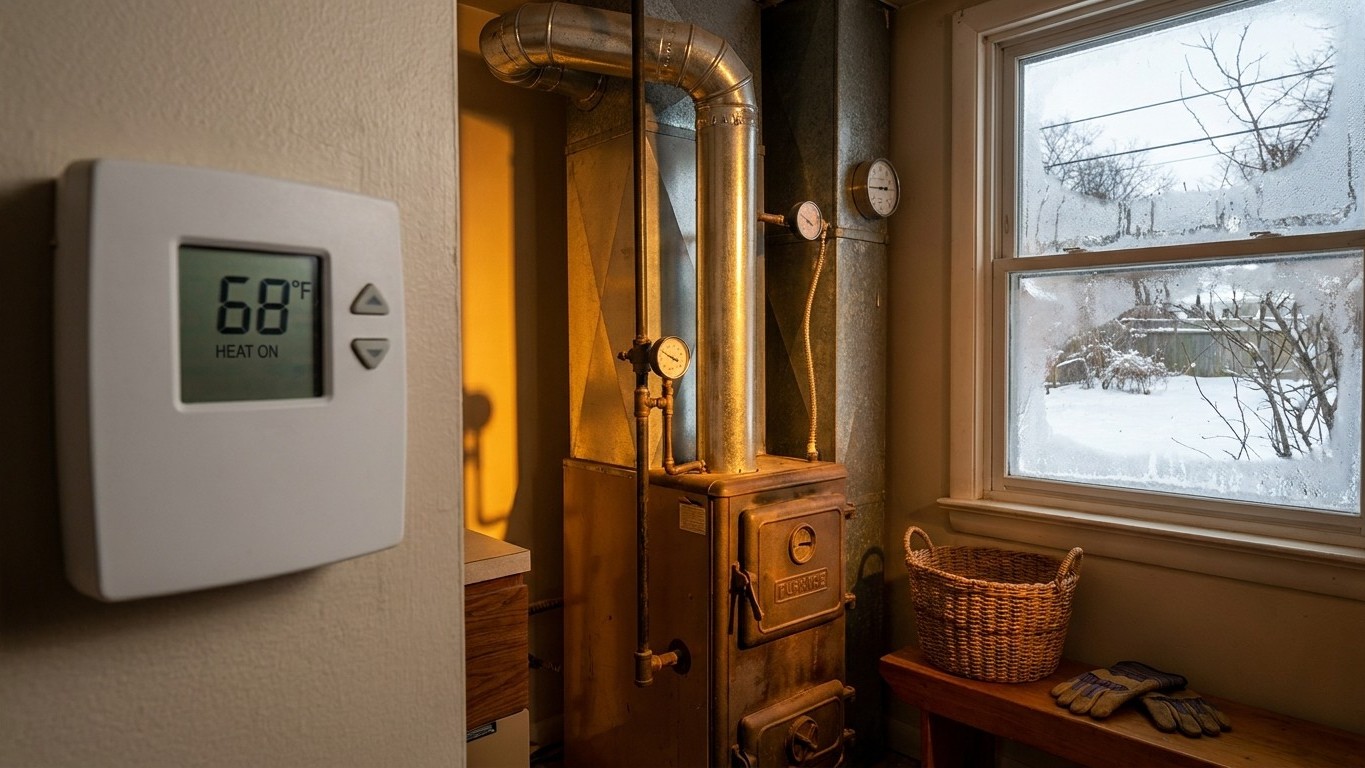

Delaware winters don’t hit the extremes you’d find further north or at higher elevation, but the season still runs long enough to matter for anyone planning heating costs or firewood needs. Here’s what the numbers actually mean for a household in this state.
How cold it gets, and for how long

The mean daily minimum for Delaware’s coldest month sits at 25.6°F, based on NOAA’s 1991-2020 climate normals from the Wilmington reference station. That’s not a record low, and it’s not an average temperature for the day. It’s the typical overnight floor during the coldest stretch of the year, and it’s the number that tells you how hard a heating system has to work night after night.
A 25.6°F minimum puts Delaware in a moderate-cold category compared with the rest of the country. It’s cold enough that pipes need protection and a furnace runs through the night, but it’s not the kind of deep-freeze territory where equipment has to be rated for sustained sub-zero performance. That distinction matters when you’re sizing a heating system or deciding how much wood to lay in: a house here is managing a long stretch of chilly nights, not a short blast of extreme cold.
Length matters as much as depth. A winter that hovers near freezing for four months puts a different kind of strain on a home than one that plunges hard for six weeks and then breaks. Delaware’s coastal position, sitting between the Atlantic and the Chesapeake, tends to moderate the coldest swings compared with inland areas at the same latitude, but it also means damp air that makes cold feel more penetrating than the thermometer suggests. A furnace or heat pump here isn’t fighting brutal lows so much as it’s fighting duration, running steadily from late fall through early spring, which is why it helps to know When Does the Heating Season Start in Delaware?
For anyone comparing notes with family in a colder state, the practical takeaway is this: Delaware homes need reliable, consistent heat over a long season rather than equipment built for extreme cold snaps. That shapes everything from insulation priorities to how much firewood makes sense to store, and it also raises the question of When Can You Turn the Heat Off in Delaware?
What a cord of wood is worth here
If wood heat is part of the plan, the unit to understand first is the cord, because it’s the single most common place firewood buyers get shorted. A cord isn’t a weight. It’s a volume, a stack measuring 4 feet by 4 feet by 8 feet, which works out to 128 cubic feet. Anything sold as a “cord” that doesn’t match those dimensions isn’t a full cord, no matter what the seller calls it.
| Measurement | Value |
|---|---|
| Standard cord dimensions | 4 ft x 4 ft x 8 ft |
| Total volume | 128 cubic feet |
| Heat output, well-seasoned hardwood | about 20 million BTU per cord |
That 20 million BTU figure, from Michigan State University Extension, is an average for well-seasoned hardwood. Species and moisture content move that number quite a bit, so it’s not the exact output of any one load sitting in a driveway. Still, it gives useful perspective: MSU puts a single cord roughly on par with the heat from 145 gallons of #2 fuel oil, or 215 gallons of LP gas. For a Delaware household using wood as a supplement to a furnace or heat pump, that’s a meaningful chunk of the season’s heat load, especially during the coldest stretch when the system is running hardest.
Density is the whole trick here. Two cords of the same size, from different species, can hold very different amounts of usable heat, because denser wood packs more mass into the same 128 cubic feet. That’s why “a cord” isn’t a complete answer on its own. What’s inside the cord, and how dry it is, decides how far it actually goes.
How long wood takes to dry in Delaware
Moisture is the mechanism that decides everything else about firewood performance. MSU Extension recommends burning wood at 20 percent moisture or less. Green, freshly cut wood can carry more than 60 percent moisture, and that water has to boil off before the wood gives up any usable heat. Every bit of energy spent evaporating water is energy that isn’t warming the house.
Split green wood typically reaches that 20 percent threshold after one full summer, provided it’s split and stacked so air can move through the pile. Rounds left whole don’t dry the same way. Stacking loosely, keeping wood off the ground, and giving it exposure to sun and wind through the humid Delaware summer all speed the process along. Red oak is a notable exception. MSU points out that its cell structure makes it dry more slowly than most other hardwoods, so it needs more time than a single season to reach burnable moisture levels.
Burning too soon has real consequences. Wet wood produces less usable heat, since so much of the energy goes into boiling off moisture instead of warming a room. It also burns dirtier, creating more creosote buildup inside the flue. That buildup raises the risk of chimney fires and means the chimney needs sweeping more often than it would with properly seasoned wood. None of this is dramatic on any single fire, but stacked over a whole heating season, the difference between wet and dry wood shows up in both comfort and chimney maintenance.
Delaware’s humid summers don’t necessarily slow drying compared to drier climates, but they do mean stacking and airflow deserve more attention than they might in an arid state. A pile that’s shaded and packed tight will dry noticeably slower than one that gets full sun and open air on all sides.
Where to check before you buy
Every figure above reflects the Wilmington reference station, and Delaware’s terrain doesn’t vary as dramatically as larger states, but conditions still shift somewhat between the coast and inland areas, and between low-lying and slightly elevated ground. That’s enough to affect which wood species are locally available and how quickly a stack dries in a particular yard.
For guidance specific to your part of the state, including species availability and any current burn restrictions, the University of Delaware Cooperative Extension is the resource worth checking before buying in bulk. Burn rules, when they exist, are set at the local or county level and can change from year to year depending on air quality conditions or drought status. What was allowed last winter isn’t guaranteed this winter, so a quick check before stocking up saves headaches later. The extension office is also the most reliable source for which hardwood species are actually sold and seasoned properly in your specific area, since availability can differ from one county to the next.
What each heat source costs to run in Delaware
At Delaware’s average residential prices, this is what one million Btu of heat delivered into the house costs with each system. It compares fuels on the same unit: it is not a yearly bill, and it leaves out the price of the equipment.
| System | Cost per million Btu delivered |
|---|---|
| Electric resistance (baseboard, 100% efficient) | $52.34 |
| Heat pump at 8.1 HSPF2 (seasonal COP about 2.4) | $22.05 |
Cheapest to run in Delaware: heat pump, $30.29 less per million Btu than the electric resistance.
Prices: U.S. Energy Information Administration (EIA), average residential prices. Efficiencies: ENERGY STAR criteria. A heat pump’s figure is a seasonal average; in the coldest weather its efficiency drops.