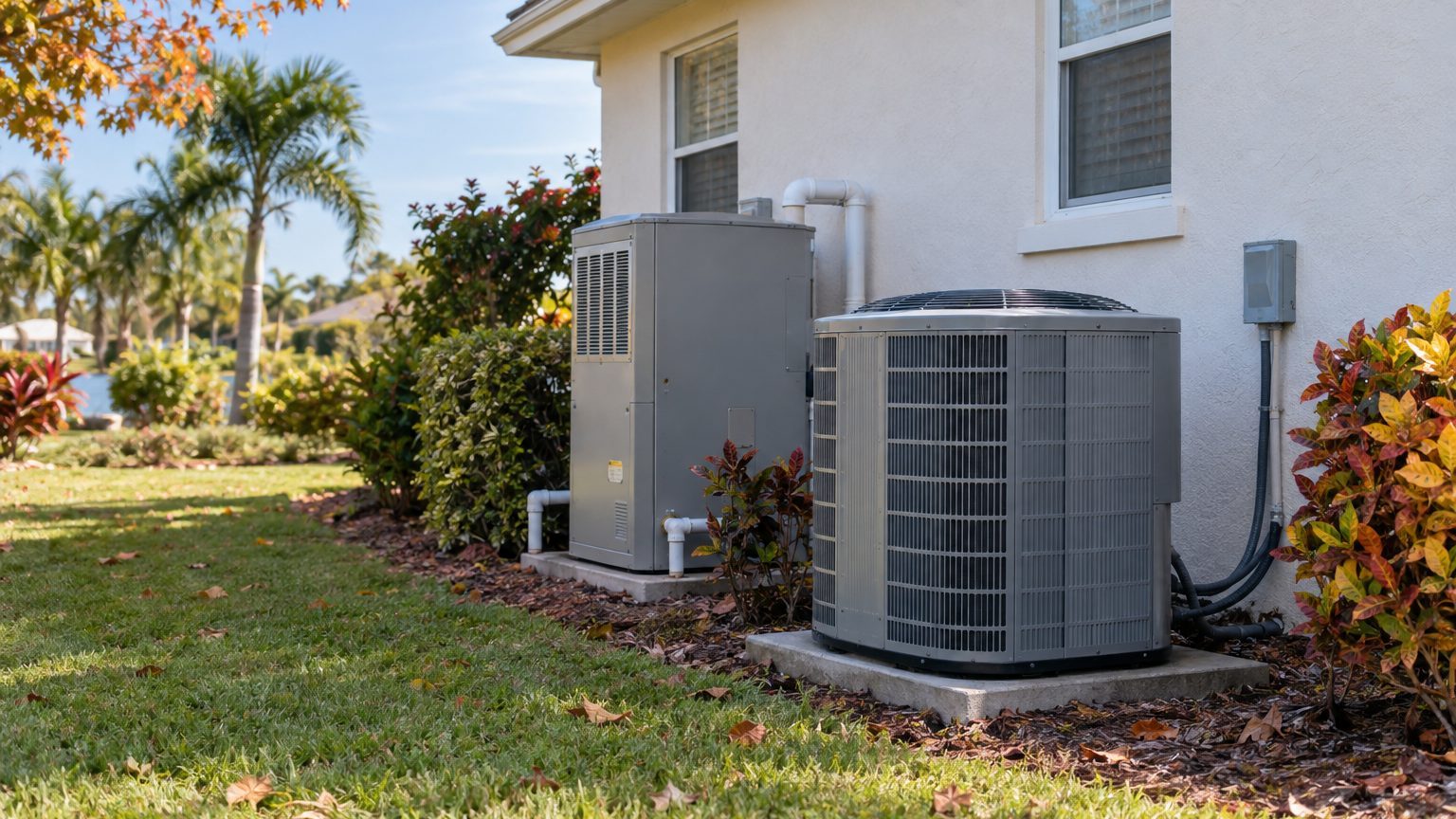

Against electric baseboard, a heat pump wins easily in Delaware: $22.05 per million Btu of delivered heat versus $52.34. Against a gas furnace, the answer turns on a number the data here does not carry, which is your utility’s gas price. The electric side is laid out below in full, along with a way to test gas against it.
The short answer for Delaware
Among the systems with a computed price, the heat pump is the cheapest to run here. Using average Delaware residential prices from the U.S. Energy Information Administration (EIA) and the ENERGY STAR minimum efficiency for a ducted heat pump (8.1 HSPF2, a seasonal COP of about 2.4), it delivers a million Btu for $22.05. Electric resistance, meaning baseboard or a plain electric furnace, delivers the same heat for $52.34. That leaves the heat pump $30.29 less per million Btu, and the gap comes entirely from how each machine treats a kilowatt-hour.
Natural gas is the missing piece. The data behind this comparison has no Delaware gas price, so no gas figure appears here, and I won’t guess one. Gas prices have to come from your local utility’s current rate sheet or a recent bill. The heat pump number gives you something to hold that price up against.
Two limits matter. These are running costs for the same unit of heat, not a yearly bill, because a leaky 1960s ranch and a tight new build burn very different amounts. And they say nothing about equipment price, installation, or ductwork changes, which can swing a decision on their own.
So the practical rule is short. Treat $22.05 per million Btu as the number a gas furnace has to beat; if your gas price, run through the furnace’s efficiency, lands above it, the heat pump is cheaper to run. If it lands below, gas wins on running cost alone. Everyone heating with baseboard or an electric furnace already has their answer.
What each option costs to run in Delaware
| System | Efficiency used | Cost per million Btu delivered |
|---|---|---|
| Electric resistance (baseboard) | 100% efficient | $52.34 |
| Heat pump | 8.1 HSPF2, seasonal COP about 2.4 | $22.05 |
| Natural gas furnace | Depends on the furnace | No price in the data; ask your utility |
The electricity behind those rows is 17.86 cents per kWh, the average residential price from the EIA’s Electric Power Monthly (Table 5.6.B), year-to-date through July of the latest report. It is a statewide average. Your utility and rate plan can land above or below it, so use it to compare fuels and to estimate, not to predict your bill.
Efficiency matters as much as the fuel price because the two multiply. One kWh holds 3,412 Btu. Baseboard turns all of that into heat and no more. A heat pump uses the electricity to move heat from outdoor air into the house, so at a seasonal COP of about 2.4 it delivers a bit more than twice the heat from the same kWh. Same meter, same price, very different results.
That detail is also why the HSPF2 label deserves a closer look. ENERGY STAR asks for at least 8.5 HSPF2 from non-ducted (ductless) split systems but only 8.1 from ducted ones, because a ductless unit has no duct losses and starts with an advantage. The $22.05 figure uses the ducted minimum, and What HSPF2 Measures, and Why Ductless Asks for More explains how to compare two units fairly. These are minimums to earn the label, not typical values.
To test gas yourself, remember that EIA treats a cubic foot of natural gas as about 1,037 Btu, so 1,000 cubic feet holds roughly 1.037 million Btu. Take the price per 1,000 cubic feet from your utility, divide by the furnace’s efficiency rating, and compare the result to $22.05. A bill that quotes gas in another unit will show the conversion on the rate sheet.
How cold it gets, and what that does to a heat pump
The reference station at Wilmington New Castle County Airport records about 4,647 heating degree days a year (base 65°F), according to NOAA’s 1991-2020 Climate Normals. Heating degree days add up, across every day of the year, how far the average temperature sat below 65°F. More of them means more fuel for the same house. This is one station, the Wilmington reference city, so a home elsewhere in the state will differ somewhat.
The coldest month there has a mean daily minimum of 25.6°F. That is an average of the lows, not the record, so some nights go lower. It tells you winter here is a real heating season with regular sub-freezing nights, but not the long, brutal kind.
That matters because the $22.05 figure rests on a seasonal efficiency. A seasonal COP of about 2.4 is an average across the whole winter, mild afternoons included. On the coldest nights, a heat pump’s efficiency drops, and a backup carries the load: electric resistance strips built into the air handler, or a furnace in a dual-fuel setup. Those hours cost more per Btu than the seasonal average suggests, though they make up a small slice of the winter. For a closer look at what happens as the temperature falls, How Cold Is Too Cold for a Heat Pump goes through it without a made-up cutoff.
The wide gap between $22.05 and $52.34 gives the heat pump room to absorb those cold hours. Even if a fraction of winter runs on backup strips at baseboard-like cost, the seasonal average stays well below resistance heating alone. With a coldest-month minimum of 25.6°F, a properly sized heat pump with a backup plan is a reasonable primary heat source in Delaware; what to plan for is the backup, not abandoning the idea.
What homes in Delaware already heat with
The EIA’s Residential Energy Consumption Survey (RECS) 2020 state tables show 62% of Delaware homes heating with a furnace and 20% with a central heat pump. By fuel, natural gas leads at 41%, with electricity close behind at 40%, then propane at 9% and fuel oil or kerosene at 8%. Steam or hot-water boilers are not reported; the survey suppressed that estimate as unreliable, which is not the same as saying none exist. These are state figures from a national survey, not a count for your street.
The 40% on electricity is the telling number. A large share of Delaware homes has no gas heat at all, and for those the fair comparison is different. A house with no gas line is choosing among a heat pump, electric resistance, and delivered fuels like propane or oil. Against resistance, the heat pump’s $30.29-per-million-Btu advantage is the whole story. Propane and oil have no price in the data, so those need a local quote. If your house has no gas service and heats with electricity, a heat pump is the first thing to price.
A boiler house is a different conversion. Radiators have no ducts, so swapping in a heat pump usually means ductless units or new ductwork, and Ductless or Central covers that choice. For the broader picture of how Delaware homes are heated, see Heating a Home in Delaware.
When the other choice wins
The heat pump is cheaper to run than electric resistance by a wide margin, but that does not make it the right call every time. The clearest exception is gas itself. If your utility’s price, run through a good furnace’s efficiency, comes in below $22.05 per million Btu, gas wins on running cost, and a heat pump has to justify itself on other grounds.
Cooling is one of those grounds, and in Delaware it counts. The Wilmington station averages about 1,228 cooling degree days a year, so summer air conditioning is a real expense, not an afterthought. A heat pump handles both jobs, which tilts the math when an old central air conditioner is near the end of its life anyway. If the AC is fairly new and the gas furnace is healthy, there is little reason to rush.
An old system with years left is the other common case. Replacing a working furnace to chase a running-cost gain can take a long time to pay back, since the savings are measured per million Btu while the installation bill arrives all at once. Repairing a Furnace or Replacing It lays out when a repair makes sense and when it does not.
Dual-fuel is the middle path: a heat pump handles most of the winter and a gas furnace takes over on the coldest nights. It needs gas service and a compatible setup, and it keeps the furnace as insurance against the hours when seasonal efficiency does not hold. If you already have a gas furnace in good shape and want lower running costs without giving it up, ask an installer about a dual-fuel system before ruling either fuel out. Ductwork is the last check: leaky or undersized ducts erode any efficiency advantage, and a ductless system sidesteps them.
Common questions
Is a heat pump cheaper to run than a gas furnace in Delaware?
That depends on your gas price, which is not in the data used here. The heat pump costs $22.05 per million Btu delivered at the ENERGY STAR minimum efficiency, so a gas furnace that delivers heat for less than that is cheaper to run.
Will a heat pump handle Delaware winters?
The coldest month at the Wilmington reference station has a mean daily minimum of 25.6°F. A heat pump runs below its seasonal efficiency on the coldest nights, and a backup (resistance strips or a furnace) covers them.
Why does ENERGY STAR require 8.5 HSPF2 for ductless and 8.1 for ducted?
A ductless system has no duct losses, so it starts with an advantage and must perform better to earn the same label. Compare HSPF2 with HSPF2, since SEER2 measures cooling.