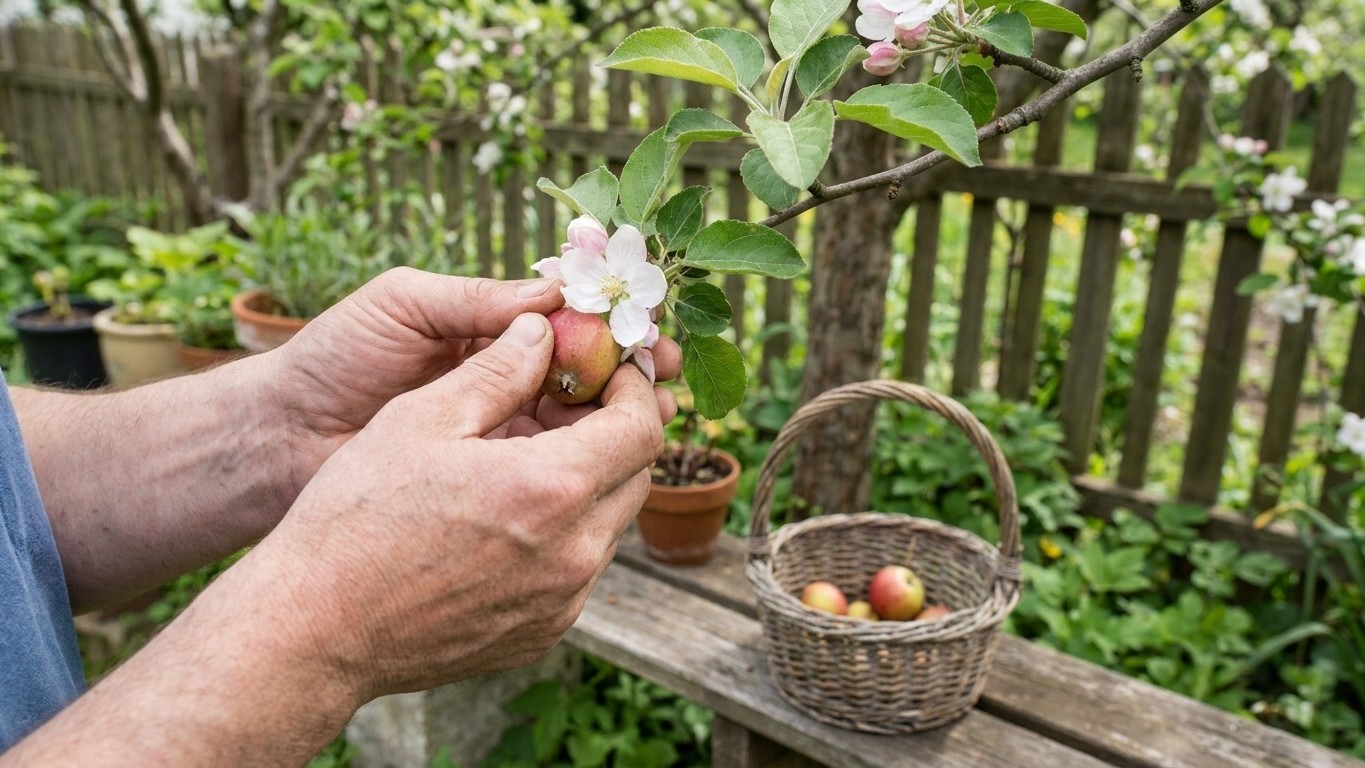

Jonagold, Mutsu, Stayman, Winesap — plant any two of those together and you get a tree full of blossom every spring and nothing to show for it by fall, because none of them makes pollen that can fertilize anything, including itself. A crabapple breaks that dead end. Most flowering crabapples shed heavy, viable pollen on their own schedule, so an established one keeps working no matter what self-sterile combination got planted around it. Best decided before the ground’s committed, though a graft can fix it later.
Why it matters
Apple trees need cross-pollination between two different varieties to set a full crop. A single tree, even one covered edge to edge in blossom, rarely fruits well alone. Bees and other pollinators carry pollen from tree to tree, but only pollen that’s viable and available at the right moment does any good. A flowering crabapple solves both problems in one planting, because most crabapple selections shed heavy, viable pollen and because an established one is loaded with pollen most home apple varieties can use.
The stakes get higher in an orchard leaning on self-sterile varieties. Jonagold, Mutsu, Stayman and Winesap all produce pollen that can’t fertilize anything, not even the flowers on the same tree, according to Clemson HGIC 1350, UGA Circular 740 and USU Extension. Plant only two of those four together and you get a yard full of bloom with no functional pollen source anywhere in it: heavy flowering, empty branches by fall. A crabapple breaks that dead end because its pollen supply doesn’t depend on what else got planted around it.
This decision belongs at the planning stage, before ground gets committed to a full apple planting, though it can be fixed later by adding a crab or grafting a crabapple branch onto an existing tree. Waiting until the trees are already blooming and not fruiting means losing a year or more while a new pollinizer establishes and reaches flowering size. The earlier the crabapple goes in, the sooner it earns its place. Matching its bloom timing to the rest of the orchard matters just as much as the pollen itself, which is a question of stage, not calendar month.
When to do it
Plant a bare-root crabapple at the same dormancy stage you’d plant a bare-root apple, before buds swell and while the tree is still leafless. Container-grown crabapples tolerate a wider planting window, but going in dormant still gives the roots a head start before the tree’s first bloom in your orchard.
The timing that actually decides whether the crabapple does its job shows up later, at the pink and bloom stages, when you can see whether its flowers overlap the apple varieties it’s meant to serve. Clemson HGIC 1350 groups apple varieties into three relative bloom windows: group A (Anna, Dorsett Golden) flowers earliest, group B (Fuji, Gala, Ginger Gold, Granny Smith, Jerseymac, Mollie’s Delicious, Mutsu, Red Delicious, Yates) flowers in the middle, and group C (Arkansas Black, Golden Delicious, Jonagold, Ozark Gold, Priscilla, Rome Beauty, Stayman) flowers latest. The order holds everywhere; the calendar date it lands on does not. A crabapple that overlaps an early bloom group in one climate can drift toward overlapping a middle or late group somewhere with a shorter or longer spring.
What moves the date year to year is spring weather, not the calendar. A cold snap right after green tip can hold a crabapple back a week or more, while an early warm stretch pulls it forward into overlap with an earlier bloom group than usual. Watch the buds rather than a date written down from last year. Green tip tells you dormancy has broken, pink tells you bloom is close, and open bloom is the only stage where overlap can actually be confirmed by eye, by which point it’s too late to fix a mismatch for that season.
If the apple varieties themselves haven’t been chosen yet, matching them for compatible bloom timing is easier before the ground gets broken. The Apple Varieties guide breaks down which cultivars share a bloom window and which don’t, which is worth checking before the crabapple selection gets locked in too.
How to do it

Choose a crabapple that fits the space
Ornamental flowering crabapples get sold on their own roots almost as often as they’re grafted, so mature size depends on the specific tree rather than a single rootstock code the way a grafted apple does. If sizing the crabapple to match a dwarf or semi-dwarf apple block matters to you, ask the nursery which rootstock it’s grafted onto and use USU Extension’s home-orchard figures as a guide: M.9 stays 8 to 12 feet at maturity, M.26 and G.11 run 12 to 15 feet, G.30 and M.7 reach 18 to 20 feet, M.106 climbs to 25 to 30 feet, MM.111 reaches 30 to 35 feet, and a seedling rootstock can top out at 35 to 40 feet. Match the crabapple’s eventual height to the apples around it so it doesn’t end up shading a dwarf block from above once both trees mature.
Set the position
Place the crabapple close enough that pollinators move between it and the varieties needing pollen during the overlapping bloom window. There’s no fixed distance in the reference figures above, since bee activity, wind and layout all affect how far pollen actually travels in a given yard. When in doubt, plant closer rather than farther.
A short planting checklist covers the sequence:
- Confirm which apple bloom group needs a pollen partner, using the HGIC 1350 groupings above.
- Choose a crabapple known for heavy, extended bloom, and note what rootstock it’s grafted onto, if any.
- Plant it dormant, at the same stage you’d plant a bare-root apple tree.
- Track bud stages each spring, green tip, pink, bloom, to confirm timing overlap once the tree is old enough to flower.
- Expect heavier fruit set on the pollinated varieties once overlap is confirmed, and thin accordingly.
What goes wrong
The most common failure shows up as a full season of bloom followed by an almost empty harvest. A grower plants Jonagold and Winesap side by side, watches both trees flower heavily, and gets little to no fruit. Both varieties carry sterile pollen, per Clemson HGIC 1350, UGA Circular 740 and USU Extension, so neither can finish the other’s flowers even with bees working the blossoms all week. Sterility runs one way: a Jonagold flower can be pollinated by something else, but its own pollen never pollinates anything, including another Jonagold.
The second failure is a bloom-timing miss that doesn’t show up right away. A crabapple planted to serve a group C variety like Rome Beauty or Golden Delicious does nothing if its own bloom finishes before that variety opens. This mismatch often stays hidden the year of planting, because a young crabapple frequently doesn’t flower at all for its first couple of seasons. The grower assumes the pollination problem is solved and only finds out otherwise once the crabapple is old enough to bloom, and the timing still doesn’t line up.
A third mistake is removing the crabapple later. Once it’s grown into an ornamental feature, started shading a bed, or crowded a walkway, it’s tempting to take it out. If it’s the only viable pollen source for a self-sterile variety in the yard, cutting it down drops that variety’s harvest the following spring with no warning beyond the missing fruit.
Heavy, successful pollination brings a problem of its own: more fruit than the tree can properly size. A well-pollinated cluster that sets every flower needs thinning down to one fruit per cluster within a few weeks of bloom, or the crop comes in undersized and the branches carry more weight than they can hold long-term.
What changes where you are
The order of apple bloom groups holds everywhere, but the calendar date each group reaches pink and bloom shifts by weeks depending on climate, and even by site within the same yard, since a low spot that collects cold air lags a slope by days. A crabapple that overlaps a middle bloom group in one region can drift toward overlapping an earlier or later one somewhere with a shorter or longer spring. Watch the bud stage on your own trees each year rather than trusting a date that worked last spring or a description printed in a catalog.
Winter hardiness varies by region in ways a general guide can’t specify for every yard. Some flowering crabapple cultivars tolerate far colder winters than others, and a tree that thrives in one part of the country can suffer dieback in a harsher climate. Check both the crabapple selection and the apple rootstock choice against the USDA hardiness zone for your own address before ordering, since a rootstock rated hardy in a mild climate can fail in a colder one even if the grafted variety on top survives.
Chill-hour needs shift the same way. An apple or crabapple that requires a long, cold winter to break dormancy evenly can bloom sparsely or erratically in a mild-winter climate, which weakens its value as a pollen source no matter how well its bloom group matches on paper. For the bloom windows, chill-hour figures and hardiness ratings that apply to your county, check with your state or county extension service, and look at how the wider apple-growing picture plays out in your climate before the variety list gets finalized.
Common questions
Does any flowering crabapple work as a pollinator, or does it need to be a specific kind?
Most flowering crabapples produce enough viable pollen to serve the job, but some ornamental cultivars are bred for a cleaner, seedless look and carry little usable pollen. Ask the nursery whether the specific tree you’re buying is known as a fruiting or pollen source rather than assuming any crabapple on the lot will do.
Will the crabapple cross-pollinate my apples and make the fruit taste different?
No. Cross-pollination affects the seed inside the apple, not the flesh or skin of the fruit itself, so an apple pollinated by a crabapple still grows and tastes like the variety it belongs to. Only a seed grown out from that fruit would show any hybrid traits, and almost nobody grows apples from seed for eating.
Do I need more than one crabapple in the yard?
Usually not. A single mature crabapple sheds far more pollen than it needs for itself, so one tree with the right bloom timing can serve several apple varieties at once. What matters more than the count is whether its bloom actually overlaps the varieties that need it.
Can I graft a crabapple branch onto an existing apple tree instead of planting a whole new tree?
Yes, and it’s a common fix when there’s no room for another full-sized tree. A grafted crabapple branch flowers and sheds pollen the same way a whole tree would, once it’s established enough to bloom, though it takes a season or two after grafting before it flowers reliably.