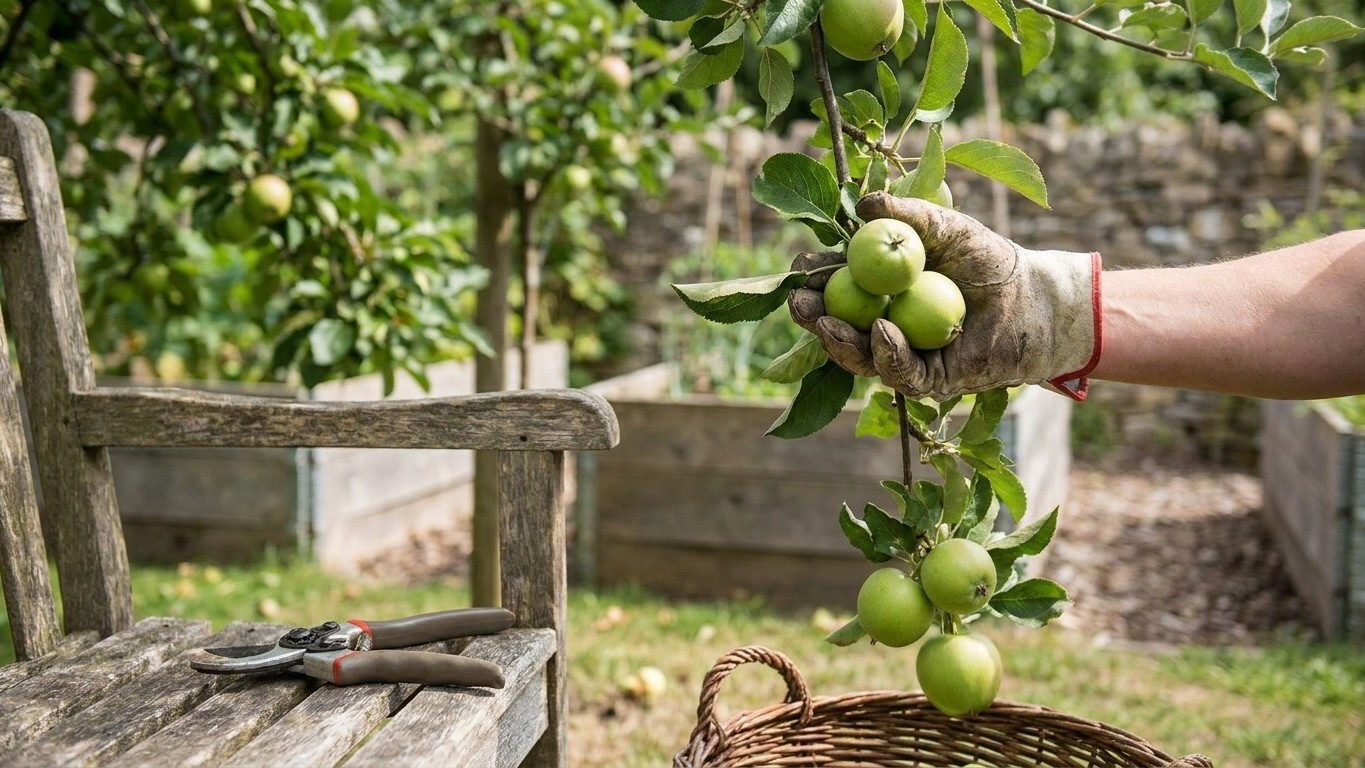

Thinning apples means removing all but one fruit from each cluster on the spur, so the tree channels its sugar into a single, larger apple instead of splitting it five or six ways. Skip the step and you get a heavy crop of small, blemished fruit this year and often none at all next year. The action to take: once the tree has finished its natural early fruit drop, walk the branches and cut every fruitlet from each cluster except the biggest, best-shaped one, usually the center fruit.
Why it matters
An apple spur does not produce one flower. It produces a cluster, usually five to six blossoms opening from a single bud, and if pollination goes well every one of them can set fruit. Left alone, those fruitlets spend the whole season crowded against each other, competing for the same limited supply of water and carbohydrate the spur can deliver. None of them ever reaches full size, and the ones touching each other trap moisture in a spot where scab and rot get a foothold before you ever see it from the ground.
The bigger cost shows up the following spring. A tree that carries a full, unthinned crop puts most of its stored energy into ripening seeds rather than building the flower buds it needs for next year’s bloom. That is the mechanical cause of biennial bearing, the pattern where a tree loads up one year and goes nearly blank the next. Thinning to one fruit per cluster, done at the right stage, is the single practice that breaks that cycle before it starts.
There is also a structural risk that has nothing to do with fruit quality. A limb carrying a full, unthinned crop weighs far more than the same limb carrying a thinned one, and on trees grafted onto dwarfing rootstock the wood and the root anchorage are not built for that load. This matters most in early summer, well before harvest, which is exactly when the crop is heaviest and the fruit is still growing.
When to do it
Timing runs off the tree’s stage, not the calendar. Apples go through dormancy, green tip, pink, bloom, and petal fall, and the cluster you’re going to thin doesn’t exist as a distinct target until after petal fall, when the fertilized blossoms have swollen into small green fruitlets you can actually tell apart. Most trees then drop a portion of that set on their own over the following few weeks, a natural culling growers call June drop. The right window for hand-thinning opens after that natural drop has finished, not before it.
Thinning ahead of the natural drop wastes effort, because you can’t tell yet which fruitlets the tree is going to shed for free. Thinning too long after it, once the remaining fruit has already grown large, wastes the tree’s investment in fruit you’re about to cut off anyway. The natural drop is the signal to watch for, and it moves with the same variables that move bloom itself.
Why the timing shifts across a mixed orchard
If you’re growing more than one variety, they won’t reach petal fall on the same day. The Clemson Cooperative Extension’s HGIC 1350 fact sheet on apples groups varieties into bloom order: group A (Anna, Dorsett Golden) flowers earliest, group B (Fuji, Gala, Ginger Gold, Granny Smith, Jerseymac, Mollie’s Delicious, Mutsu, Red Delicious, Yates) follows, and group C (Arkansas Black, Golden Delicious, Jonagold, Ozark Gold, Priscilla, Rome Beauty, Stayman) comes last. That order holds everywhere, but the actual dates shift by climate, so treat each variety’s own petal fall and natural drop as its own trigger rather than thinning the whole orchard on one visit.
Pollination status changes what you’ll find when you get there. Jonagold, Mutsu, Stayman, and Winesap carry sterile pollen, a fact confirmed by Clemson’s HGIC 1350, the University of Georgia’s Circular 740, and Utah State University Extension. Those varieties still need a compatible pollenizer nearby to set fruit at all, and if the orchard is short one, the cluster count you find after bloom may already be sparse. Check the actual set on the tree before assuming a heavy thinning job is ahead of you.
How to do it

The gesture is simple once you’re standing at the right stage. Work one cluster at a time, and use small scissors or pruners rather than your fingers.
- Find the king bloom: the largest, most centrally positioned fruitlet in the cluster, usually the one from the first flower to open.
- Cut every other fruitlet in that cluster off at its stem, leaving the king bloom fruit in place.
- If the king bloom fruit is misshapen, undersized, or damaged, keep the next best one instead.
- Cut, don’t pull. Yanking a fruitlet off by hand can tear the spur it grew from, and that same spur is expected to fruit again in future years.
- Look at spacing along the whole limb, not just within one cluster. Clusters that sit close together on the same branch should be thinned so the kept fruit have room to size up without touching their neighbors.
How much climbing this takes depends on the rootstock. A tree on M.9 tops out at 8 to 12 feet by USU Extension’s figures, and most clusters stay within hand or short-ladder reach. Trees on MM.111 or on seedling rootstock reach 30 to 40 feet, and the upper canopy will need a ladder or pole pruner to thin properly, which is worth planning for before the season gets away from you.
| Rootstock | Mature height (USU Extension) | What it means for thinning |
|---|---|---|
| M.9 | 8-12 feet | All within hand reach, but weak wood and shallow roots mean overcropping is riskier here than anywhere else |
| M.26 / G.11 | 12-15 feet | Mostly hand reach, occasional step stool for the top |
| G.30 / M.7 | 18-20 feet | Ladder needed for upper scaffolds |
| M.106 | 25-30 feet | Taller ladder, but sturdier limbs tolerate a heavier crop before thinning becomes urgent |
| MM.111 | 30-35 feet | Full ladder or pole pruner for the top third of the canopy |
| Seedling | 35-40 feet | Hardest tree to thin completely; upper clusters often go unthinned by default |
What goes wrong
The most common mistake is thinning before the natural June drop has finished. You end up cutting fruit the tree was going to shed on its own, and you can’t yet tell which fruitlets in a cluster are strongest, since some haven’t finished sizing up relative to their neighbors. Wait for the drop to settle before you make the first cut.
The second mistake is leaving two fruits per cluster instead of one, usually out of reluctance to cut a perfectly healthy-looking fruitlet. Two fruits touching in a cluster trap moisture between them all season, and that damp pocket is where scab and brown rot get started before the skin shows any outward sign. By the time you notice, the damage is already inside.
Pulling instead of cutting
Pulling a fruitlet off by hand instead of snipping it can tear the spur along with it. Apple spurs are perennial, meaning the same spur is expected to flower and fruit again for several years running, and a torn spur may not recover in time for next spring’s bloom. This kind of damage doesn’t show up until the following year, when that spot on the branch stays blank while the rest of the limb flowers normally.
Ignoring pollination status causes the opposite mistake: over-thinning a tree that was never going to carry a heavy crop in the first place. Jonagold, Mutsu, Stayman, and Winesap all carry sterile pollen, and a garden that pairs two of them together with no other pollenizer will set little or no fruit regardless of thinning. Check the actual cluster count on the tree before assuming it needs the same aggressive thinning as a well-pollinated variety nearby.
Finally, skipping thinning altogether in a heavy bloom year risks limb breakage in mid to late summer, once the unthinned fruit has put on most of its weight but before it’s ready to pick. This shows up as a split at the branch union, often on the very rootstocks with the weakest wood, and once a limb splits it doesn’t heal back to full strength.
What changes where you are
The bloom-group order that Clemson’s HGIC 1350 lays out, group A ahead of group B ahead of group C, holds true in every climate, but the actual calendar dates it maps onto move considerably from one region to another. A grower in a short, cool season will see the whole sequence compressed into fewer weeks than a grower in a long, mild one, even though the relative order between varieties stays the same. That’s the detail to carry into your own orchard: use the group order to predict which variety reaches petal fall first, not to guess a date.
Rootstock height figures from USU Extension don’t shift by region, since they describe the rootstock’s own growth habit rather than anything climate-driven, so the table above applies whether you’re thinning in a short season or a long one. What does shift regionally is how much natural fruit drop and frost damage the bloom sees before you ever pick up the shears. A late frost after bloom can thin a crop on its own, sometimes more thoroughly than you’d choose to by hand, which changes how much hand-thinning is actually needed that year.
For the frost timing, chill-hour expectations, and any spray program tied to fruit-cluster crowding in your own area, check with your local extension service rather than relying on a national figure. If you’re still working out which varieties and rootstocks to plant in the first place, the broader picture is in Growing Apples, and if you’re adding a variety to a tree you already have rather than planting new, that’s covered separately in Grafting an Apple Tree: Adding a Variety to What You Have. Getting the rootstock and bloom group right at the point of purchase avoids a lot of the pollination guesswork described above, which is exactly what Buying an Apple Tree: What the Label Does Not Tell You walks through.
Common questions
Do I have to thin every single year, even a light bloom year?
Thin whenever a cluster has set more than one fruit, regardless of how light the overall bloom looked. A light year can still produce fully set clusters on the spurs that did flower, and those clusters carry the same crowding and biennial-bearing risk as they would in a heavy year.
All the fruitlets in a cluster look identical, so how do I pick which one to keep?
Look for the one growing from the center of the cluster with the straightest stem, since that’s usually the king bloom fruit and tends to size up best. If none stands out, keep the largest one and cut the rest close to their stems rather than agonizing over a perfect choice.
Can I just shake the branch or knock fruit off instead of cutting each one?
Don’t. Shaking removes fruit at random rather than the specific extras you’re trying to cull, and it can knock off the king bloom fruit along with a healthy spur or two. Hand-cutting each cluster takes longer but it’s the only way to control which fruit stays.
My tree dropped a lot of fruit on its own. Do I still need to thin what’s left?
Check the remaining clusters before assuming the tree did the job for you. Natural June drop often removes only one fruitlet per cluster rather than clearing every cluster down to a single fruit, so clusters that still hold two or more still need a hand.