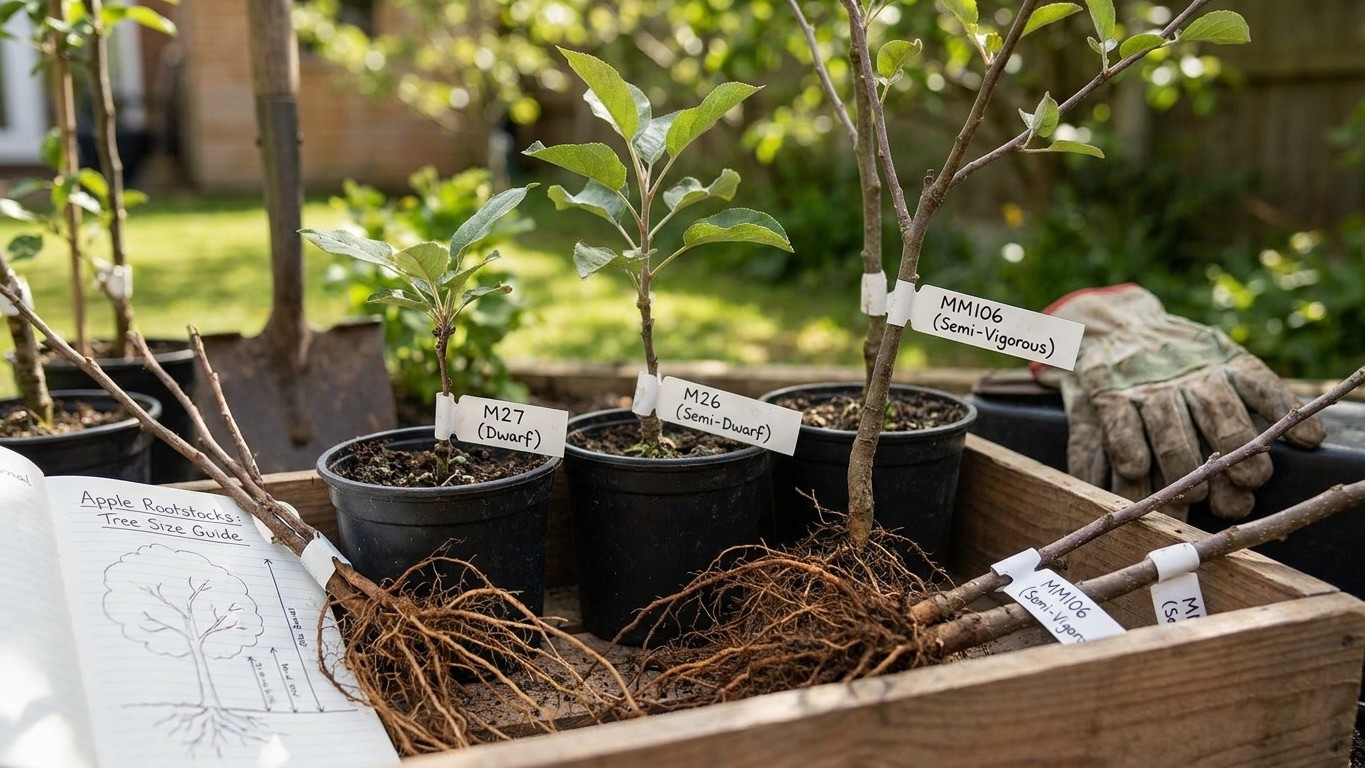

A thirty-five-foot seedling tree doesn’t announce itself at the nursery — it hides inside a two-foot whip with one price tag and no warning label. Plant it against a fence line thinking dwarf, and six years later you’re hauling out a ladder to reach the top third of the canopy while it shades out everything planted nearby. The mistake was never the variety. It was the rootstock underneath, chosen once, long before the tree shows you what it’s become.
Why it matters
Every apple tree sold at a nursery is really two plants grafted into one: a fruiting variety on top and a rootstock underneath it. The variety decides what the apple tastes like and when it ripens. The rootstock decides how big the tree ultimately gets, how soon it starts fruiting, and how much space you owe it for the next few decades. Get the rootstock wrong and no amount of pruning will turn a 35-foot seedling tree into something you can pick from a stepladder.
This decision gets made once, and it gets made before the tree ever goes in the ground. USU Extension lists mature heights running from 8 to 12 feet on M.9 rootstock up to 35 to 40 feet on ungrafted seedling rootstock, with M.26, G.11 apple rootstock, G.30 apple rootstock, M.7 apple rootstock, M.106 apple rootstock and MM.111 apple rootstock spread across the range between. A tree on M.9 apple rootstock fits against a fence line or in a large container. A tree on MM.111 or seedling stock needs the kind of open ground you’d give a shade tree, because that’s effectively what it becomes.
Size affects more than how much lawn you give up. A dwarf tree on M.26 or G.11 typically starts bearing sooner than a full-size seedling tree, and every branch stays within reach of a hand pruner and a picking bag. A standard tree on MM.111 or Seedling apple rootstock needs an orchard ladder for the top third of its canopy and casts enough shade to affect anything planted nearby. If you’re laying out your first planting under Growing Apples, this is the decision that shapes every other one you’ll make about spacing, staking and pruning from here on.
When to do it
Rootstock selection happens at one point in the tree’s life: before you buy it, while the nursery stock is still dormant bare-root material with no leaves to distract you from what’s printed on the tag. Once a tree is planted and has pushed its first green tip, the rootstock underneath is fixed for good. There’s no later season in the tree’s life when you get to revisit the choice short of digging it out.
What moves the timing isn’t a date on the calendar, it’s the nursery’s own dormant shipping window, which runs from when trees are dug during winter dormancy through to just before spring buds swell toward green tip. Order and plant within that window, because a bare-root tree that sits around after its roots start pushing new white growth loses vigor fast.
The second timing decision that rides along with rootstock choice is pollination. Most apple varieties need a different variety flowering nearby at roughly the same time to set fruit, and that overlap is described by bloom groups rather than by calendar dates. Clemson Cooperative Extension’s HGIC 1350 fact sheet groups varieties as A, B or C by how early or late they flower relative to each other: group A (Anna, Dorsett Golden) blooms first, group B (Fuji, Gala, Ginger Gold, Granny Smith, Jerseymac, Mollie’s Delicious, Mutsu, Red Delicious, Yates) blooms next, and group C (Arkansas Black, Golden Delicious, Jonagold, Ozark Gold, Priscilla, Rome Beauty, Stayman) blooms last. The actual dates shift with the weather in a given year and region, but the order between the groups holds, so a group A and group C variety may miss each other’s bloom window in a short, fast spring. Choose the rootstock and the pollinator variety together, before either tree leaves the nursery.
How to do it

Picking the right rootstock is mostly a matter of reading the tag correctly and doing the arithmetic on the space you have. Work through it in this order:
- Find the rootstock code on the tree’s tag or catalog listing. It’s usually printed as a letter-and-number code such as M.9, M.26, G.11, G.30, M.7, M.106 or MM.111, separate from the variety name.
- Look up the mature height for that code before deciding anything else.
- Walk the planting site and picture that height and an equal spread of canopy width, not just the hole you’re about to dig.
- Pick a second variety for pollination from the same or an adjacent bloom group, using Clemson HGIC 1350’s groupings.
- Cross-check both varieties against the sterile-pollen list before finalizing the pair.
- Plant while the tree is still dormant bare-root stock, setting the graft union, the visible knob or bend low on the trunk, well above soil grade so it never sits buried in wet soil.
Rootstock heights at a glance
| Rootstock | Mature height (USU Extension) | General category |
|---|---|---|
| M.9 | 8-12 feet | Dwarf |
| M.26 | 12-15 feet | Dwarf |
| G.11 | 12-15 feet | Dwarf |
| G.30 | 18-20 feet | Semi-dwarf |
| M.7 | 18-20 feet | Semi-dwarf |
| M.106 | 25-30 feet | Semi-standard |
| MM.111 | 30-35 feet | Standard |
| Seedling | 35-40 feet | Standard |
On the pollination side, don’t stop at matching bloom groups. Four varieties carry sterile pollen: Jonagold, Mutsu, Stayman and Winesap, according to Clemson HGIC 1350, University of Georgia Extension Circular 740 and USU Extension. Sterility runs one way. Any of those four can be pollinated by another variety and will set a full crop, but none of them can pollinate a neighboring tree in return. A two-tree planting made up of only two sterile-pollen varieties, even from the same bloom group, sets no fruit on either tree.
What goes wrong
The most common mistake is buying on variety name alone and never checking the rootstock code, then discovering years later that the “dwarf-looking” tree from the nursery is actually on MM.111 or seedling rootstock and is on its way to 30 or 40 feet. By the time that shows up as a problem, the tree is fruiting, established, and expensive to remove. Check the rootstock code before you buy, not after the tree starts crowding the fence line.
Burying the graft union
Planting too deep, so the graft union sits at or below soil level, lets the fruiting variety root directly into the ground above the rootstock. Once that happens, the dwarfing or semi-dwarfing effect the rootstock was supposed to provide gets bypassed, and the tree grows as if it were on its own full-size roots. This doesn’t show up in year one. It shows up two or three seasons in, as unexpected suckering and a canopy that keeps climbing past the height the tag promised.
Mismatched bloom timing
Pairing a group A variety like Anna with a group C variety like Rome Beauty can leave too little overlap in bloom timing for pollination to succeed, especially in a spring where warm weather pushes the early bloomer through its flowers fast. Clemson HGIC 1350 notes the group order is relative and holds across regions, but the calendar spread between groups depends on that year’s weather, so a pairing that works most years can fail in an unusually fast, warm one.
Two sterile-pollen varieties, no pollinator
Planting only two trees and picking both from the sterile-pollen list, Jonagold and Stayman for instance, means neither tree can pollinate the other even though both bloom in group C. The trees may flower heavily and still set little or no fruit. Crowding two trees too close for their eventual size compounds the problem: dense growth cuts airflow through the canopy, which raises humidity and disease pressure, the kind of symptoms covered in Apple Diseases: Telling Them Apart Before You Treat.
What changes where you are
The rootstock height figures from USU Extension hold regardless of climate, because they describe the rootstock’s own growth habit rather than a response to weather. What does change from one region to the next is bloom timing and winter hardiness, and both affect the choices layered on top of rootstock selection.
Bloom group order stays fixed, but the actual calendar dates and the size of the gap between groups move with local spring weather. A grower matching a group B and group C variety in a region with a short, fast spring needs to confirm both varieties still overlap enough to pollinate each other in a compressed bloom season. Check your own state extension service’s bloom-timing and chill-hour guidance for your specific area before locking in a pollinator pair, since group order alone doesn’t translate into a calendar date you can circle in advance.
Winter cold also narrows the rootstock list in colder regions, since some rootstocks tolerate harder freezes at the root zone than others. That’s a local hardiness question the national fact sheets referenced here don’t settle for every state, so check with your own state extension service or land-grant university before ruling a rootstock in or out for your winters.
Once the trees are cropping, the size decision keeps paying off or costing you at harvest. A dwarf tree on M.9 or G.11 keeps the whole crop within reach from the ground, while a standard tree on MM.111 or seedling rootstock puts a third of the crop up a ladder. Either way, knowing what ripe actually looks like on the branch still comes down to the fruit itself, which is covered separately in Knowing When an Apple Is Ready, Without a Calendar.
Common questions
Can I keep a full-size rootstock tree small by pruning it hard every year?
Pruning controls shape and can slow growth for a season, but it doesn’t change the vigor coded into the rootstock. A tree on MM.111 or seedling stock will keep pushing toward its mature height every year, and hard annual pruning just turns into a permanent fight rather than a fix. Choosing a dwarfing rootstock like M.9 or M.26 up front solves the problem instead of managing it forever.
Does the rootstock change how the apples taste?
No. Flavor, texture and ripening time come from the grafted variety, not the rootstock underneath it. The rootstock governs the root system, overall vigor and mature size, which is why the same variety, say Gala, tastes the same whether it’s grafted onto M.9 or MM.111, it just grows on a smaller or larger tree.
The tag on my tree doesn’t list a rootstock code. What do I do?
Ask the nursery directly before you plant, since that’s the only reliable way to know what mature size you’re committing to. If nobody can tell you, treat it as an unknown and plant with the spacing you’d give a standard, full-size tree, because that’s the safer assumption if the rootstock turns out to be seedling stock.
Do I need two different apple trees to get any fruit at all?
Most apple varieties need a different variety blooming at roughly the same time nearby to set fruit, per Clemson HGIC 1350. A single tree standing alone in a yard, with no compatible pollinator within reach of bees, often blooms heavily and sets little or nothing. Check the bloom group of your variety and plant a second one from the same or an adjacent group to be sure.