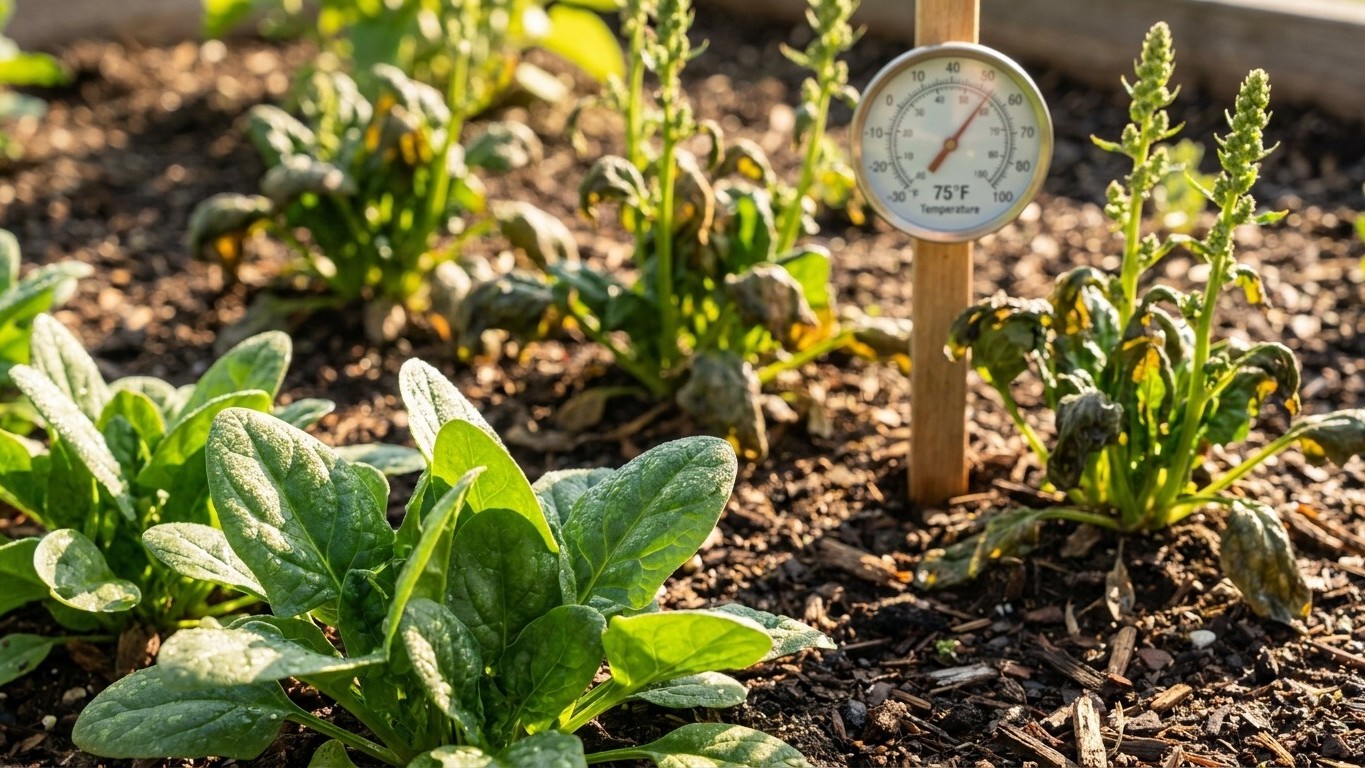

Spinach turns bitter once temperatures climb past 75 F, according to Utah State University Extension. That single number works as both a growth ceiling and a flavor tipping point, and it explains why a patch that looked fine in May can turn sharp and unpleasant by the time June heat sets in.
The short answer

Utah State University Extension states plainly that spinach grows best when temperatures do not exceed 75 F. Push past that line and two things happen at once: growth slows and the leaves turn bitter. That’s not two separate problems, it’s one threshold with a double penalty. You don’t get a warning phase where the plant is still sweet but just growing a little slower. Once the air (and more importantly, the plant tissue) sits above 75 F for stretches of the day, the chemistry inside the leaf shifts, and the taste follows.
What makes this tricky for home gardeners is that the same source flags a second trigger working alongside heat: long days. Spinach flowers, or bolts, during long days and warm temperatures in summer, per the Extension’s guidance. That “and” matters more than most people realize. It means the calendar is pushing the plant toward bolting at the same time the thermometer might be. A stretch of unusually cool weather in June won’t rescue a crop that’s sitting under fifteen-plus hours of daylight. The days are long regardless of what the mercury does, and that alone can be enough to send the plant toward a flower stalk.
So the 75 F line isn’t a date you can circle on a calendar. It’s a condition, one that can show up in late spring in a warm region or hold off until midsummer somewhere cooler. Two gardens in different states could hit that line weeks apart, or the same garden could hit it early one season and late the next depending on how quickly temperatures ramp up. The practical upshot: once you know 75 F is the ceiling, you stop watching the calendar and start watching the thermometer and the sky.
This is also why spinach has a reputation as a short-season crop. It’s not that the plant is fragile. It’s that its window of good flavor is bounded on one side by cold-tolerant germination and on the other by a fairly low heat threshold. Once you understand that boundary, the rest of the growing strategy (early planting, quick harvest, a second planting in fall) starts to make sense as a direct response to that single number.
What actually decides it
Two separate mechanisms push spinach toward bitterness and bolting, and they don’t always arrive together. Understanding them as distinct forces, rather than one vague “heat problem,” changes how you plan the season.
Day length
Spinach is sensitive to how long the sun is up, independent of temperature. Utah State University Extension notes that the plant bolts during long days and warm temperatures in summer, listing day length as its own factor rather than a side effect of heat. This is the piece gardeners most often miss. A mild, overcast stretch in early summer can still carry fifteen or sixteen hours of daylight, and that alone nudges the plant toward flowering. It’s worth being clear about what this does not mean: it does not mean spinach needs long days to thrive, the way some crops need long days to bulb up or size out. For spinach, long days are a countdown, not a benefit. The plant is racing to flower and set seed before conditions change, and the leaves become bitter as part of that shift toward reproduction.
Temperature
The second mechanism is more familiar: heat above 75 F slows growth and turns leaves bitter, according to the same source. Unlike day length, which is fixed by the calendar and your latitude, temperature swings week to week and even day to day. A cool snap can buy a little time. But because day length and temperature often climb together as the calendar moves from spring into summer, most gardens experience both pressures at once, and separating them is more than academic. It tells you which lever you have any control over. You can’t change how long the sun is up. You can choose when you plant, how much shade you provide, and how often you check the thermometer, which is why timing and site selection matter as much as any other input.
How to do it
- Plant early, while soil is still cool. Spinach seed germinates in cool soil, so getting it in the ground as soon as the ground can be worked in spring gives the crop the best shot at maturing before the 75 F line arrives.
- Water consistently. Utah State University Extension recommends 1-2 inches per week. Even moisture keeps growth steady and helps the plant handle the stretch of days before heat becomes an issue.
- Watch for pests as leaves fill in. The Extension lists aphids, slugs, and flea beetles as the problems to check for. Catching them early keeps the plant’s energy going into leaf production instead of recovery.
- Track temperature, not the calendar. Once daytime temperatures start pushing toward and past 75 F, treat that as the signal to shift into harvest mode rather than waiting for a specific week.
- Harvest before the flower stalk forms. Individual leaves may be picked any time before that stalk appears, or the whole plant can be cut to within 2 inches of the soil in one pass, per Utah State University Extension. Once the stalk forms, the leaves turn bitter and the harvest window closes.
- Store what you don’t use immediately at 32 F and 95% relative humidity. The Extension notes spinach holds for 1-2 weeks under those conditions, which is useful if a heat spike forces you to harvest more at once than you’d planned to eat right away.
- Consider a fall planting. The source recommends planting 50 to 75 days before the date you want to harvest, which sidesteps the long-day, high-heat window of summer entirely by growing the crop as daylight and temperatures fall instead of rise.
Four varieties come up in Utah State University Extension’s guidance: Bloomsdale, Melody, Teton, and Olympia. The source names them without publishing days-to-maturity or other performance data for any of the four, so treat variety choice as a separate decision from timing, not a shortcut around the 75 F line.
What Goes Wrong
- Bolting despite a mild summer. Gardeners often assume cooler-than-average weather buys them more time. It doesn’t fully protect the crop, because day length keeps climbing regardless of temperature. Once days are long, bolting pressure is present even in a mild season. The remedy is to harvest based on plant stage (before the flower stalk forms), not on how the weather feels.
- Bitter leaves after a heat spike. A few days above 75 F can be enough to shift flavor even if the plant hasn’t bolted yet. The remedy is to harvest proactively once daytime highs start regularly crossing that line, rather than waiting to see visible signs of stress.
- Aphids building up unnoticed on leaf undersides. Utah State University Extension lists aphids among the problems to watch for. Check leaves regularly through the growing period, since infestations tend to grow quietly before they become obvious.
- Slug damage on young leaves. Slugs are also named as a concern. They tend to strike overnight, so inspecting plants in early morning makes the damage, and the culprit, easier to catch before too much leaf is lost.
- Flea beetles riddling leaves with small holes. Listed alongside aphids and slugs, flea beetles are another named problem. Since spinach’s usable window is already short, damaged leaves cut into an already tight harvest period, making early monitoring worthwhile.
- Fall seed failing to germinate. Warm soil, not cold, is the obstacle for a fall crop. Germination drops once soil climbs above 80 F, so sowing too early in late summer heat can leave you with a thin stand. The remedy is to wait until soil temperature actually falls before sowing, using the 50-to-75-days-before-harvest window as your guide rather than a fixed date.
Common questions
Does a cooler summer prevent spinach from bolting?
Not on its own. Utah State University Extension identifies long days as a trigger alongside warm temperatures, so even a mild summer with long daylight hours can push spinach toward flowering.
Can I still eat spinach leaves after the flower stalk forms?
The Extension’s guidance is to harvest before that stalk appears, since leaves turn bitter once flowering is underway. Treat the appearance of a flower stalk as the end of the harvest window.
How long does harvested spinach keep?
Utah State University Extension states spinach can be stored 1-2 weeks at 32 F and 95% relative humidity, which gives some flexibility if you need to harvest a full bed at once ahead of a heat spike.
When should I sow spinach for a fall harvest?
The source recommends planting 50 to 75 days before your target harvest date. Because warm soil above 80 F reduces germination, wait for soil to cool rather than sowing purely by the calendar.