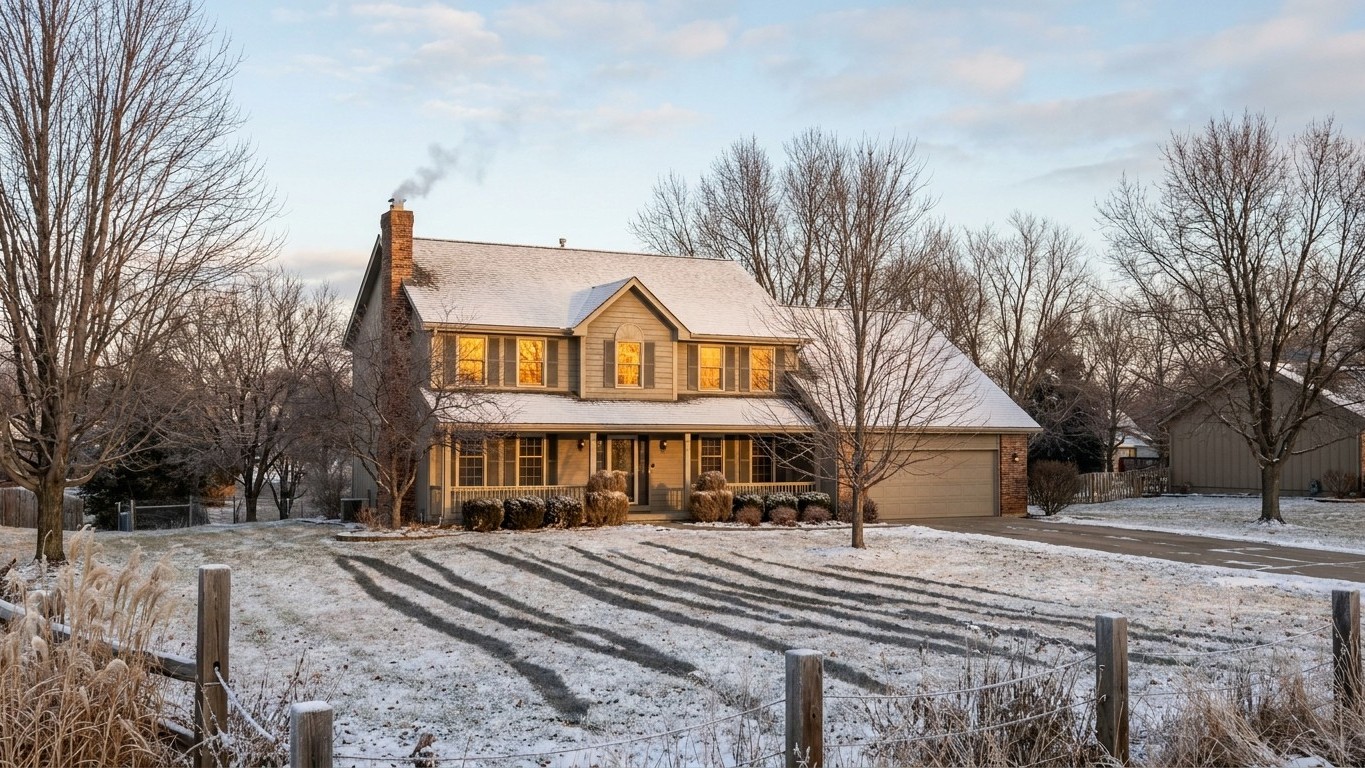

Kansas winters hover right around freezing for months at a stretch, which means furnaces run long and often rather than in short brutal bursts. That steady demand shapes everything from how much wood a household needs to how a heating system should be sized. Here’s what the numbers actually mean for a Kansas home.
How cold it gets, and for how long

The average daily low in Wichita’s coldest month sits at 22.5°F, based on NOAA’s 1991-2020 Climate Normals. That’s not a record low or some rare cold snap. It’s the typical nighttime temperature across the peak of winter, which tells you this isn’t a place where cold arrives in one sharp week and leaves. It settles in.
A mean minimum near 23°F puts Kansas in a middle band of winter severity. Compare that to a state where the coldest-month low drops into the single digits or below zero, and the difference isn’t just a matter of degree. It’s a matter of duration and how hard equipment has to work. In Kansas, furnaces and wood stoves aren’t fighting extreme lows so much as they’re fighting persistence: weeks on end of near-freezing nights that keep pulling heat out of a house.
What this means for a house
For anyone heating with wood, that steady mid-20s low means a stove or insert needs to hold a consistent burn for months, not just survive a handful of hard freezes. Insulation gaps and drafty doors matter more here than in climates with short, sharp cold snaps, because the heat loss adds up over a longer stretch of the calendar. A house that’s merely “okay” on insulation will feel the difference by February, when the furnace has already been working for twelve or fourteen weeks straight.
It also means the heating season itself runs long. Depending on elevation and how far west or north a property sits in the state, that mid-20s stretch can extend from late November into March. Anyone planning wood as a primary or supplemental heat source needs enough seasoned fuel to cover that whole window, not just the deep-winter weeks.
What a cord of wood is worth here
A cord is a volume, not a weight, and that distinction is where most firewood buyers get shorted. A full cord measures 4 feet by 4 feet by 8 feet, which works out to 128 cubic feet of stacked wood. Anything smaller, a “face cord” or a truckload sold loosely, isn’t the same product even if it’s priced like one.
| Measurement | Value |
|---|---|
| Cord dimensions | 4 ft x 4 ft x 8 ft |
| Total volume | 128 cubic feet |
| Heat energy (well-seasoned hardwood) | about 20 million BTU |
According to Michigan State University Extension, a cord of well-seasoned hardwood delivers roughly 20 million BTU, which the university puts in terms a homeowner can actually use: that’s about the equivalent of 145 gallons of #2 fuel oil, or 215 gallons of LP gas. Given a Kansas heating season that stretches from late fall well into March, that figure helps translate “how many cords do I need” into something closer to a real answer, though the exact count depends on the house, the stove’s efficiency, and how much of the load wood is carrying versus a furnace.
The 20 million BTU number is an average, not a guarantee. Species matters (dense hardwoods pack more mass, and therefore more energy, into the same 128 cubic feet than a lighter wood does), and so does moisture. A cord of unseasoned wood might occupy the same stack dimensions and still hand over dramatically less usable heat, because a chunk of that energy gets spent boiling off water before the wood ever warms a room.
How long wood takes to dry in Kansas
Seasoning time isn’t a fixed number. It’s a function of humidity, summer heat, and airflow, which means the same species dries at different rates in different states. MSU Extension’s benchmark is moisture content: wood should be burned at 20 percent moisture or less, while green, freshly cut wood can run over 60 percent. That gap is the whole reason seasoning exists.
Split and stacked wood, left where air can move through the pile, typically reaches that 20 percent mark after a full summer of drying. That’s split and stacked, not left in rounds in a shady corner of the yard. Rounds trap moisture at the core no matter how long they sit, so splitting first isn’t a cosmetic step. It’s what lets the interior of the wood actually dry.
Red oak is the named exception worth knowing about if it’s common in a local wood supply. MSU notes it dries more slowly than other hardwoods because of its cell structure, so a single summer might not be enough. Anyone burning oak should plan on extra seasoning time or verify moisture content before assuming it’s ready.
Burning wood before it’s seasoned doesn’t just waste a fraction of its heat. The trapped moisture has to boil off inside the firebox, which cools the burn, produces more smoke, and deposits more creosote in the flue. That creosote buildup is what turns an occasional chimney cleaning into an annual necessity, and in the worst cases it’s what causes chimney fires. Buying or cutting wood a full season ahead isn’t just a heat-efficiency choice. It’s a maintenance one.
Where to check before you buy
Every figure above comes from Wichita, used here as the reference point for the state. But Kansas spans a real range of terrain, from the flatter east to the higher, drier plains toward the western border, and local conditions shift accordingly. Elevation, wind exposure, and even proximity to open ground all affect how a specific property’s winter compares to the reference numbers.
Wood species availability also varies by region, and so do any seasonal burn restrictions, which are set at the local level and can change from year to year depending on air quality conditions. Before buying a season’s worth of wood or assuming a particular species is the local standard, it’s worth checking with Kansas State University’s Research and Extension service, the land-grant extension office for the state. They track regional wood supply, seasoning guidance specific to Kansas conditions, and any current burn rules that might apply to a given county.