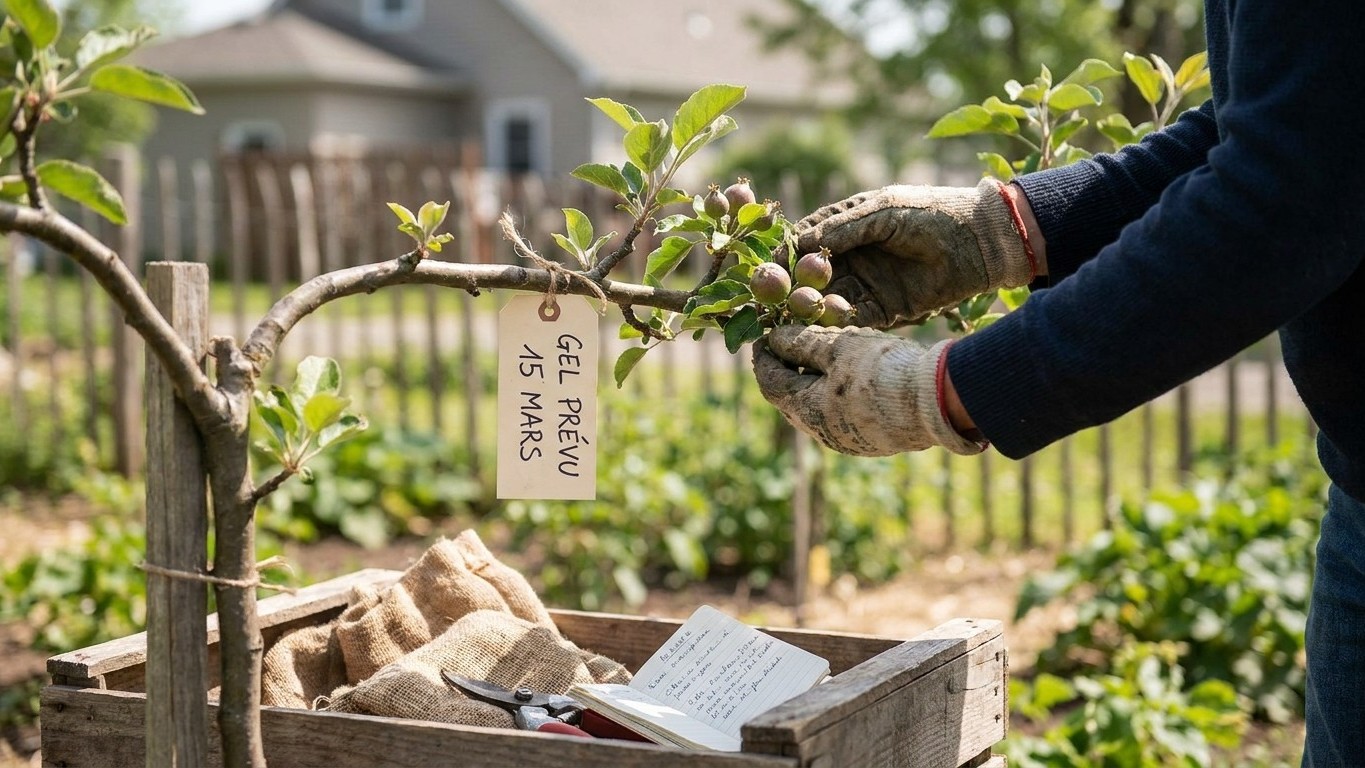

Yes, you can grow apples in Mississippi, though the state’s mild winters make it a harder crop than in states further north. NOAA’s 1991-2020 climate normals put Jackson’s coldest month average minimum at 35.3°F, and the USDA Plant Hardiness Zone Map places the state across zones 7b to 9a. Those numbers mean most classic northern apples never get cold enough to break dormancy properly. Pick a low-chill variety bred for the Deep South, such as ‘Anna’ or ‘Dorsett Golden’, rather than a cultivar developed for New England or the upper Midwest.
Can you grow apples in Mississippi
Winter chill hours, not frost, decide whether a Mississippi apple tree ever fruits well. A tree can shrug off every cold snap Jackson throws at it and still bloom thin and ragged, because surviving the winter and banking enough hours below 45°F are two different things. Jackson’s mild 35.3°F coldest-month average delivers some chill, just far less than a Minnesota orchard racks up without trying. That shortfall, more than any freeze date, is what actually shapes which varieties and which corners of the state make sense.
The real obstacle isn’t survival, it’s winter chill. Apple trees need a certain number of hours below about 45°F each winter to break dormancy and flower on schedule. Jackson’s mild coldest-month average of 35.3°F, per NOAA’s 1991-2020 normals, still delivers some chill, but nowhere near what a Minnesota or Vermont orchard racks up. Trees bred for cold climates can survive a Mississippi winter and still bloom thin, ragged, or not at all, because they never banked enough cold hours.
North Mississippi, from the hill country near the Tennessee border down through the Golden Triangle, sits at the cooler end of the state’s 7b-9a range and banks more chill hours than the coastal counties. That’s where apple growing in Mississippi tends to work best. Along the Gulf Coast and in the Delta’s warmer pockets, growers need to lean hard on the lowest-chill cultivars available, and even then should expect a shorter, less reliable bloom than orchards further north in the state. For a rundown of cultivars suited to these conditions, see this guide to Mississippi apple Best varieties.
Local microclimate matters as much as the state-wide zone. A hilltop orchard drains cold air away on a still night, while a low field or a valley bottom collects it and turns a light frost into real damage. If you’re deciding where on your property to plant, favor higher ground with open air movement over a sheltered hollow, even if the hollow feels warmer during the day.
Wherever you garden, treat Jackson’s figures as a reference point, not a guarantee. Check the hardiness zone and expected chill hours for your own county before choosing a variety, since a river valley or a hilltop a few miles apart can differ by a full zone. For planting and care timing throughout the year, consult the Mississippi apple Calendar. The next section works through the chill-hour question with real cultivar names.
Which varieties suit this climate

Two filters decide whether a variety belongs in a Mississippi yard: hardiness zone and winter chill requirement. Hardiness tells you whether the tree survives the winter. Chill hours tell you whether it flowers properly the following spring, and the two aren’t the same test. A tree can be hardy to zone 6 and still perform badly at zone 8, because it needs far more cold hours than a Mississippi winter delivers.
For most of Mississippi, that puts the state at the low-chill end of the apple spectrum, needing cultivars bred for roughly 100 to 300 hours of chill rather than the far higher totals a New England orchard racks up. ‘Anna’, a semi-self-fertile variety that catalogs list at around 200 to 300 chill hours, is one of the standard low-chill choices for the Deep South. ‘Dorsett Golden’ needs even less, around 100 to 200 hours, and blooms early alongside ‘Anna’. ‘Ein Shemer’ sits in that same 100 to 200 hour range and is another commonly offered low-chill apple.
| Variety | Chill hours (catalog figure) | Bloom timing | Pollen |
|---|---|---|---|
| ‘Anna’ | 200-300 | Early | Fertile, semi-self-fertile |
| ‘Dorsett Golden’ | 100-200 | Early | Fertile |
| ‘Ein Shemer’ | 100-200 | Early to mid | Fertile |
| ‘Gala’ | ~500 | Mid | Fertile |
| ‘Fuji’ | 400-500 | Mid to late | Fertile |
Moderate-chill varieties such as ‘Gala’ or ‘Fuji’ can work in the cooler hill country of north Mississippi, where the season runs closer to what north Alabama or the Piedmont sees, but they’re a gamble along the coast or in the Delta’s warmer pockets. Compare that to a state like North Carolina, where mid- and high-chill apples dominate because the winters bank far more cold hours, or to Connecticut, where growers plant almost exclusively high-chill northern cultivars. Mississippi sits at the opposite end of that spectrum.
No figure in Mississippi State University Extension’s published material sets exact chill-hour thresholds by county, so treat the numbers above as catalog figures from the nurseries that sell these cultivars, not a local recommendation. They’re consistent from one seed catalog to the next because chill hours are a physiological trait of the variety, not a fact that changes with local climate the way a frost date does.
Planting a pair that works here
Apple trees need a partner. Even the varieties marketed as self-fertile, like ‘Anna’, set a heavier and more even crop with a second tree blooming at the same time nearby. Plant two compatible varieties within about 50 feet of each other, closer if you can, and you remove one of the most common reasons a young apple tree fruits poorly in its first bearing years.
In Mississippi’s low-chill lineup, the easy pairing is ‘Anna’ with ‘Dorsett Golden’. Both bloom early and at roughly the same time, and both carry fertile pollen, so either one can pollinate the other. ‘Ein Shemer’ blooms in that same early window and works as a third tree or a substitute for either half of the pair. If you’re growing a moderate-chill variety like ‘Gala’ or ‘Fuji’ in the cooler hill country, pair them with each other rather than with the low-chill group, since their bloom windows fall later and won’t overlap cleanly with ‘Anna’ or ‘Dorsett Golden’.
Bloom overlap matters more than variety count. Two trees that flower three weeks apart might as well be growing in different yards, since the pollinating bees have nothing to cross by the time the second tree opens.
Watch for one trap that catches new growers everywhere apples are sold: triploid varieties with sterile pollen. Cultivars such as ‘Mutsu’ (also sold as ‘Crispin’) and ‘Jonagold’ produce little to no usable pollen of their own. They need two other varieties nearby, one to pollinate them and a second to pollinate that pollinator, and they can’t do the pollinating job themselves even though they flower normally. None of the low-chill varieties suited to Mississippi are triploids, but if you add a moderate-chill cultivar to the mix, check its pollen fertility on the tag before assuming it can pair with anything else in the yard.
The frost that costs a crop here

The frost that actually costs a Mississippi grower a crop rarely kills the tree. It kills the flowers, and the tree stands there green and healthy while the season’s apples are already gone.
When the danger window falls
At the Jackson airport weather station, NOAA’s 1991-2020 climate normals put the last spring freeze (32°F) in the window of March 6 to March 22. That’s a 30 to 70 percent probability band, not a guaranteed cutoff, and it comes from one station. Suburban and rural gardens away from the airport’s paved surroundings typically see their last frost later, sometimes by a week or two, and gardens at higher elevation in the hill country can run later still. Check your own county’s frost record rather than assuming Jackson’s window applies to your yard.
The stage of the buds matters more than the date on the calendar. Once buds swell and show the pink of the unopened flower, and especially once the blossoms are open, a hard freeze can kill the flower parts outright while leaving the wood, bark, and leaf buds undamaged. The tree leafs out on schedule and looks fine all summer. There’s simply no fruit, because the flowers that would have become apples died in a few cold hours weeks earlier.
Low-chill varieties like ‘Anna’ and ‘Dorsett Golden’ bloom early, which is exactly the trait that makes them suited to Mississippi’s mild winters, but it also puts their flowers in the frost window more often than a later-blooming cultivar would be. There’s no practical way to warm an outdoor apple tree in bloom on a large scale, so the useful defenses are smaller ones: plant on a slope or high ground where cold air drains away rather than in a low pocket where it collects, and cover a young or small tree with frost cloth on nights when a freeze is forecast after bloom has started. A later-blooming variety is the real long-term protection where the local frost record runs into late March, since it simply isn’t in flower yet when the last hard freeze arrives.
The apple year in Mississippi
Apple timing is read off the tree, not the wall calendar, but the stages line up loosely with Jackson’s frost windows from NOAA’s 1991-2020 normals, and gardeners elsewhere in the state should shift these by however much their own last frost differs from that reference city.
- Dormancy (winter): the tree is bare and banking chill hours. Prune while it’s fully dormant, before any bud swell, and finish before growth starts.
- Green tip: the first green growth pushes through the bud scales, usually before the last-frost window opens. Frost at this stage rarely damages the crop since flower parts aren’t exposed yet.
- Pink bud: the unopened flower shows color, often falling inside or just before Jackson’s March 6 to March 22 last-frost window. This is where frost risk to the crop starts in earnest, and where covering a young tree pays off.
- Bloom: flowers open and pollinators need to be active. A freeze now can wipe out the year’s fruit even though the tree survives untouched.
- Petal fall and fruit set: pollinated flowers begin swelling into small fruit. Thin overcrowded clusters now so the tree isn’t carrying more apples than it can size up.
- Summer growth: fruit sizes up through the warm months. Keep up with watering during dry stretches and watch for pest and disease pressure typical of Deep South humidity.
- Harvest: timing depends on variety, with low-chill cultivars like ‘Anna’ typically ready earlier in the season than a moderate-chill variety like ‘Fuji’. Pick by taste and by how easily the fruit separates from the spur rather than by date alone.
- Fall frost: NOAA’s 1991-2020 normals put Jackson’s first fall freeze between November 7 and November 22, well after harvest for most Mississippi apple varieties, so fall frost rarely threatens the crop the way spring frost does.
The gap between those two frost windows, roughly from early March to mid-November at Jackson, is the frame the whole season fits inside. Everything from pruning to harvest gets pushed earlier or later depending on how your own property’s frost dates compare to that reference point.
Local help
Mississippi State University Extension is the best local source for variety performance reports and spray timing, since chill-hour needs and disease pressure both shift across the state’s counties. Their extension office publishes guidance on tree fruit for home growers, and county agents can tell you which cultivars other growers nearby have had success with, information that changes faster than any statewide guide can track. Call or visit before you order trees for spring planting.
Common questions
Can I grow a ‘Honeycrisp’ or ‘Pink Lady’ apple tree in Mississippi?
Not reliably. Both need far more winter chill than Mississippi’s mild coldest-month temperatures typically provide, so they tend to bloom late, erratic, or not at all. A low-chill cultivar like ‘Anna’ or ‘Dorsett Golden’ is the safer bet.
Do I need two apple trees, or will one produce fruit alone?
A semi-self-fertile variety like ‘Anna’ will set some fruit on its own, but a second tree blooming at the same time increases the crop noticeably. If you only have room for one tree, expect a lighter, less consistent harvest than a paired planting.
How long before a new apple tree starts bearing fruit here?
Most young apple trees on standard nursery rootstock begin bearing a few years after planting, with earlier crops on some dwarfing rootstocks. Mississippi’s mild winters and long growing season don’t change that timeline much either way.
My apple tree bloomed but the flowers turned brown and dropped without setting fruit. What happened?
The most likely cause is a late freeze that hit the open blossoms, or a lack of pollination if there was no compatible tree blooming nearby. Both leave the tree looking healthy while the crop is simply gone for the year.
Can apple trees handle the heat and humidity in the Mississippi Delta?
They survive it, but summer humidity raises the risk of fungal diseases like scab and cedar-apple rust more than cold ever does in this state. Good airflow around the canopy and a site that isn’t waterlogged after rain matter more here than in a drier climate.