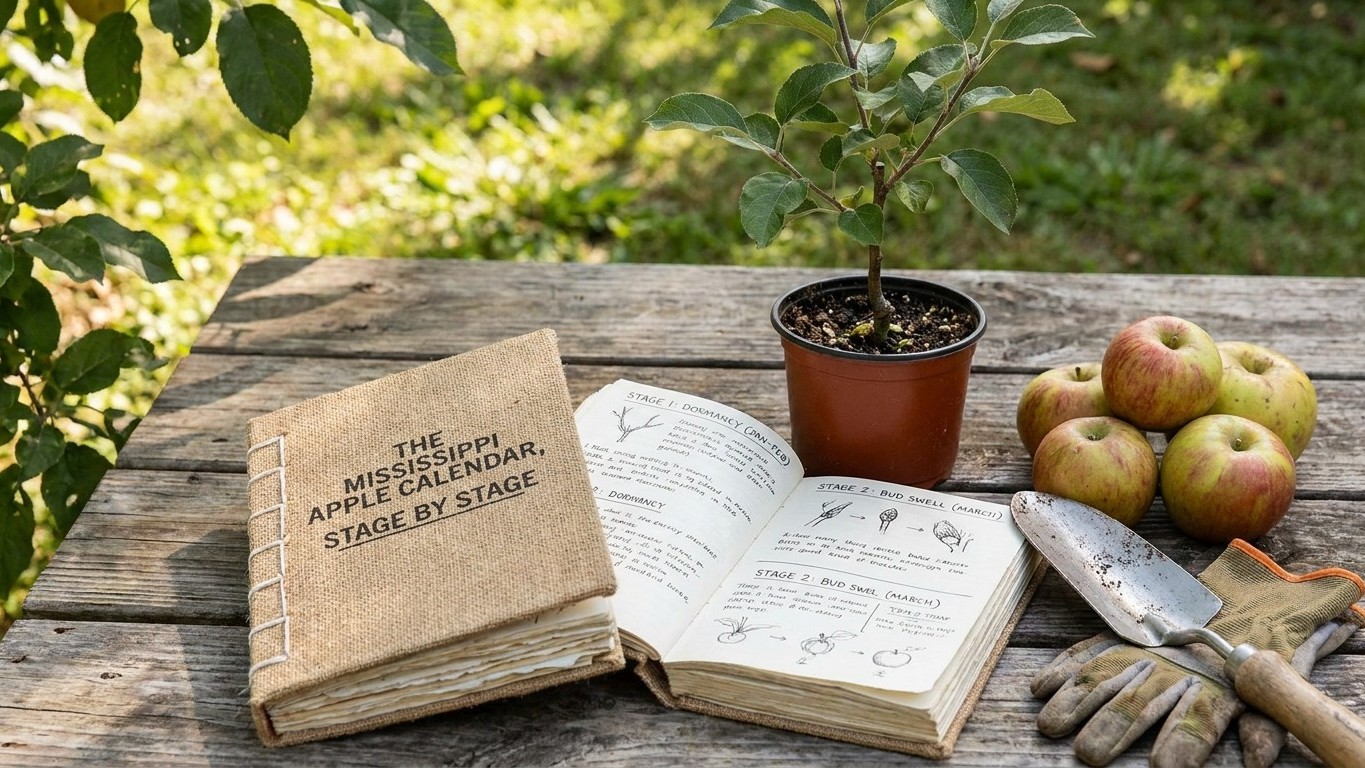

Apple trees in Mississippi run on a stage-by-stage calendar anchored to frost, not a fixed date. Around Jackson, NOAA’s NCEI 1991-2020 climate normals put the last spring freeze between March 6 and March 22, and the first fall freeze between November 7 and November 22. Bloom is the stage that matters most: a tree flowering before that spring window closes risks losing its crop to frost. Check your own tree’s bloom stage against your county’s frost pattern before you spray, prune, or worry about a cold night.
The short answer for Mississippi
Mississippi’s apple calendar doesn’t run on dates — it runs on bloom, and around Jackson that means the danger stretches roughly March 6 to March 22, whenever the frost happens to break. A tree in green tip stage that week sails through untouched; the same tree in full bloom can lose its whole crop overnight. So don’t check the wall calendar, check the buds. Walk out this morning, find your tree’s actual stage, and match it against your county’s own frost window before you decide whether tonight’s cold is a problem or nothing at all.
Mississippi’s winters are mild enough that chill, not cold, is usually the limiting factor. NOAA’s 1991-2020 normals put the average daily minimum for the coldest month at Jackson at 35.3°F, far short of the deep freezes that block bud break elsewhere. That mildness means many high-chill northern apples never accumulate enough cold hours to leaf out and flower evenly here. Realistic low-chill and moderate-chill choices for most of the state include:
- ‘Anna’ – low chill, an early, reliable bloomer for mild winters
- ‘Dorsett Golden’ – low chill, similar timing to ‘Anna’ and often planted alongside it for pollination
- ‘Ein Shemer’ – low chill, a dependable pollinator partner for the other two
Those and other options for the state are covered in depth on The Best Apple Varieties for Mississippi.
Frost hardiness and winter chill are two separate filters, and an orchard can fail either one. A tree can survive winter and still flower badly if it never gets enough cold hours. A tree can get plenty of chill and still lose its whole crop if it blooms into a March freeze. Whichever variety you plant, the calendar below is built around Jackson’s frost dates, and your own county’s dates may run later in spring and earlier in fall, sometimes by a week or two.
Working through it

Every apple stage in Mississippi lines up against the frost window, not the date on the wall. A late winter, an early spring, or a warm February all shift the calendar, so the stage the tree is actually in is what should decide the next task, not the number on the calendar.
| Stage | What’s happening | Frost risk (Jackson reference) |
|---|---|---|
| Green tip | Buds swell and show first green | Low, wood still dormant-hardy |
| Pink | Flower buds show color, unopened | Rising, watch the forecast |
| Bloom | Blossoms fully open | Highest, a freeze here can take the whole crop |
| Petal fall / fruit set | Petals drop, fruitlets begin to swell | Still elevated through the tail of the frost window |
| Harvest | Fruit reaches maturity for the cultivar | Fall freeze risk shifts to unhardened new growth, not fruit |
Dormancy and green tip

Dormancy runs through the coldest stretch of winter, while the tree accumulates the chill hours it needs before it can flower normally. Green tip, the first visible swelling of the buds, usually follows as days lengthen and temperatures climb past the tree’s chill threshold. This stage is the last safe point for dormant pruning and dormant oil sprays, since once green tissue is showing, cuts and sprays start costing the tree wood and buds it needs for the coming crop.
Pink to bloom

Pink stage, when the unopened flower buds show color but haven’t split, is the point to start watching the forecast closely. Around Jackson, NOAA’s NCEI 1991-2020 normals place the last spring freeze between March 6 and March 22, and a tree that reaches full bloom before that window closes is exposed. Open blossoms are killed at temperatures well above what dormant wood tolerates, so a late cold snap during bloom can wipe out the year’s crop even if the tree itself is undamaged. This is the stage where a variety’s bloom date landing after the local frost window closes matters more than any other single decision, which is why cultivar choice belongs upstream of this calendar, not downstream of it.
Petal fall and fruit set

Once petals drop, the fruit begins to swell, and this is when thinning decisions get made. Fruit set is also when the tree is most sensitive to a late, hard freeze, since young fruitlets have less cold tolerance than the open blossom did. A frost that lands after petal fall but still within the tail end of the spring frost window can thin a crop the grower never meant to thin.
Harvest

Harvest timing depends on the cultivar’s days-to-maturity count from bloom, not from a fixed date, and runs from midsummer for the earliest low-chill varieties to well into fall for later types. The first fall freeze, which NOAA’s NCEI normals put at November 7 to November 22 around Jackson, matters less for fruit already picked but a great deal for any late growth still on the tree, since soft new wood caught by that first freeze is what winter-kills a young tree the following year. Growers who have already sited and planted their orchard can find the earlier decisions covered in Growing Apples in Mississippi.
What changes across Mississippi
The frost dates above come from the Jackson airport station, and NOAA’s NCEI normals note that suburban and rural gardens elsewhere typically see the last spring frost later and the first fall frost earlier than that reference site, often by one to two weeks, and more at elevation. That gap matters more for apples than for most crops, because bloom is a narrow window and a week either way changes whether the blossoms sit inside or outside the frost risk.
The hill country of northeast Mississippi, where elevation runs higher than the Delta or the coastal plain, tends to hold cold air longer into spring and pick it up sooner in fall. Orchards there should plan on a later last frost and an earlier first frost than the Jackson figures show, which shifts the whole bloom-to-harvest window relative to the calendar month even though the frost itself arrives later in spring.
The Delta lowlands in the northwest of the state sit at low elevation with heavy, often poorly drained soils, and cold air draining off higher ground nearby can pool there on clear, calm nights. That produces frost pockets that run colder than the regional pattern would suggest. An orchard sited on a slope that drains cold air away performs differently from one in a flat bottom a mile away, even at the same latitude.
The Gulf Coast counties in the south run milder in winter than the rest of the state, which helps hardiness but can work against chill accumulation for cultivars that need a real cold spell to break dormancy evenly. A coastal orchard is the setting where choosing the lowest-chill cultivars available becomes less optional and more of a requirement, since a mild coastal winter may simply not deliver enough cold hours for anything else.
None of this changes the stages themselves. It changes when each one falls, and by how much, which is why a grower’s own record of bud break and bloom dates, kept for two or three years, is worth more than any regional average once it exists.
The mistakes this climate punishes
Three mistakes recur in Mississippi orchards, and each one shows at a different, predictable stage.
Planting an early bloomer where the frost window runs late
Around Jackson, the last spring freeze can land as late as March 22 in NOAA’s NCEI 1991-2020 normals, and a variety that reaches full bloom in early March is exposed to that entire back half of the window. This mistake shows every few years rather than every year, which is what makes it dangerous. A grower plants an early bloomer, gets three or four mild springs in a row, and then loses the whole crop the first year the frost lands late. A bloom date that clears the tail end of the local frost window, not just the average date, is the only safe margin.
Planting a high-chill variety for a mild winter
Mississippi’s winters, with a coldest-month average daily minimum of 35.3°F at Jackson per NOAA’s 1991-2020 normals, rarely deliver the long, hard cold spells that high-chill northern cultivars need to break dormancy evenly. This mistake shows in spring as patchy, delayed leaf-out and thin, uneven bloom rather than a clean flush, which growers sometimes mistake for a disease or nutrient problem when the real cause is a chill deficit from the winter before. It gets worse in a warm winter and better in a cold one, which is why it can look fine for a year or two before it doesn’t.
Feeding or pruning late enough to push soft fall growth
Nitrogen applied in late summer, or pruning that stimulates a fresh flush of growth heading into fall, leaves the tree with soft, unhardened wood right as the first fall freeze approaches. NOAA’s NCEI normals put that first freeze at Jackson between November 7 and November 22, and any new growth still soft when it arrives is what gets killed outright, weakening the tree going into winter even if the rest of it is fine. The fix is timing: stop nitrogen and stop any growth-stimulating pruning well before that fall window opens, not after.
Checking this against your county
The frost dates and chill guidance above are anchored to the Jackson reference station, and your county can run meaningfully different, especially at elevation or near the coast. The Mississippi State University Extension Service, at extension.msstate.edu, is the place to check your county’s own planting dates and cultivar performance before committing to a variety or a bloom-sensitive planting site. If you’re still deciding whether apples make sense for your particular property at all, that decision belongs upstream of this calendar, and Growing Apples in Mississippi is the place to work through it.
Common questions
Can I even grow apples on the Mississippi Gulf Coast?
Yes, but the variety choice narrows. Coastal winters are the mildest in the state, so a cultivar has to break dormancy on relatively little cold, which points toward the lowest-chill options rather than the general list for the rest of Mississippi.
Do apple trees need a second tree nearby to fruit?
Most apple cultivars need pollen from a different variety blooming at the same time to set fruit reliably, so a single tree of one cultivar often disappoints even when it flowers well. Planting two compatible varieties, or having a neighbor’s tree bloom nearby at the right stage, solves this.
A late frost hit my trees while they were in bloom. Is the crop gone?
Often, yes, at least partly. Open blossoms have little cold tolerance, and a hard freeze during bloom can kill the flowers outright while leaving the tree itself fine. Check a few blossoms the next day: a blackened, mushy center means that flower is done, while a firm green center means it may still set fruit.
How do I find out how many chill hours my specific area gets?
There’s no statewide figure in the official climate normals that breaks chill hours down by county, so the reliable path is asking the Mississippi State University Extension Service directly or keeping your own bud-break records over a few winters. Guessing from a general “Mississippi is low-chill” rule works for most of the state but can mislead you in the coldest hill counties.