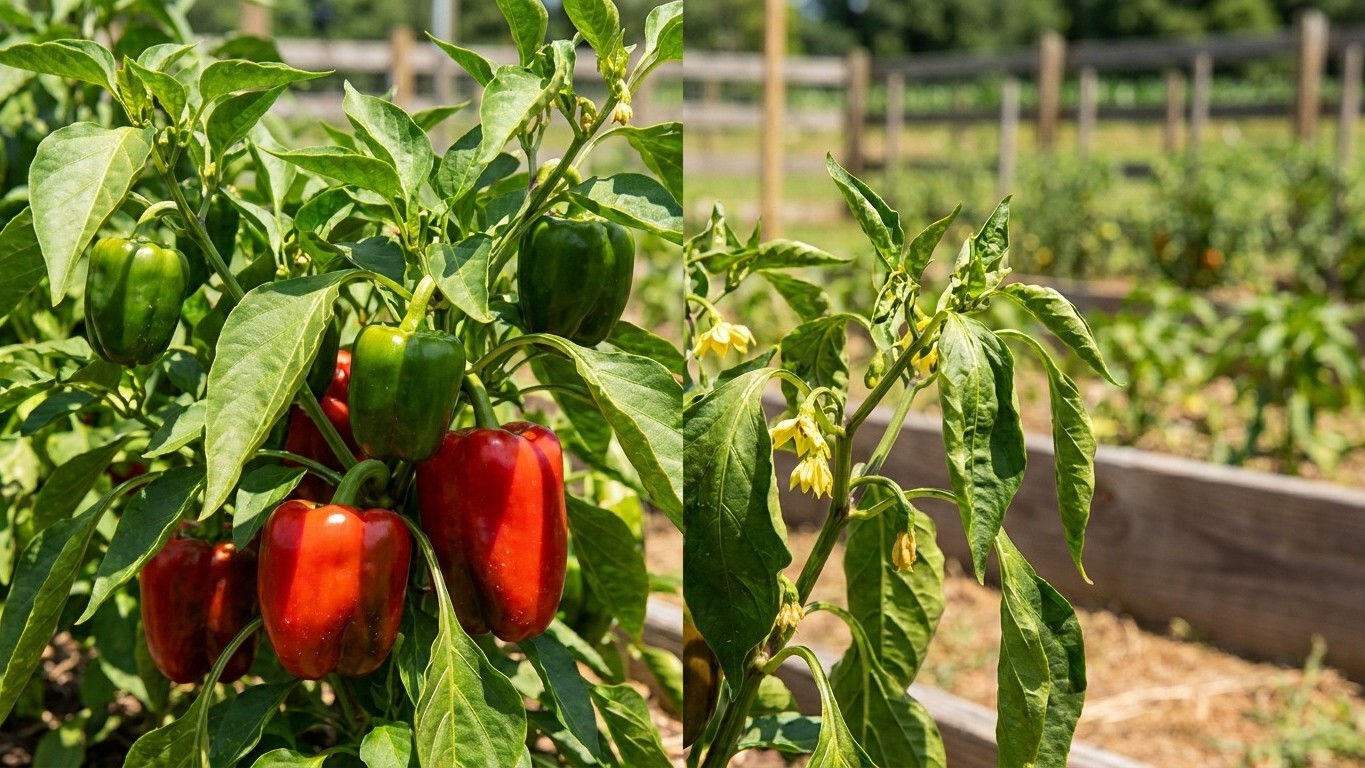

Pick peppers when the fruit has reached full size and firm walls, which Clemson Extension puts at about 70 to 85 days after transplanting. Then keep them out of the refrigerator. A home fridge runs colder than peppers tolerate. Below about 45 F they pit and soften, a form of chilling injury that shows up days later. A cool spot at 45 to 50 F does far better. In Mississippi, though, the harder part is the heat that comes before harvest.
The short answer
At the Jackson reference station, NOAA NCEI Climate Normals count 71.1 days a year at or above 90 F. That is more than ten weeks of days. Utah State University Extension says pepper fruit set fails at both ends: days above 90 F or nights below 55 F. A flower that opens on a hot day is a flower at risk of dropping without making a pepper. The count is an annual average for one airport station, so it cannot tell you which weeks of your own summer will be the worst. Its job is to show that hot stretches are a normal feature of a Mississippi season, not a freak event. If you want the full picture of what that does to the plant, Why Peppers Fail to Set Fruit in Mississippi goes through it flower by flower.
The other end of the range is nights under 55 F. Watch your own. A min/max thermometer set at bed height costs little, and a week of readings when the first flowers open tells you more than any regional average. Do not guess from how far north or south you live. The reading on your own thermometer decides.
Both limits feed into the harvest date. Clemson’s 70 to 85 days runs from transplanting, and it assumes the plant keeps setting fruit along the way. A stretch of blossom drop pushes the first pick later than the count suggests, so treat the range as a planning window and not a promise. When the time comes, cut the pepper with pruners and leave a short stub of stem. Pulling by hand can snap a whole branch, and a branch carries next month’s crop. You can pick green or wait for color. Green peppers can be picked sooner, while ripening on the plant takes longer and leaves fruit exposed to heat and pests that much longer (see What Eats Pepper in Mississippi, and When).
Then comes the mistake nearly everyone makes. Clemson’s guidance for storage is 45 to 50 F with 80 to 90 percent relative humidity, for two to three weeks. That is the best case, and two to three weeks is a ceiling, not a guarantee. A household refrigerator runs colder than that range. Peppers kept in it develop pitted, sunken spots and go soft, which looks like age but is cold damage. If a cool cellar or similar spot is not available (and few Mississippi homes have one in summer), plan to use the harvest quickly, or slice and freeze what you cannot eat. If the fridge is the only option, keep the stay short and expect some pitting. The source is Clemson’s pepper factsheet.
When to start seed here
Start from the date you want plants in the ground and count backward. Here is the arithmetic in order, so you can redo it for your own county.
- Find your transplant date. Utah State University Extension says to transplant when the soil reaches 60 F, and only after frost is past. Both conditions have to be true. A warm week in early March does not count if a freeze is still possible.
- Check the frost date against your own ground. At the Jackson reference station, NOAA NCEI puts the last spring freeze between March 6 and March 22 (the 30 to 70 percent probability band at 32 F). That is the reference-city figure, not a state-wide guarantee. Suburban and rural gardens typically see the last spring frost one to two weeks later, and more so at elevation. Your county Extension office can tell you what holds locally.
- Wait for the soil. Frost passing is not the same as 60 F soil. Use a soil thermometer and take readings in the morning. Your transplant date is whichever condition arrives last.
- Subtract 8 to 10 weeks. That is how long transplants need indoors, per Utah State. Suppose your soil reaches 60 F on April 1. Eight weeks back is February 4, and ten weeks back is January 21. Your seed-starting window runs from late January to early February. Swap in your own date and the window moves with it.
- Add 70 to 85 days for the first harvest. Clemson counts from transplanting. With the same April 1 transplant, 70 days lands on June 10 and 85 days on June 25. Plan for the first fruit somewhere in that stretch, and expect it to slip if a hot or cool spell interrupts flowering.
Once you have the harvest window, lay it over the heat. Fruit that sets in June has to size up through the weeks when 90 F days are common, and the annual count of 71.1 says there will be plenty. Starting earlier does not cure this, and a plant forced out too soon meets cold soil and cool nights instead. The two limits, 60 F in the soil and 55 F at night, bracket your planting.
For a fuller walk through the season, see Growing Peppers in Mississippi.
What goes wrong here
This climate produces a handful of predictable failures. Each one has a cause you can see and a fix you can apply.
- Blossom drop. Flowers fall off without setting fruit when days climb above 90 F or nights dip below 55 F. In a hot spell, give afternoon shade with a light cloth and keep watering even. Water stress on top of heat makes it worse. On a cool night, a row cover or an upturned bucket over a young plant takes the edge off. Do not feed extra nitrogen to compensate. It builds leaves and does nothing for flowers. New blossoms usually appear once conditions settle, so pinching the dropped ones is unnecessary.
- Sunscald. Pale, papery, sunken patches appear on the side of the fruit that faces the sun, and a mold often moves in afterward. Strong sun on fruit with no leaf cover causes it. Keep the foliage healthy and resist stripping leaves to “let the sun in.” Shade cloth during the worst afternoons helps. Hollowed or chewed fruit is a different problem, and the pest guide covers that.
- Blossom-end rot. A dark, leathery, sunken spot forms at the bottom of the fruit, opposite the stem. It is tied to uneven moisture, which limits the calcium the plant can move into growing fruit, even where the soil holds plenty. The fix is steady watering and a layer of mulch to hold moisture through hot weeks. Test the soil before adding anything, because more calcium will not help if the real problem is irregular watering. Cut off affected fruit so the plant puts energy into the next one.
- Chilling injury after harvest. The fridge is where good peppers go to die. Pitting and softening show up after a few days below about 45 F. Store at 45 to 50 F if you can, and for a shorter time than you think you need to.
Most of these trace back to the same two numbers, 90 F by day and 55 F by night. Keep a thermometer where the plants are and the rest gets easier to diagnose.
Common questions
How do I know a pepper is ready to pick?
Look at size and feel first. The fruit should be full-sized for its type, with firm, glossy walls. As a planning check, Clemson says peppers should be ready about 70 to 85 days after transplanting. A pepper left on the plant can turn color, and you can pick at either stage.
Can I put peppers in the refrigerator for a day or two?
You can, but it is the wrong place for them. Clemson’s storage range is 45 to 50 F, and a home refrigerator is colder. Below about 45 F peppers pit and soften. If you have no other option, keep the stay brief and use those peppers first.
How long do harvested peppers keep?
Under ideal conditions, 45 to 50 F and 80 to 90 percent relative humidity, Clemson says two to three weeks. That is a maximum, not an expectation. Peppers stored warmer or drier will not last as long. Freezing is the better plan for a big harvest.
Will my plants set fruit through a Mississippi summer?
Some will, and some flowers will drop. Jackson averages 71.1 days a year at or above 90 F, and Utah State says fruit set fails above that threshold. Nights below 55 F cause the same failure, and only your own thermometer can say whether that applies to you. Many gardeners find that flowers set again when a heat wave breaks, so a quiet plant in August is not necessarily a dead one.