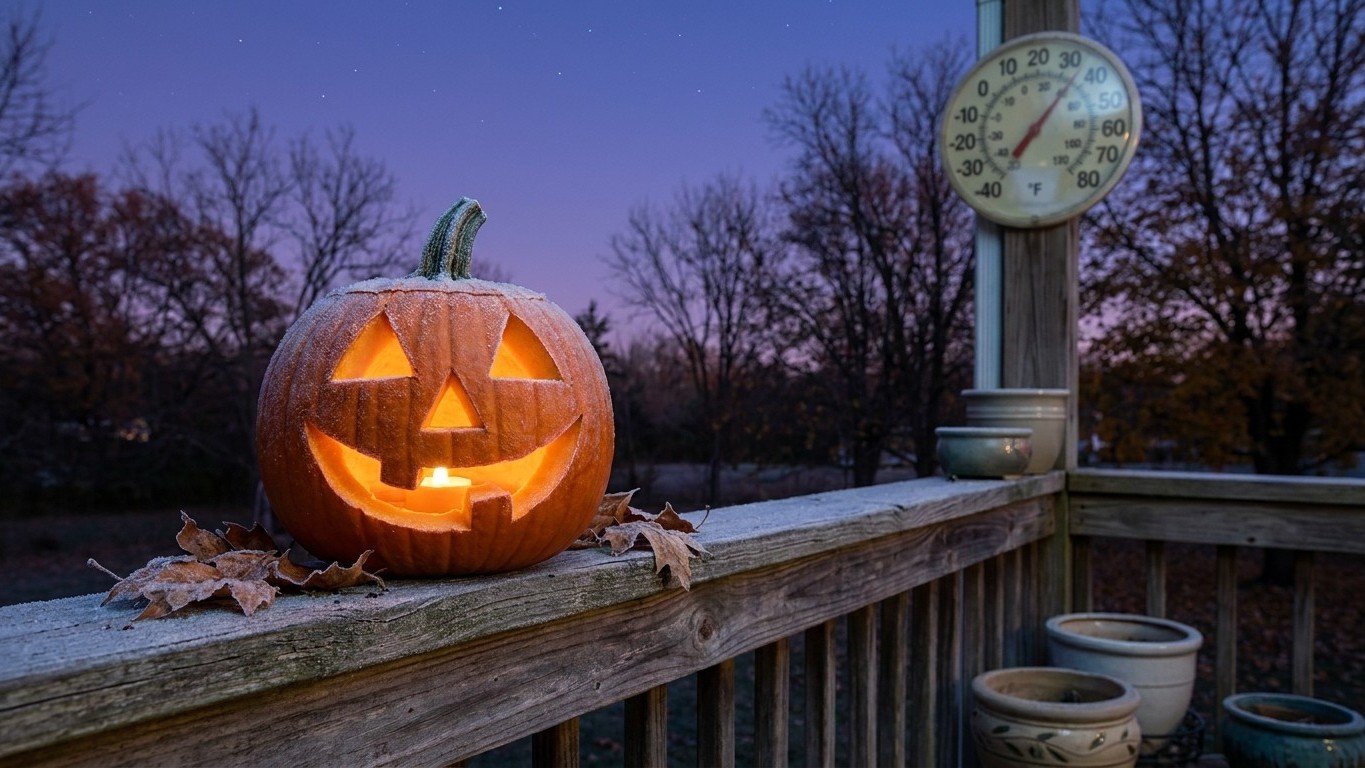

Missouri’s mean first fall frost lands somewhere between October 18 and October 29, and that single fact should drive your carving date more than any tradition about doing it on Halloween weekend. A pumpkin left whole on a porch handles a cool night fine. A carved one is a different story, and the timing question comes down to matching your knife to the calendar, not the other way around.
The short answer

Around October 18 to October 29 is when the Kansas City area, used here as the state’s reference station, typically sees its first freeze. Halloween falls on October 31, which means for a lot of Missouri, that first frost risk shows up anywhere from about two weeks before Halloween to just a couple of days ahead of it. That’s a wide spread for a state this size, and it matters because it tells you frost is not a late-arriving guest here. It’s often already knocking before trick-or-treaters are.
What that means practically: don’t carve too early and expect the pumpkin to hold through weeks of exposure. A whole, uncarved pumpkin tolerates a chilly porch night without trouble, but once you’ve cut into it, the exposed flesh is now dealing with the same air that’s approaching freezing in much of the state during this window. The safer play is to treat the last week before Halloween as your carving window, rather than the last two or three weeks. If your area tends to sit on the later end of that October 18 to October 29 range, you get a little more breathing room. If you’re closer to the early end, tighten it up.
This is an average, not a guarantee. Some years the freeze holds off past Halloween. Other years it shows up early and catches gardeners and porch decorators off guard. Treat the range as a planning tool, not a promise, and lean toward carving closer to Halloween rather than earlier just because the pumpkin looks ready in mid-October. A pumpkin that looks perfect three weeks out can still be sitting on a porch when that first freeze note from NOAA turns out to be accurate for your yard.
The takeaway for most of the state: aim for the final week before Halloween, and shift that window earlier or later depending on where your county falls relative to the Kansas City reference point. Northern Missouri counties tend to see frost arrive on the earlier side of that range, and southern Missouri, milder overall, often gets a few extra days of cushion.
Frost or heat: which one gets it here
A whole pumpkin is best kept between 45 and 50 degrees Fahrenheit, according to University of Illinois Extension. That’s a narrow band, and the question for any state is which direction local weather tends to miss it in late October: too cold, or too warm. In Missouri, the answer is cold.
The cold end
The mean first fall frost of October 18 to October 29 means a good chunk of the state is already flirting with freezing temperatures before Halloween even arrives. That’s colder than the 45-50 F storage band, not warmer. And Missouri’s winters aren’t mild once they arrive: the coldest month averages a daily minimum of 19.5 degrees Fahrenheit at the Kansas City reference station. That’s not the record low, and it’s not a fall figure, but it shows how quickly the state tips from pumpkin-friendly cool into genuine winter cold once the season turns. Late October sits right at that hinge point. A pumpkin sitting outside overnight in that stretch isn’t sitting in a controlled 45-50 F range. It’s sitting in whatever the night decides to do, and by late October in Missouri, that increasingly means below freezing.
The warm end
In parts of the Deep South, the opposite problem shows up: late October nights still hover in the 60s or 70s, well above that 45-50 F band, and pumpkins age faster than the owner expects because the air simply never gets cool enough. That’s not Missouri’s situation. By the time you’re within a week or two of Halloween here, the risk has already flipped toward cold, not warmth. Trying to store a Missouri pumpkin the way a Gulf Coast household might, worrying mainly about heat, misses what’s actually happening outside.
| Factor | Ideal storage band | Missouri late October reality |
|---|---|---|
| Temperature | 45-50 F | Trending toward or below freezing as first frost approaches |
| Main risk | N/A | Freeze damage, not overheating |
| Coldest month reference | N/A | 19.5 F average daily minimum (Kansas City) |
Where to keep it until you carve
Given that late October in Missouri tends to run colder than the ideal storage band rather than warmer, the goal is finding a spot that’s cool but not freezing, and dark. Here’s a practical order to check around a typical Missouri house or yard:
- An unheated garage. This is often the closest match to 45-50 F in a Missouri home during the weeks before Halloween, especially if the garage isn’t attached to a heated living space.
- A three-season porch or mudroom. Cooler than the main house but shielded from direct wind and hard frost better than an open porch.
- A basement landing near an exterior door. Basements run cooler than the rest of the house and stay dark, which helps.
- A covered spot on the porch, out of direct sun and away from the front door draft. Fine for shorter stretches once you’re within a few days of carving.
- Avoid placing it near apples, potatoes, or tomatoes anywhere in the house. Ripening produce gives off a gas that speeds up how fast a pumpkin ages, so the kitchen counter next to the fruit bowl is one of the worst spots, even though it feels convenient.
Whichever spot you pick, check the pumpkin for 1 to 2 inches of stem still attached before you commit to storing it. That stem acts as a seal. Once it breaks off, that section is exposed and spoils faster than the rest of the pumpkin. Never carry or lift a pumpkin by the stem. It’s not a handle, and treating it like one is the single most common way that seal gets broken before you even get it home.
Checking this against your own county
Missouri stretches from the Bootheel’s milder river-bottom climate to the colder northern counties bordering Iowa, so a single Kansas City-based frost estimate won’t fit every yard exactly. For a reading specific to your county, contact University of Missouri Extension. Local extension offices track frost data and growing conditions at a finer scale than a single statewide reference station can, and they can tell you whether your area typically lines up with, runs ahead of, or lags behind the October 18 to October 29 window used here. That’s the more reliable number to plan your actual carving day around, especially if you’re in a county far from the reference point.
Common questions
How long does a carved pumpkin last in Missouri?
No extension service publishes a specific number of days for a carved pumpkin, and there’s no research-backed preservation protocol either, despite what you might read elsewhere. What’s actually documented is how to choose and store a whole pumpkin well: pick one with an intact 1 to 2 inch stem, no soft spots, and keep it in a cool, dark spot. Carve it close to the day you plan to display it rather than banking on any trick to extend its life afterward.
Should I carve earlier if frost is forecast before Halloween?
If a hard freeze is forecast and your pumpkin is still whole, bring it into a cooler indoor spot like a garage rather than rushing to carve it. Carving doesn’t protect a pumpkin from cold. It just changes what kind of damage the cold can do to it.
Does the hardiness zone tell me when to carve?
No. A hardiness zone describes winter minimum temperatures for plant survival over an entire year, not a fall frost date. Use the first fall frost window instead when you’re timing a Halloween pumpkin.
Is a warm October in Missouri ever a real risk for pumpkins?
It’s a much smaller factor here than in the South. Missouri’s late October risk runs toward cold, not warmth, based on the state’s mean first frost timing and how sharply its winters set in once the coldest month arrives.