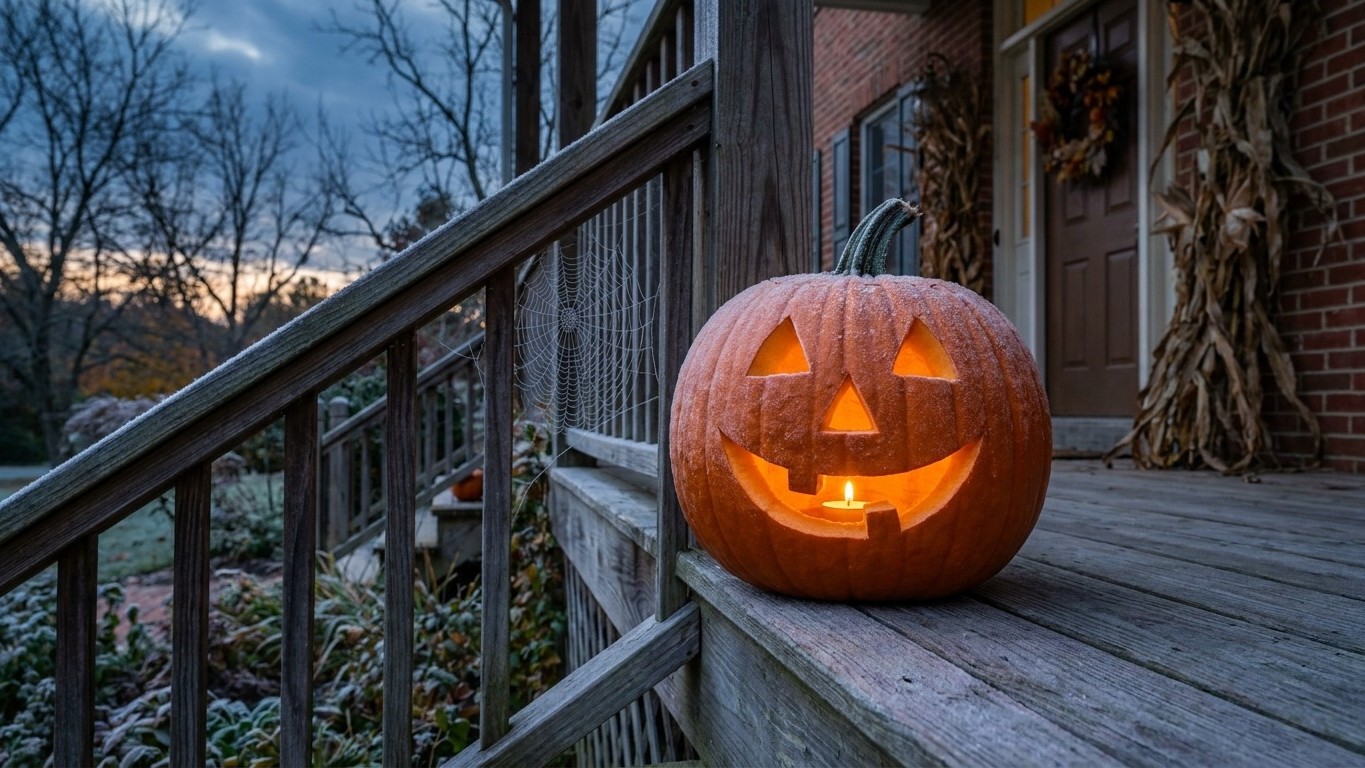

Maryland’s mean first fall frost lands around October 26 to November 5, a window that straddles Halloween itself rather than falling safely before or after it. That means a pumpkin left out on a porch through the whole month is gambling on the wrong side of that average almost as often as the right one. The practical window for carving without frost damage runs from about five days before Halloween through the day itself, watching the forecast rather than the calendar.
The short answer

Here’s what that October 26 to November 5 window actually means for a jack-o’-lantern sitting outside until Halloween: for most of Maryland, the average first frost doesn’t clear Halloween by a comfortable margin, and it doesn’t miss it by much either. Some years the frost arrives before trick-or-treaters show up. Other years it holds off until the first week of November. A mean frost date is an average, not a promise, and Maryland sits close enough to that average that either outcome is normal.
What that means practically: carve close to Halloween rather than weeks ahead. If you carve on October 15 and leave the pumpkin outside through the end of the month, you’re exposing cut flesh to two and a half weeks of unpredictable weather, some of it possibly below freezing, some of it possibly still mild. Neither extreme is kind to a carved pumpkin. The safer play is to keep the pumpkin whole and uncut until roughly the last week of October, then carve within a few days of Halloween itself.
What the frost window buys you
Counted backward from Halloween, that gives most of the state somewhere around zero to five days of buffer before frost risk becomes real, not a generous head start. Compare that to a Deep South state where frost might not show up until well into November or later, and Maryland’s timeline looks tight by comparison. It’s not a state where you can carve in early October and expect the pumpkin to sail through three weeks of open-air storage unscathed.
The caution here matters: this window shifts by region. Western Maryland’s mountain counties, Garrett and Allegany, run weeks later on this same average, not earlier, so a pumpkin sitting outside there follows a different clock than one on a porch in Baltimore or Annapolis. The Eastern Shore, moderated by the Chesapeake Bay, tends to stay milder into fall, which nudges the frost risk toward the back half of that window or past it. Neither of those local patterns overrides the statewide average, but they do mean a Garrett County household and a Talbot County household aren’t working with an identical clock.
Frost or heat: which one gets it here
A whole pumpkin keeps best in a cool, dark spot between 45 and 50 degrees Fahrenheit. That’s the target band. The question for any state is whether late October tends to run colder than that band, warmer than that band, or bounces around it, because that determines whether the bigger threat is freezing or overheating.
The cold end
Maryland’s coldest month runs a mean daily minimum of 25.4 degrees Fahrenheit at the Baltimore reference station, a figure that describes deep winter, not October. But it signals something useful: this is a state where cold settles in hard once fall turns, and the mean first frost sitting right around Halloween is the leading edge of that pattern. By late October, nighttime lows in much of Maryland are already dipping well below the 45-50 storage band on a regular basis, sometimes into the 30s, sometimes to freezing. That’s the dominant risk here. A carved pumpkin left outside overnight in that kind of cold can suffer frost damage to the cut surfaces, turning soft and collapsing faster than one kept in a moderated space.
The warm end
Earlier in October, Maryland can still see afternoon temperatures in the 60s and occasionally 70s, which is warmer than the ideal storage band and speeds up softening and mold on a whole pumpkin left in direct sun or a warm garage. But that heat risk is a September and early-October problem, not a late-October, near-Halloween one. By the time frost risk becomes real, the warmth has mostly backed off. For Maryland specifically, cold is the risk that matters most around the day you actually plan to carve, not heat.
Where to keep it until you carve
- Choose an unheated garage, enclosed porch, or basement stairwell that stays dark and doesn’t swing far from 45 to 50 degrees. These spots exist in most Maryland homes and are far more stable than a sunlit front porch.
- Avoid direct sun exposure on the pumpkin’s skin, even in cool weather; sunlight on a south-facing porch step can push the surface Temperature well above the storage band even when the air feels cool.
- Keep the pumpkin away from any ripening fruit or vegetables, including apples, potatoes, and tomatoes. Ripening produce gives off a gas that ages a pumpkin faster, which is exactly why the fruit bowl or the crate of fall apples on the same porch is the worst possible neighbor.
- Once the region’s frost risk window opens, generally the last several days of October in most of Maryland, bring a whole pumpkin indoors or into an unheated but enclosed space overnight rather than leaving it exposed on an open porch or step.
- Handle the pumpkin by its base or sides, never by the stem. The stem isn’t a handle, it’s a seal over the cut end where the pumpkin was harvested, and breaking it opens that spot to faster spoilage.
- At the patch or the store, look for a pumpkin with 1 to 2 inches of stem still attached and no soft spots or blemishes. Shape doesn’t matter for storage; weight and an intact stem do.
Checking this against your own county
NOAA’s frost averages are built from a statewide reference station, and Maryland’s geography, from the Appalachian ridges in the west to the tidal Eastern Shore, means real local timing can shift from that average by more than a week in either direction. For a number specific to your county, the University of Maryland Extension is the resource built for exactly that question, with local offices that track conditions county by county rather than statewide. If you garden or grow pumpkins yourself rather than just carve them, that same office is the right place to ask about planting and harvest timing for your specific soil and elevation.
Common questions
How long does a carved pumpkin actually last?
No university extension publishes a specific number of days for a carved pumpkin, and there’s no verified preservation protocol, so treat any claim of “three to five days” or bleach-dip tricks as unproven. What extension research does confirm is that a whole, uncarved pumpkin stored between 45 and 50 degrees in a dark spot can keep for three to six months. The reliable strategy is choosing a sound pumpkin, keeping it whole as long as possible, and carving close to the day you’ll display it.
Should I worry more about frost or about the pumpkin getting too warm?
In Maryland specifically, frost is the bigger concern by late October, since the statewide mean first frost sits right around Halloween. Warmth is more of an early-October issue, before that frost risk sets in.
Does the shape or size of the pumpkin affect how it stores?
No. Extension guidance is clear that shape doesn’t matter for storage quality. What matters is weight, an intact stem of 1 to 2 inches, and skin free of soft spots or blemishes.
Is Western Maryland really that different from the rest of the state?
Yes, on timing. Garrett and Allegany counties see this same frost pattern arrive weeks later than the statewide average window, which shifts the whole carving calendar for households in that part of the state compared to central Maryland or the Eastern Shore.