
New Brunswick gardens don’t face the scorching afternoons that punish plants further south. Environment and Climate Change Canada’s normals show an average of 0.0 days a year above 90°F at the Moncton reference station. That changes the math on watering, but it doesn’t remove the need for a real schedule, or knowledge of the local rules that can limit when you turn on the hose.
How much, how often

The single biggest mistake in a home garden is a light daily sprinkle. It wets the top inch of soil and nothing more, so roots stay near the surface where the ground heats up fastest and dries out first. Deep, infrequent watering trains roots to grow downward, into soil that holds moisture longer and buffers the plant against a few missed days. The goal is to soak the root zone, then leave it alone until it’s actually dry again, not on a fixed calendar.
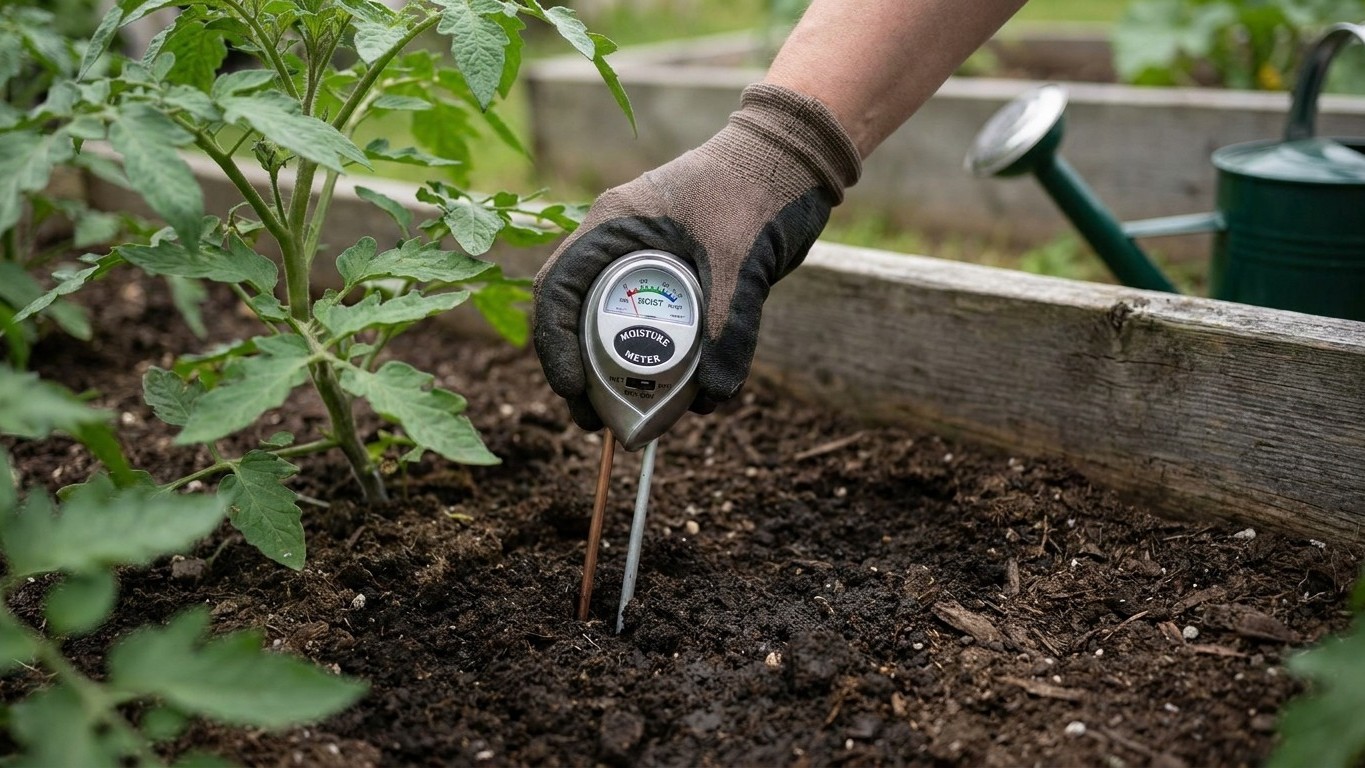
Knowing when that point arrives takes about ten seconds. Push a finger, or a garden trowel, two inches into the soil near the base of the plant. If it’s dry at that depth, water. If it’s still cool and damp, wait. This one habit does more for a garden’s health than any fertilizer schedule, and it costs nothing.
New Brunswick’s climate helps here in one specific way: with essentially no days reaching 90°F in a typical year, plants aren’t losing water to evaporation and heat stress the way they would in a hotter province. That means the watering clock is set less by air temperature and more by rainfall gaps and soil type. Sandy soil drains fast and needs shorter, more frequent watering to keep moisture at root depth. Heavy clay holds water for days, sometimes closer to a week, but it drowns roots if watered again before it has actually dried, and working or soaking clay while it’s still wet compacts it, which causes problems that outlast the season. Know which kind of ground is under your feet before you decide on a schedule.
A dependable watering routine, step by step:
- Check soil moisture two inches down at the base of the plant before deciding to water.
- Water in the early morning, so foliage dries before evening and moisture reaches roots before the day heats up.
- Apply water directly at the base of the plant, never over the leaves, to cut down on fungal disease.
- Aim for roughly 1 inch of water per week for most vegetable and flower beds, delivered in one or two deep sessions rather than several light ones.
- Adjust for soil type: shorter, more frequent sessions on sandy ground; longer gaps between deep soakings on clay.
- Recheck soil moisture two to three days after a deep watering to calibrate the next session instead of guessing.
The growing season itself is bounded by frost, not by a fixed date on a calendar. The average last spring frost at Moncton falls around May 23, and the average first fall frost lands near October 2. Both are averages, meaning frost arrives later than that in roughly half of all years, so treat them as the middle of a window rather than a safe start or stop date. And Moncton is one station; northern and upland parts of the province run weeks behind it.
Restrictions and rules
New Brunswick doesn’t have a single province-wide watering schedule that applies to every yard. Rules on when and how much you can water are set at the municipal or water-utility level, and they change from year to year depending on reservoir levels and rainfall. A dry stretch in July can trigger restrictions that weren’t in place in June, and a wet spring can mean no restrictions at all.
Because there’s no widely available current dataset behind those local rules, the honest answer is to check with the water utility or municipality that actually supplies your address before setting up an irrigation timer or scheduling regular lawn watering. Many towns post seasonal watering notices on their own websites, and some tie restrictions to street address (odd or even numbers watering on alternating days), while others simply ban daytime watering during a drought advisory.
Since New Brunswick summers run cool by North American standards, with an average of zero days above 90°F, restrictions here tend to track rainfall and reservoir supply rather than heat-driven demand spikes. That’s a different pattern than in hotter provinces or states, where restrictions often follow temperature more than precipitation. It’s still worth checking before you plant a water-hungry vegetable bed or install a sprinkler system, because a restriction that shows up in a dry August can undo a spring’s worth of planning. For general agricultural guidance and current federal resources, the Government of Canada’s agriculture site is a reliable starting point, though local restrictions themselves are set closer to home.
Using less
Cutting water use in the garden isn’t about watering less overall. It’s about making every gallon count, so the garden needs fewer of them in total. A few techniques do most of the work, and they stack well together.
- Mulch: A two- to three-inch layer of bark, straw, or shredded leaves over the soil surface slows evaporation dramatically, which means the two-inch moisture check stays “damp” for longer between waterings.
- Drip irrigation: Delivers water directly to the root zone instead of spraying it into the air or onto leaves, cutting the water lost to evaporation and runoff that a sprinkler wastes.
- Grouping plants by need: Placing thirsty vegetables together and drought-tolerant perennials elsewhere means you’re not overwatering the tough plants just to satisfy the thirsty ones on the same zone.
- Organic matter in the soil: Compost worked into sandy soil helps it hold moisture longer between waterings; worked into clay, it improves drainage so water reaches roots instead of pooling on the surface.
- Rain barrels, where local rules allow them: An inch of rain falling on a 1,000-square-foot roof yields roughly 600 gallons of runoff, a useful number for sizing how much a barrel or cistern can realistically capture from a single storm.
That rain barrel math matters most in how it lines up with the local growing season. With the average last spring frost near May 23 and the first fall frost near October 2, the usable watering season runs about four and a half months. A barrel filled during a heavy spring downpour has that whole stretch to be drawn down gradually, but it will sit empty during any multi-week dry spell unless it’s topped up by another storm. Since there’s no reliable rainfall-by-month figure to draw on here, the practical approach is to treat a rain barrel as a supplement to hose watering, not a replacement for it, and to check it after every storm rather than assume it refills on its own schedule.
Common questions
Does New Brunswick have one set of watering rules for the whole province?
No. Watering restrictions are set at the municipal or water-utility level and change based on local reservoir levels and rainfall. Check with the water supplier for your specific address rather than assuming a province-wide standard.
When should I start watering my garden in spring?
Tie it to your soil and to frost, not the calendar. The average last spring frost at the Moncton reference station is May 23, but that’s a midpoint, not a guarantee, since frost arrives later than that in about half of all years. Wait until frost risk has genuinely passed for your specific area before relying on regular outdoor watering for tender plants.
How much water does a typical vegetable garden need per week?
A common guideline is about 1 inch of water per week, delivered in one or two deep sessions rather than daily light sprinklings. Sandy soil may need that split into more frequent, shorter sessions; clay soil can often go longer between waterings.
Is it fine to water in the evening if mornings don’t work for my schedule?
Morning is better because it lets foliage dry out during the day, cutting the risk of fungal disease. Evening watering isn’t ideal since leaves can stay damp overnight, but it beats not watering deeply enough. If evening is the only option, water at the base of the plant and avoid wetting the leaves.