
New Brunswick’s driest summer month brings just 3.18 inches of rain, and the region averages 0.0 days a year at or above 90F. That combination means gardens rarely face a heat emergency, but they do face a slow, steady rainfall gap that a light sprinkle won’t close. The fix is deep, infrequent watering timed to the soil’s own dry spells, not the calendar.
What changes here

Two numbers set the terms for watering in this province: 3.18 inches of rain in August, the driest month of summer, and 0.0 days a year that reach 90F. Read together, they tell a gardener something specific: this isn’t a place where plants wilt from heat stress by afternoon, but it is a place where the sky quietly under-delivers during the exact stretch when growth demands the most water.
Do the arithmetic and the gap becomes concrete. A vegetable bed or a perennial border wants roughly an inch of water a week. August has about 4.43 weeks in it (31 days divided by 7), so that 3.18 inches spreads out to roughly 0.72 inch of rain per week on average. That leaves close to 0.28 inch a week that has to come from a hose or a watering can if the bed is going to hit its target. It sounds like a small number. It isn’t, once you multiply it across eight or ten weeks of summer growth.
The FACTS for this station don’t break out a specific sand or clay percentage for New Brunswick soils, so no figure is given here for that. But the general rule still applies with force: the same 0.28-inch weekly shortfall drains through a sandy garden bed within a day, while it sits and slowly soaks a clay-heavy one for most of a week. A gardener on light, fast-draining ground will feel this deficit sooner and more often than one on heavier soil, even though both are working with the identical rainfall numbers from the sky.
The near-total absence of 90-degree days changes the risk profile too. Evaporation off open soil and off leaf surfaces is far lower here than in a hot inland climate, so a missed watering doesn’t turn into a crisis by the next afternoon the way it might elsewhere. That’s a genuine advantage. It also means the temptation to skip watering “because it doesn’t feel that hot” is exactly the trap: the deficit builds anyway, just more quietly.
How to water when it matters
The method that fits this climate is deep and infrequent, delivered at the base of the plant, done in the morning. Each part of that has a reason rooted in what the plant is actually doing underground and on its leaves.
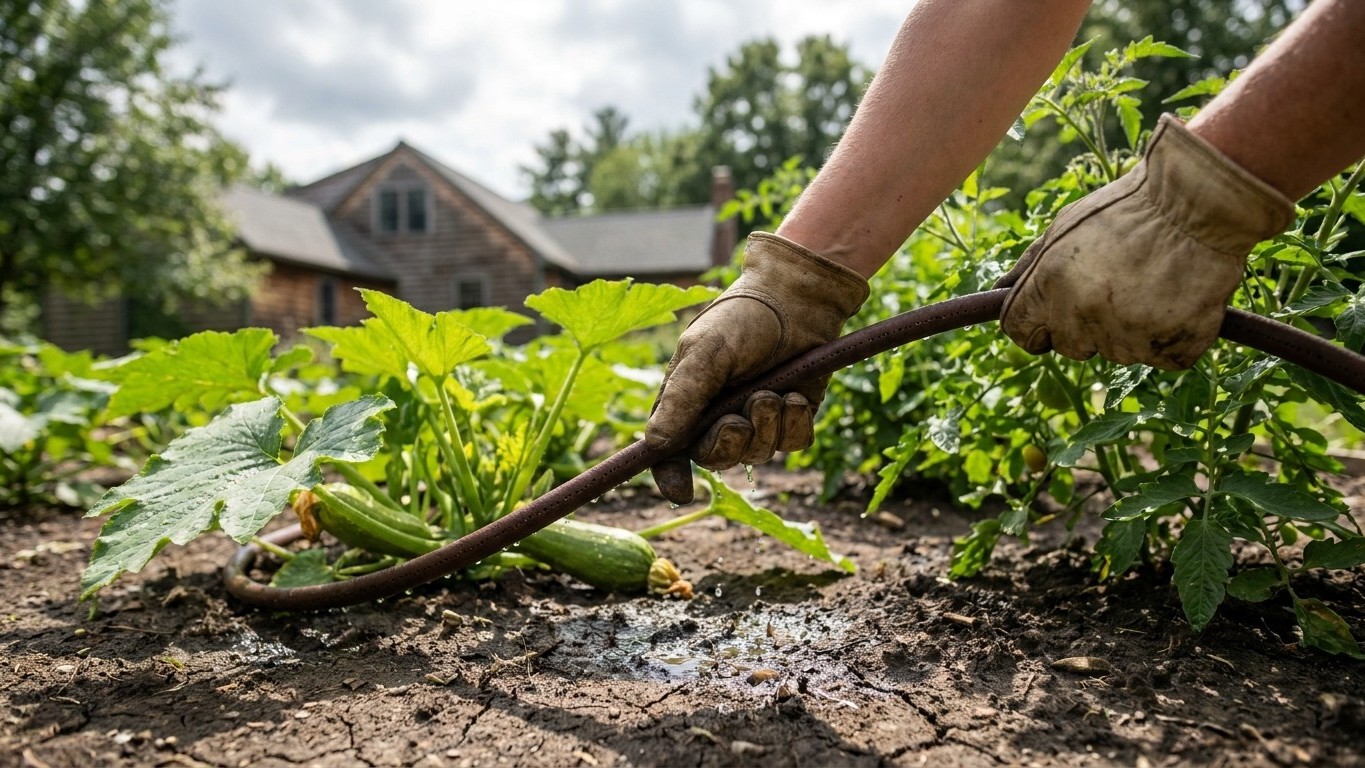
Deep watering pushes moisture down past the top two or three inches of soil, which is where roots go looking for it when the surface has already dried. A shallow daily splash never reaches that depth, so it trains roots to stay near the surface, where they’re most exposed the next time a dry stretch actually does line up with warmer air. Watering at the base rather than overhead means the water goes where the roots are instead of evaporating off leaves or drifting on a breeze. Morning watering gives the day’s mild warmth a chance to dry any leaf splash before evening, and it lets the plant take up water before the working hours of active growth.
Before turning on the hose, check the soil rather than guessing from the weather. Push a finger two inches down, or use a trowel to lift a small plug near the base of the plant. If it’s dry at that depth, water. If it’s still damp, wait. This is a better guide than any fixed schedule, because it accounts for what actually happened on that particular patch of ground.
Soil texture changes the rhythm, even without a specific number to plug in. Sandy ground holds little water and needs shorter, more frequent soakings to keep up. Heavy clay holds a week’s worth of moisture but will drown roots of oxygen if it’s watered again before it’s had the chance to dry partway. Start from one number and adjust from there: about an inch of water a week, split across one or two deep sessions, checked against the finger test on your own soil rather than followed blindly.
- Check the soil two inches down with a finger or trowel before watering at all.
- If dry at that depth, water deeply at the base until the top six inches are moist, roughly one inch of water for the week.
- Water in the morning, giving leaves time to dry before evening.
- On sandy soil, split that inch into two shorter sessions rather than one long one.
- On heavy clay, wait for the surface to dry partway between waterings, even if that stretches past a week.
What goes wrong
A little every day
Daily light sprinkling feels responsible, but it wets only the top inch or so of soil. Roots follow the moisture, staying shallow and near the surface instead of growing down into cooler, steadier ground. When a real dry stretch hits, those shallow roots have nothing in reserve.
Watering the leaves in the evening
Overhead watering after dinner leaves foliage wet through the cooler night hours, and that damp leaf surface is exactly the condition fungal disease needs to take hold. Morning watering, or a soaker hose at the base, avoids the problem entirely.
Trusting a passing shower
This is probably the costliest habit in New Brunswick specifically, given how modest the driest-month rainfall already is. A summer thunderstorm can look generous while wetting only the top half-inch of soil, especially on ground that sheds water fast. The only way to know is the finger test: two inches down, not a guess based on how wet the driveway looked.
Skipping the mulch
Bare soil gives back to the sun and air what was just watered in. A two- to three-inch layer of mulch around the base of plants slows that evaporation, which matters most in exactly the weeks when rainfall is already running short of the inch-a-week target.
Local help
For soil testing, planting calendars, and crop-specific guidance suited to New Brunswick’s growing conditions, the federal agriculture department maintains a public resource at agriculture.canada.ca. Watering restrictions during dry spells are set locally and vary by municipality or water district, so check with your own water provider for current rules before setting an outdoor watering schedule.
Common questions
Does New Brunswick really need supplemental watering if summers aren’t that hot?
Yes. The near-absence of 90-degree days lowers evaporation, but August’s 3.18 inches of rain still falls short of the roughly 1-inch weekly target most garden beds want, leaving a gap the sky doesn’t close on its own.
How often should I water a vegetable garden during a dry August?
Start from about an inch a week total, delivered in one or two deep sessions rather than daily sprinkles, and adjust based on a finger check two inches into the soil.
Is it safe to rely on rain gauges instead of checking the soil?
A rain gauge tells you how much fell, not how much soaked in. A thunderstorm can register a decent number while still leaving the root zone dry, so the finger or trowel test at planting depth remains the more reliable check.
Does mulch matter as much here as in hotter climates?
It still helps, since it slows evaporation during the driest month regardless of temperature, but the effect is less urgent than in a region logging many days above 90F.