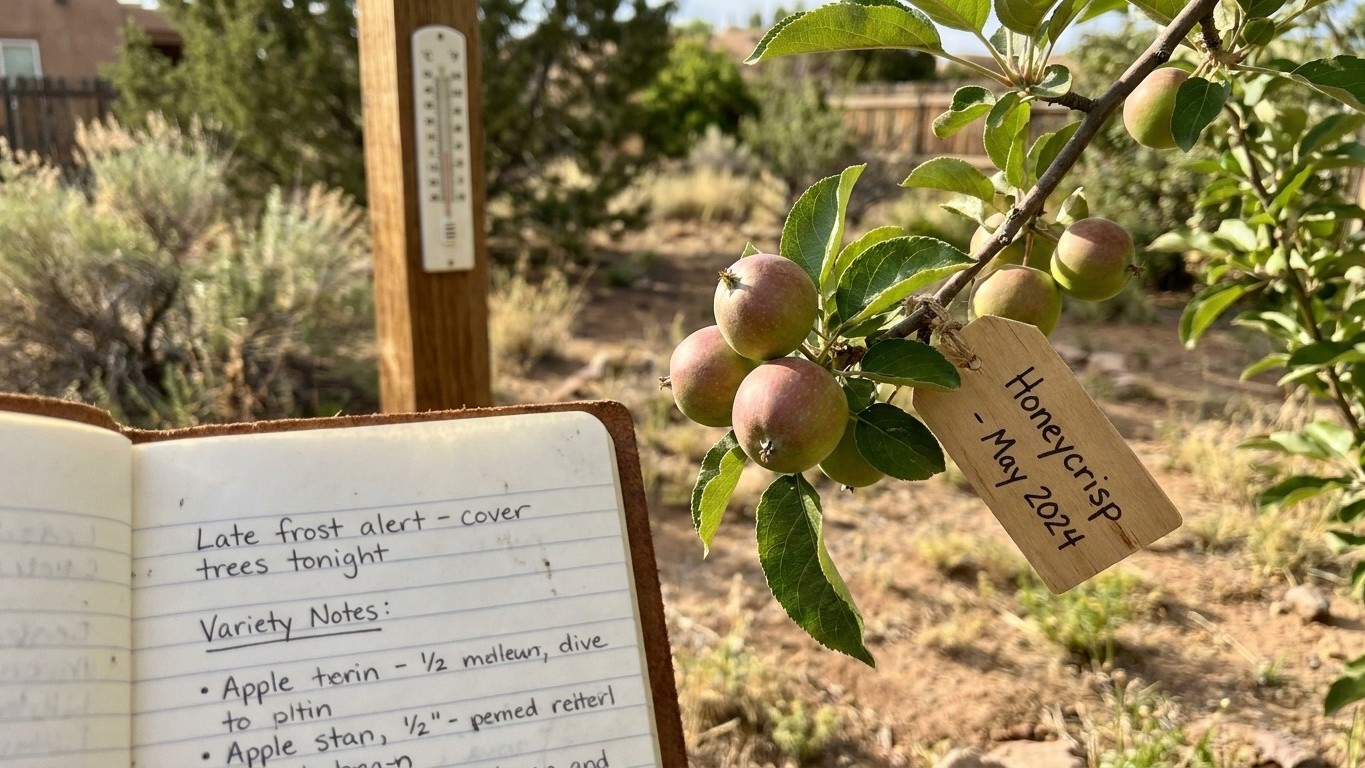

Yes, apples grow well across much of New Mexico, though the right variety depends on where in the state you garden. The USDA’s 2023 Plant Hardiness Zone Map spans the state from zone 4b in the northern mountain valleys to zone 9a along the low southern river valleys, and NOAA’s NCEI 1991-2020 climate normals for Albuquerque, the reference station used here, put the average low of the coldest month at 26.1°F, cold enough to satisfy winter dormancy for nearly any apple cultivar. Find your own county’s zone and elevation before choosing a variety, and check the New Mexico apple Calendar for timing guidance.
Can you grow apples in New Mexico
Albuquerque’s 26.1°F average winter low is the number every New Mexico apple guide quotes, but it only describes Albuquerque. Elevation is what actually decides your outcome: a Taos or Colfax orchard sees colder minimums and a shorter frost-free window, while Deming or Carlsbad stays warmer and shifts the whole bloom calendar. That gradient, not cold hardiness, is why the same “apple advice” fails half the state and works in the other half.
Where the climate gets tough
The 26.1°F figure describes Albuquerque only. A garden at higher elevation in Taos or Colfax County will see colder winter minimums and a shorter frost-free season than Albuquerque does, while a low-elevation garden near Deming or Carlsbad runs warmer through winter and the whole frost calendar shifts. Neither extreme rules apples out. The northern mountain valleys favor cultivars bred for a short, cool season and heavy winter chill, while the hot low desert of the south asks more of summer heat tolerance and irrigation than of cold hardiness.
Where apples struggle in New Mexico is not the winter cold at all. It’s the combination of low humidity, alkaline soil, and hail that shows up in mountain-adjacent counties during bloom season. What the climate data does settle is that winter cold is not the limiting factor for an apple tree almost anywhere in the state.
Because most commercial apple cultivars are rated hardy to USDA zone 4 or 5 at the coldest, hardiness alone rules out very little of New Mexico. The harder question, especially in the warmer river valleys, is whether a tree gets enough winter chill to break dormancy evenly and bloom well, which is the second filter covered next in The Best Apple Varieties for New Mexico.
Which varieties suit this climate

New Mexico’s hardiness range covers cultivars bred for climates far colder than any of them will actually face here, so hardiness zone is rarely the deciding factor. Winter chill is the filter that matters more in this state: apple trees need a set number of hours below about 45°F each winter to break dormancy evenly, and a variety bred for the Deep South’s short, mild winters will bloom thin and ragged in a New Mexico spring, while a variety bred for a long northern winter will simply sit and wait for chill it may never fully get in the warmest southern valleys.
Winter chill: the second filter
Most of New Mexico, including Albuquerque and the mountain valleys, sits at the moderate-to-high end of the chill scale rather than the low end. That favors moderate-to-high-chill cultivars over the low-chill types, such as ‘Anna’ and ‘Dorsett Golden’, bred for the Gulf Coast and the Deep South. It also means most home growers in this state should shop the same cultivar lists a Midwestern or northern grower would use, not a Florida or South Texas list.
Published catalogue figures for days to maturity and chill requirement are counted from a fixed reference point and shift by a week or two with the season, so treat the numbers below as a starting comparison rather than a guarantee:
| Variety | Published hardiness zone | Approx. chill hours | Bloom timing |
|---|---|---|---|
| ‘Honeycrisp’ | 3-8 | 800-1000 | Mid-season |
| ‘Liberty’ | 4-8 | 800 | Mid-season |
| ‘Enterprise’ | 4-8 | 800 | Late |
| ‘Jonathan’ | 4-8 | 700-800 | Mid-season |
| ‘Gala’ | 5-8 | 500 | Early-mid |
| ‘Fuji’ | 5-9 | 400-500 | Late |
| ‘Arkansas Black’ | 5-8 | 600 | Late |
‘Liberty’ and ‘Enterprise’ carry scab-resistance bred for humid climates, which matters less in New Mexico’s dry air, but both still perform well here on hardiness and chill grounds alone. ‘Fuji’ and ‘Gala’ sit toward the lower-chill, warmer end of this list and suit the low desert valleys of the south better than the cold mountain valleys of the north.
Planting a pair that works here
Almost no apple variety reliably pollinates itself. Plan on two trees that bloom at overlapping times, with at least one of them producing fertile pollen, or you’ll get a tree full of blossoms and a bare crop come fall.
Avoiding sterile-pollen pairs
A handful of well-known varieties, including some triploids like ‘Jonagold’ and the old New England heirloom ‘Rhode Island Greening’, produce pollen that cannot fertilize other trees at all, so they need two other trees nearby rather than one. That same sterile-pollen problem is what trips up new growers in Rhode Island’s apple orchards, and it applies just as much to a backyard pair in Albuquerque or Las Cruces as it does in New England.
Working from the varieties listed above, ‘Gala’ and ‘Fuji’ bloom close enough together in the early-to-late midseason window to pollinate each other reliably, and both suit the warmer valleys of the state. In the cooler mountain valleys, ‘Liberty’ and ‘Enterprise’ overlap in bloom and both are reliable, widely available nursery stock. Avoid pairing an early bloomer like ‘Gala’ with a late bloomer like ‘Enterprise’ unless you also plant a mid-season variety such as ‘Honeycrisp’ or ‘Jonathan’ to bridge the gap, since the whole point of a pair is overlapping bloom, not just two different trees in the same yard.
The frost that costs a crop here

NOAA’s NCEI 1991-2020 climate normals put Albuquerque’s last spring frost between March 31 and April 12, based on the 30-70% probability band for a 32°F freeze at the airport weather station behind this data. That’s the reference-city figure only. Suburban and rural gardens elsewhere in the state, and especially those at higher elevation, typically see their last spring frost later than Albuquerque does, sometimes by a week or two, so check your own county’s frost dates before you trust this window for your yard.
What to do about it
The damage that actually costs a New Mexico grower a harvest doesn’t come from a killing freeze in January. It comes from a frost that lands after the buds have opened to the pink stage or into bloom, when a dip to 32°F or below kills the open flowers, not the tree. The tree leafs out fine that summer and looks perfectly healthy. There’s simply no fruit on it, because the blossoms that would have set apples were the part that froze.
A grower can do a few things about that risk once bloom is close:
- Cover small trees with frost cloth or old bedsheets on a night a hard freeze is forecast, removing it by mid-morning
- Run water under trees before a clear, calm night, since wet soil holds and releases more heat than dry soil
- Avoid planting in a low frost pocket at the bottom of a slope, where cold air pools on a still night
- Choose a late-blooming variety such as ‘Enterprise’, ‘Fuji’, or ‘Arkansas Black’ if your site regularly sees frost into the second week of April
That last point matters more than any spray or cover. In a state where the reference-city frost window already runs into mid-April and rural gardens often run later still, a variety that simply blooms after the frost risk has passed protects a crop far more reliably than reacting to a forecast every spring. Growers working the same wide spring-frost window in Oklahoma’s apple orchards lean on the identical strategy, picking a late bloomer over fighting the weather every April.
The apple year in New Mexico
Timing an apple orchard by the calendar month is a mistake in a state where the same variety can be three weeks apart in bloom between a low desert valley and a mountain garden. Read the tree by its stage instead, and anchor that stage against Albuquerque’s own frost dates, adjusting later for a higher or cooler site.
Reading the calendar by stage, not month
| Stage | Anchor point | What to do |
|---|---|---|
| Dormancy | Through late winter, before growth starts | Prune, and apply dormant oil if scale or mite pressure was a problem last year |
| Green tip | Weeks before Albuquerque’s last frost window of March 31-April 12 (NOAA NCEI) | Watch nightly lows closely, since tender new growth is more frost-sensitive than a dormant bud |
| Pink bud | Days before that same frost window closes | Have frost cloth ready. This is the stage where a freeze starts costing you flowers |
| Bloom | Straddling Albuquerque’s last-frost window | Protect on any forecast night at or below 32°F. Bees need calm, warmer afternoons to work the flowers |
| Petal fall / fruit set | Just after the frost window closes | Thin fruit clusters to one or two apples each once they’re marble-sized |
| Harvest | Ahead of the first fall frost, October 29-November 9 at Albuquerque (NOAA NCEI) | Pick by variety maturity, not by date, and get fruit in before a hard freeze |
Rural and higher-elevation gardens should shift the spring end of this table later and the fall end earlier than Albuquerque’s dates, since NOAA’s normals for that station typically run milder in spring and longer in fall than sites away from the airport. A garden in Mora County or up toward Angel Fire may see green tip and pink bud arrive a week or two after Albuquerque does, which is useful if it also means the last frost has already passed by the time the buds are vulnerable.
Local help
New Mexico State University’s Cooperative Extension Service publishes county-level guidance on variety selection, spray timing, and pest pressure. Check aces.nmsu.edu for the office nearest your county before you plant, and again each spring before you spray. Bring your own elevation and past frost observations when you call, since the office will ask.
Common questions
Can one apple tree produce fruit by itself in New Mexico?
Not reliably. Almost every common apple variety needs a second tree blooming nearby with fertile pollen to set a full crop, and the pollination section above covers which pairs work with the varieties suited to this climate. A single tree may set a light, spotty crop some years off a neighbor’s ornamental crabapple, but don’t plan an orchard around that chance.
Why did my apple tree bloom heavily but set almost no fruit?
The most common cause in New Mexico is a spring frost that hit the open flowers after bloom, which kills the blossom without harming the tree itself. The next most common cause is no compatible pollinator tree blooming at the same time, or a cold, windy bloom period that kept bees from working the flowers.
Does New Mexico’s alkaline soil cause problems for apple trees?
It can, particularly iron chlorosis showing up as yellow leaves with green veins, but soil chemistry varies a lot by county. A soil test through your local extension office is the right first step before you plant.
Can I grow apples at high elevation, like around Taos or Angel Fire?
Yes, and the cooler summers and reliable winter chill at higher elevation actually suit apples well. The trade-off is a shorter frost-free season than Albuquerque’s, so favor an earlier-maturing variety and confirm your local frost dates rather than borrowing Albuquerque’s window directly.
How much water does an apple tree need in a high-desert climate?
More than the same tree would need in a humid state, and the right schedule depends on your soil type and rootstock, neither of which this article can size for your yard. Your county extension office can help set a watering plan based on local conditions rather than a generic rule.