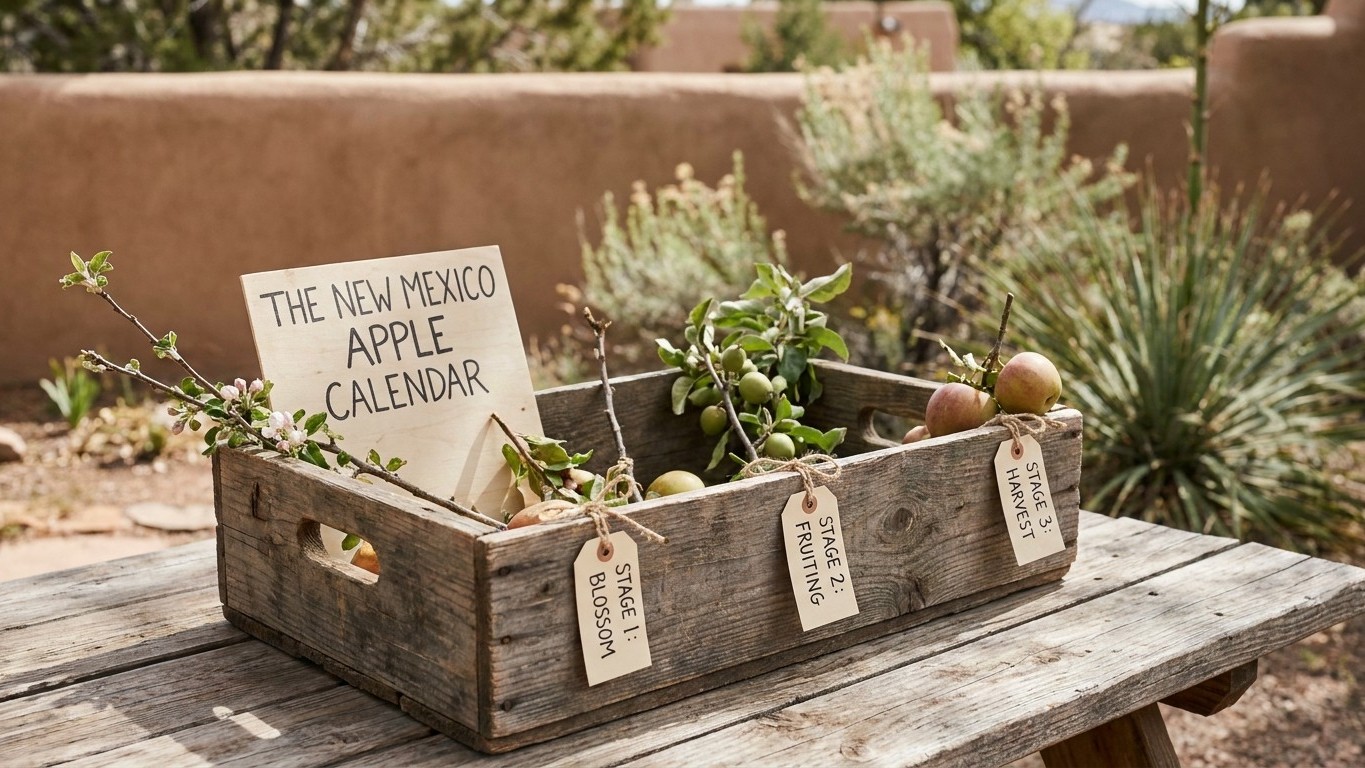

Apple trees in New Mexico run on frost, not on the month printed on a calendar. NOAA’s NCEI 1991-2020 climate normals for the Albuquerque airport station put the last spring freeze between March 31 and April 12, and the first fall freeze between October 29 and November 9. Every pruning cut, spray, and harvest date in the state gets checked against that window and against what stage the tree is actually in. Before you plant or spray, find out where your own bloom date lands against your county’s frost dates, not Albuquerque’s.
The short answer for New Mexico
Albuquerque’s frost window is the number every New Mexico apple chart quietly assumes, and it’s the one figure that doesn’t travel. Move uphill from the valley and frost lingers weeks past what those reference dates promise; pick a cultivar bred for the warmer south and its bloom can walk straight into that lingering cold. The calendar on the wall doesn’t know your elevation. What actually starts the clock each year is pink bud, triggered by accumulated heat, not by a printed date.
What the date depends on
The date bloom actually opens on your tree depends on the cultivar’s bloom timing, the winter chill the tree banked over the previous months, and how fast your specific site warms once nights stop dropping below freezing. A cultivar bred for a warmer part of the state pushes bloom earlier than one suited to the mountains, and an early bloom that lands inside Albuquerque’s frost window is the single biggest risk apple growers face here.
Gardens sitting at higher elevation than Albuquerque should expect frost to linger later into spring and arrive earlier in fall than the reference figures show. Treat the NOAA dates as the earliest, mildest edge of what’s realistic across the state, and check your own site’s history before trusting them at face value.
Working through it

If you’ve already sited and chosen rootstock using the guidance in Growing Apples in New Mexico, the stages below are what repeats every year after planting. Each one is triggered by accumulated temperature, not by a date on the wall, so use this to read your own tree rather than a chart.
Dormancy

The tree sits leafless from around the first fall freeze, which the NOAA normals place between October 29 and November 9 at Albuquerque, through late winter. Prune during this stage, since cuts made on a tree that isn’t actively growing close cleanly instead of pushing tender new tissue into the cold. It’s also the most cold-tolerant stage of the year, which matters given that Albuquerque’s coldest month averages a nightly low of 26.1F under NOAA’s 1991-2020 normals, a threshold that already rules out anything short of a genuinely hardy apple tree.
Green tip

Buds swell and split to reveal a sliver of green leaf tissue. This usually starts once a run of warm days breaks the winter cold, well ahead of the last-frost window, so a freeze at this stage still does little harm. It’s the last comfortable point to finish any pruning left undone before the tree commits its energy to new wood.
Pink

Flower clusters swell and show color through the still-closed bud, typically days to a couple of weeks before petals open. Cold tolerance drops sharply from here. This is the point to start checking the forecast against Albuquerque’s NOAA-normal frost window of March 31 to April 12, or against your own county’s later equivalent if you sit above the valley floor.
Bloom

Open white blossoms are the most frost-tender stage of the entire year. Because bloom for most cultivars lands close to or inside that same frost window, an early-blooming variety carries real risk in this climate. The cultivars ranked in The Best Apple Varieties for New Mexico are chosen partly for bloom timing that pushes flowering to a later, safer date relative to that window.
Petal fall

Petals drop and the small green fruitlet left behind is tougher than the flower it replaced, though a late freeze can still thin the crop or scar what remains. Whatever survives cleanly to this stage usually finishes out the season.
Fruit set

Marble-sized fruit forms, and the tree naturally sheds a portion of what it set on its own. Thinning by hand in the weeks after this stage is what keeps the remaining apples sizing up instead of crowding three or four to a spur.
Harvest
Fruit matures and colors according to the variety, and it needs picking before growth turns soft ahead of the first fall freeze, which NOAA’s normals place at Albuquerque between October 29 and November 9. Gardens that run colder than that reference station should plan to pick earlier rather than wait for a date that may not apply locally.
What changes across New Mexico
The NOAA figures above are measured at one station at the Albuquerque airport, and no single date works for the whole state. Elevation is the biggest driver: New Mexico runs from low desert river valleys to mountain orchards well over a mile higher, and gaining elevation tends to push the last spring frost later and the first fall frost earlier than the reference-city dates.
Where it runs warmer and colder
The Mesilla Valley around Las Cruces sits at lower elevation than Albuquerque and generally sees an earlier last frost and a later first frost than the Albuquerque normals describe, which is part of why growers there can lean on earlier-blooming cultivars with less risk. Higher country around Taos, Cloudcroft, and the Sacramento Mountains sits well above Albuquerque’s elevation and should expect the opposite: a later spring frost, an earlier fall frost, and a shorter overall window for bloom and fruit fill than the reference-city dates suggest.
River valleys add a second effect on top of elevation. Cold air drains downhill at night and pools in low ground along the Rio Grande and similar valley bottoms, so an orchard on the valley floor can see a harder, later spring frost than an orchard on a slope just a few hundred feet above it, even at similar elevation. Planting on a gentle slope rather than the lowest point of a property is a real way to buy extra frost margin in exactly the kind of terrain that’s common across the state.
None of this changes the physiology described above. It only shifts where, on the calendar, each stage lands. A grower in the high country reads the same green tip, pink, and bloom stages as a grower in the Mesilla Valley, just later in the year, and should time spraying and thinning to the tree’s own progress rather than to a date borrowed from a lower, warmer part of the state.
The mistakes this climate punishes
Three mistakes account for most of the lost crops reported around the state, and each one shows up at a specific stage rather than a specific month.
The three that cost a crop
- Planting an early-blooming cultivar in a late-frost location. If bloom opens before Albuquerque’s NOAA-normal window of March 31 to April 12 has fully passed, or before the later equivalent window at elevation, an open blossom can be killed by a freeze that a dormant bud would have shrugged off.
- Choosing a cultivar for the wrong winter chill. An apple that needs a long, cold winter to break dormancy properly can bloom sparse and uneven after a mild one, while a low-chill type planted in the coldest parts of the state may never get the rest it needs and leafs out weak.
- Feeding or watering heavily into late summer. Nitrogen applied late pushes soft new growth right as the season closes, and that soft growth is the first tissue killed at the first fall freeze, whether that lands in Albuquerque’s NOAA-normal window of October 29 to November 9 or earlier at elevation.
Each mistake announces itself at a different point in the year. The bloom-timing mistake shows up as a scorched, browned bloom cluster in spring that never sets fruit. The chill mistake shows up as patchy, weak bloom spread over several weeks instead of one tight flush. The late-feeding mistake shows up as blackened leaf tips and dieback on the newest wood right after the first hard freeze, sometimes on wood that looked perfectly healthy going into fall.
The fix for all three is the same: read the stage on the actual tree rather than trusting a fixed date, and match the cultivar’s bloom timing and chill need to your own elevation and valley position rather than to whatever grew well two counties over.
Checking this against your county
The frost dates and cold-month figures above come from one weather station near Albuquerque, and they’re a starting point, not a forecast for your specific address. New Mexico State University’s ACES extension service, at aces.nmsu.edu, is the place to check county-level planting guidance and cultivar advice suited to your particular elevation and valley position.
Confirm your own frost window with your county’s extension office before locking in a bloom date, especially if your orchard sits well above or below Albuquerque’s elevation, or in a valley known to trap cold air overnight.
Common questions
My apple tree’s last frost date seems way later than what you listed for Albuquerque, is something wrong?
Probably not. The NOAA figures cited here come from one airport station, and gardens at higher elevation or in low valleys that trap cold air commonly see a later last frost and an earlier first frost than that station shows.
Keep a simple log of your own tree’s stages and any frost events over a few seasons. That local record will tell you more than any single reference figure.
Will a late frost that kills the blossoms mean no apples that year?
Not necessarily. Each cluster has a central king bloom and several lateral blooms, and a freeze severe enough to kill the king bloom sometimes leaves some laterals intact, giving a smaller but real crop.
A freeze hard enough or long enough to hit the whole open bloom across the tree, though, can wipe out the crop for that year regardless of which flowers were hit first.
How many chill hours does an apple tree need in New Mexico?
It depends entirely on the cultivar you plant. Published nursery figures put a low-chill type like ‘Anna’ at around 200 hours of winter chill, while a cultivar like ‘Fuji’ needs closer to 700 to 800 hours, so the two are suited to very different winters.
Match the cultivar to your own winter and confirm with your county extension office if you’re unsure.
Should I cover a young apple tree during a spring frost?
Yes, for a young tree in the pink or bloom stage, an old sheet, frost cloth, or blanket draped over the canopy overnight can hold enough heat to protect open blossoms from a light freeze.
Remove the cover during the day so the tree gets light and doesn’t overheat, and don’t rely on covering as your only defense against a hard freeze deep into the bloom window.