
North Carolina gardens don’t follow one rulebook. A raised bed in the Piedmont clay around Charlotte behaves nothing like a bed on Blue Ridge slopes or coastal plain sand, and the state’s own climate data reflects that spread. Here’s what the numbers actually say, and how to use them.
What the climate asks of you

Start with one figure that tells you what kind of summer you’re gardening through: at the Charlotte reference station, an average of 35.0 days a year reach 90F or more, according to NOAA NCEI Climate Normals for 1991-2020. That’s not a summer average, it’s the count of days hot enough to stress a cool-season lawn and push containers to dry out by afternoon. Thirty-five days is enough to rule out fescue surviving on rainfall alone through July and August, and it’s enough to make afternoon wilt in tomatoes and squash a routine event rather than a rare one.
What the same data doesn’t hand over on a plate is a single number for summer rainfall, and that’s worth sitting with rather than papering over. North Carolina’s June-July-August rain comes mostly from afternoon thunderstorms, and thunderstorms are notoriously local: one yard gets an inch, the yard two miles over gets a light sprinkle. That pattern means the “how much did the sky deliver this week” question has no fixed answer for the whole state, only for your particular rain gauge. The USDA Plant Hardiness Zone Map places North Carolina across an unusually wide band, zones 5b through 8b, from the high mountains near the Tennessee line down to the barrier islands. A zone spread that wide tells you the rainfall pattern shifts just as much: coastal plain summers run more humid with a longer wet season, mountain summers cool off at night and lose less moisture to evaporation, and the Piedmont sits in between, hot by day and prone to the kind of quick, hard downpour that runs off a clay bed before it ever soaks in.
Soil texture matters as much as rainfall count, and it varies by the same geography. Piedmont ground (Charlotte, Raleigh, Greensboro) tends toward clay that holds water for days once it’s wet, but sheds a fast summer storm off the surface before the moisture gets past the top inch. Coastal plain soil runs sandier and drains fast, so a downpour there disappears from root zone within a day or two. None of that changes the arithmetic gardeners everywhere use as a baseline, roughly an inch of water a week for an established bed, but it changes how that inch gets delivered and how much of it you’ll need to carry yourself. Check your local NOAA station or the NC State Extension office for your county’s actual summer rainfall average before you set a watering schedule off a statewide guess.
How much, how often
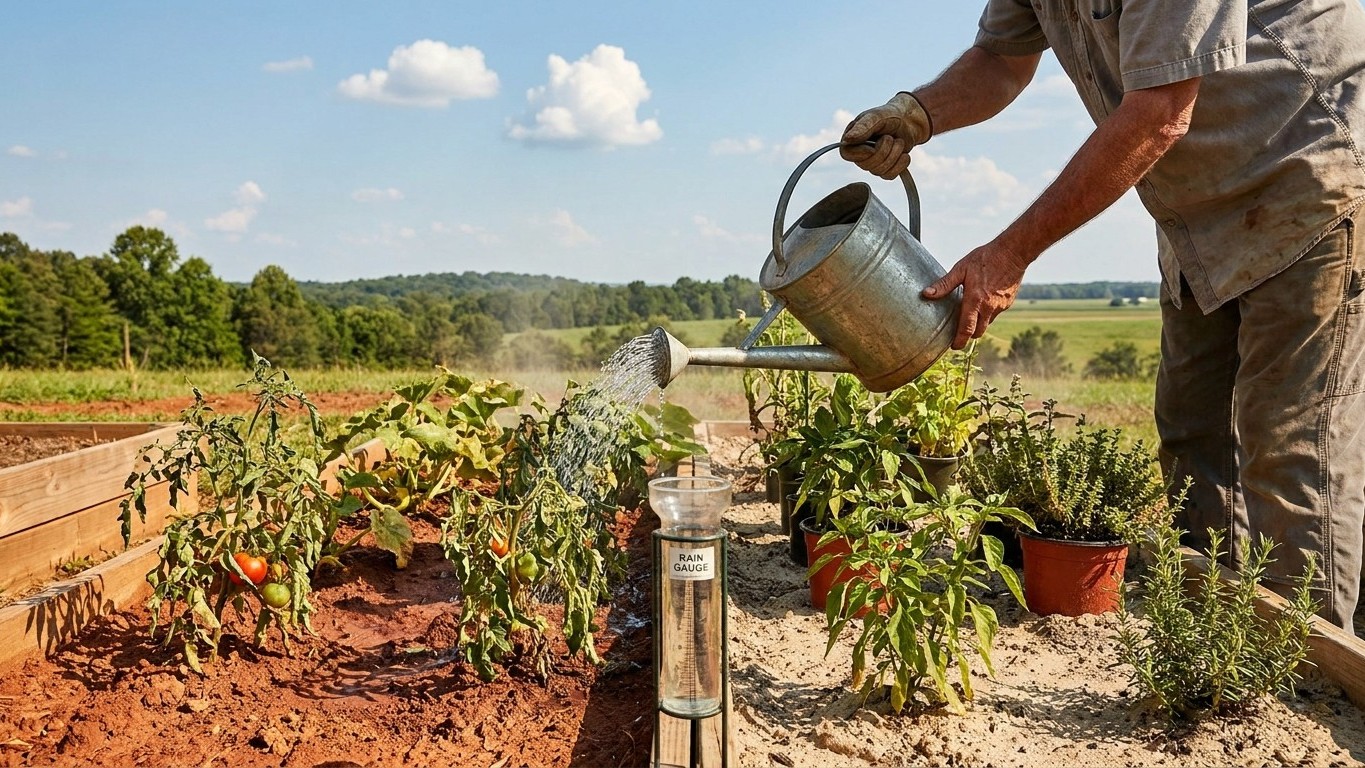
The habit that kills more North Carolina gardens than drought does is the daily five-minute sprinkle. A light, frequent watering wets only the top inch or two of soil, and roots respond by staying shallow, right where the sun bakes them hardest during a run of 90F days. Deep, infrequent watering trains roots to go down where the ground stays cooler and holds moisture longer. The test for whether a bed actually needs water is simple: push a finger, or better, a garden trowel, about two inches into the soil near the base of the plant. Dry at that depth, water. Still damp, wait another day and check again.
Timing and placement do almost as much work as volume. Morning watering, aimed at the soil rather than the leaves, gives plants a full day to take up moisture before evening humidity sets in, and it avoids leaving wet foliage overnight, a habit that invites the fungal disease pressure North Carolina’s humid summers are already prone to. Evening watering isn’t a disaster, but it’s second choice for exactly that reason.
Soil texture changes the schedule, not the goal. On Piedmont clay, a thorough soak can hold for the better part of a week, but that same clay punishes impatience: watering or working a bed that’s still wet compacts it and starves roots of air, so the finger test matters more here than almost anywhere else. On coastal plain sand, water passes through fast and holds little, so the same “inch a week” target usually means shorter, more frequent sessions rather than one long soak. And because summer rain across the state arrives in scattered, unreliable thunderstorm bursts rather than steady weekly totals, a garden here is realistically on a supplemental irrigation schedule for most of the hot season, not on rainfall alone.
- Check before you water. Push a finger or trowel two inches into the soil at the plant’s base; water only if it comes up dry.
- Water early. Run the hose or drip line in the morning, before the day’s heat sets in, so the plant has hours to absorb moisture.
- Aim at the soil, not the leaves. Wet foliage overnight invites fungal problems in humid Piedmont and coastal air.
- Soak deeply once, rather than sprinkling daily. Give an established bed roughly an inch total, delivered slowly enough to sink past the top few inches.
- Adjust for your soil. Clay holds a soak for several days; sandy ground needs shorter, more frequent watering to make up for fast drainage.
Restrictions and rules
Local water utilities across North Carolina set their own outdoor watering restrictions, and those rules shift with reservoir levels, drought stage declarations, and the season, sometimes changing more than once in a single summer. There’s no single statewide watering day or hour that applies everywhere; a rule that holds in one county’s water district can be different or nonexistent one town over. That patchwork is exactly why a printed guide can’t substitute for a phone call or a visit to your utility’s website before you set an automatic timer.
Because so much of North Carolina’s summer rainfall depends on scattered, unpredictable thunderstorm activity rather than steady totals, drought conditions can develop and restrictions can follow with relatively little warning, particularly in years when those storms miss a given area for weeks at a stretch. That makes checking current rules more than a formality here; it’s the difference between a garden watered on schedule and one caught mid-summer by an odd-even day restriction or an outright ban on daytime sprinkler use.
The most reliable source is your own water provider, whether that’s a municipal utility, a rural water district, or a well you manage yourself (private wells generally aren’t subject to municipal restrictions, though drought can still affect well output). For general guidance on drought-appropriate gardening practices tailored to your county, the NC State Extension service is the standing resource, with local offices that track conditions county by county rather than for the state as a single block.
Using less
Every gallon a garden doesn’t need from a hose is a gallon that doesn’t show up on a summer water bill, and a handful of low-effort changes account for most of the savings. The techniques below work independently, so pick what fits the bed rather than trying to layer all of them at once.
- Mulch, two to three inches deep. A layer of shredded bark or straw slows evaporation from the soil surface, which matters most on the fast-draining sandy ground of the coastal plain and during the 35 days a year that push past 90F in the Piedmont.
- Drip irrigation or soaker hoses. Water delivered at soil level, slowly, loses far less to evaporation and wind drift than an overhead sprinkler running in mid-afternoon heat.
- Group plants by water need. Deep-rooted, drought-tolerant natives on one zone, thirsty vegetables and annuals on another, so you’re not soaking a whole bed to satisfy the one plant that needs it most.
- Work organic matter into the soil. Compost helps sandy coastal soil hold moisture longer between waterings, and it helps heavy Piedmont clay drain a bit faster so it doesn’t stay waterlogged after a storm.
- Rain barrels, where local rules allow them. As a rule of thumb, an inch of rain falling on a thousand square feet of roof yields roughly 600 gallons of runoff. Given how unevenly North Carolina’s summer thunderstorms distribute rainfall, a barrel can fill fast during an active storm week and sit nearly empty through a dry stretch immediately after, so it’s a supplement to a watering routine, not a replacement for one. Check with your local utility on collection rules before installing a system.
Common questions
Does North Carolina’s whole state fall in one hardiness zone?
No. The USDA Plant Hardiness Zone Map places the state across zones 5b to 8b, from the cold high mountains down to the mild coast. Use your specific city or county, not a statewide average, when timing plantings.
When should I stop worrying about frost in spring?
At the Charlotte reference station, the last spring frost typically falls between March 23 and April 5. That’s Piedmont timing; the Blue Ridge mountains to the west run several weeks later, and the coastal plain tends to clear frost earlier. Check your county extension office for a local date.
When does frost return in fall, and why does it matter for watering?
Charlotte’s first fall frost typically arrives between October 30 and November 8. As that date approaches, cooling nights and shorter days cut a garden’s water demand sharply, so watering frequency should taper well before the first frost hits, not stop abruptly on the day it does.
Where do I check current watering restrictions for my area?
Contact your local water utility or district directly, since rules vary by town and change with drought conditions. The NC State Extension service is also a reliable source for county-level guidance on drought response and garden watering practices.