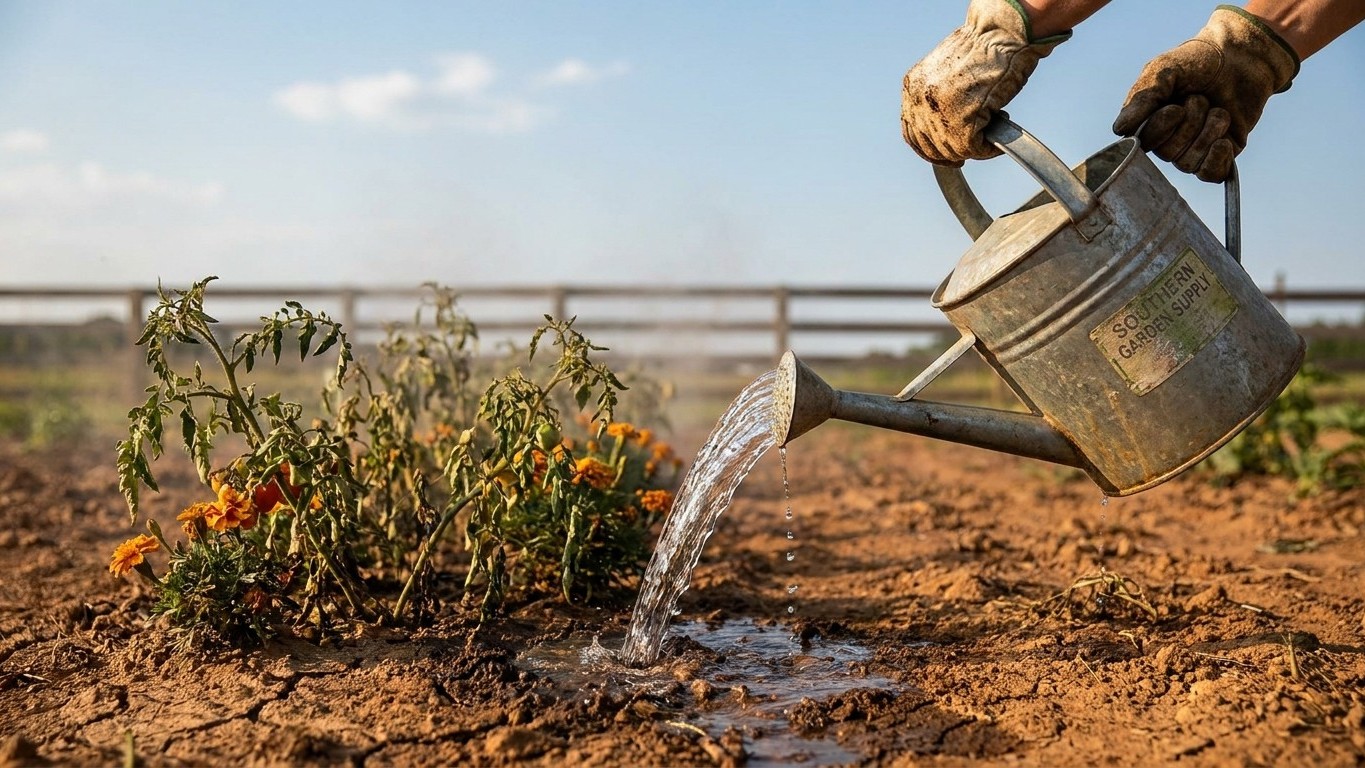

Across North Carolina, gardens usually need about an inch of water a week to keep growing well, and rainfall alone rarely covers that during the hottest stretch of summer. The state’s driest summer month, July, averages just 3.74 inches of rain, while the region logs 35.0 days a year at 90 degrees or hotter. That combination means most beds need a deliberate watering routine, not just hope for rain, from roughly June through September.
What changes here

North Carolina’s driest summer month, July, averages 3.74 inches of rain. The same season brings 35.0 days a year when the temperature reaches 90 degrees Fahrenheit or higher. Put together, those two figures mean the weeks when plants are working hardest, and losing the most moisture to heat, are also the weeks when the sky is offering the least help.
The arithmetic makes the gap concrete. A garden bed wants roughly an inch of water a week to keep growing without stress. Spread July’s 3.74 inches evenly across the month’s 31 days and that works out to about 0.84 inch a week from rainfall alone, leaving a gap of roughly 0.16 inch that a gardener has to supply. In practice the shortfall is usually worse than that, because July rain rarely falls evenly. A single afternoon thunderstorm can dump an inch in twenty minutes and then nothing falls for the next ten days, so in a given week the real gap can be the entire inch, not a sixth of one.
Soil texture decides what happens to whatever water does show up, whether from the sky or from a hose. On sandy ground, common across the Coastal Plain, that inch drains through within a day, leaving roots with no reserve to draw on by midweek. On heavier clay, more typical of the Piedmont, the same inch can sit in the root zone for most of a week, which is useful during a dry stretch but dangerous if more water gets added before the soil has had a chance to dry out. A garden a hundred miles inland can behave completely differently from one near the coast, even under the same rainfall numbers.
The heat side of the equation matters just as much. Thirty-five days a year at 90 degrees or above works out to roughly one day in three across a typical summer. Water applied to an exposed bed on one of those mornings can be pulled back out of the soil by evaporation before the plant has had much chance to use it, which is part of why timing matters as much as quantity.
How to water when it matters
The goal on North Carolina ground is to get water down to where roots actually live, rather than just wetting the surface. Deep, infrequent watering pushes roots downward, chasing moisture deeper in the soil where it’s cooler and more stable. Shallow, frequent watering does the opposite: roots stay near the surface, right where 35 days a year of 90-degree heat can bake them. Morning watering gives plants time to take up moisture before the heat of the day pulls it back out through evaporation, and it lets any water that lands on leaves dry off before evening, which matters in a humid climate prone to fungal disease.
Before turning on the hose, check the soil rather than guessing. Push a finger or a small trowel about two inches down near the base of the plant. If it’s still damp at that depth, the plant doesn’t need water yet, even if the surface looks dry and dusty. Skipping this step is how a lot of water gets wasted on soil that didn’t need it.
Soil texture should set the rhythm. Sandy soil holds little reserve, so it calls for shorter, more frequent soakings. Heavy clay holds a week’s worth of water, so it calls for one deep soaking and then a wait, since watering clay again before it dries invites root rot rather than drought stress. A reasonable starting point for an established bed is about one inch of water, applied in one or two sessions a week, adjusted up on sandy soil and down on clay after checking the two-inch depth test.
- Check soil moisture two inches down with a finger or trowel before watering; if it’s damp, wait another day.
- Water at the base of the plant, at soil level, rather than overhead, to keep foliage dry.
- Water in the early morning, ideally before 9 a.m., so moisture soaks in before the day’s heat sets in.
- Apply water slowly and deeply, aiming for about one inch per session, so it soaks into the root zone instead of running off.
- On sandy soil, split that inch into two or three shorter sessions across the week; on clay soil, apply it in one deep soaking and skip the next scheduled watering if the two-inch test still shows damp soil.
Treat the one-inch figure as a starting point to test against a particular yard, not a fixed rule. A bed under a shade tree, a raised bed with amended soil, or a slope that sheds water will all need their own adjustment once the finger test starts giving answers.
What goes wrong
A little water every day
Watering on a daily schedule, in small amounts, feels responsible but works against the plant. It trains roots to stay near the surface, where they’re first in line for damage on any of the 35 days a year that reach 90 degrees. Deep, infrequent watering builds a root system that can ride out a dry week; daily sprinkling builds one that can’t.
Watering the leaves in the evening
An evening watering session, especially one that hits the foliage instead of the soil, leaves leaves wet through the warm, humid overnight hours common in North Carolina summers. That combination of standing moisture and heat is close to ideal for fungal disease to take hold, which shows up later as spots, mildew, or blight that has nothing to do with how much water the plant actually got.
Trusting a passing thunderstorm
A loud afternoon storm can look like it solved the watering problem for the week, but a fast, heavy downpour often wets only the top half-inch of soil before running off rather than soaking in. The two-inch finger test settles the question a glance at wet pavement can’t: if the soil is still dry just below the surface, the storm didn’t do the job.
Skipping the mulch
Bare soil left exposed after watering hands the moisture right back to the sun, especially across a summer with 35 days at 90 degrees or above driving evaporation. A two-to-three-inch layer of mulch around the base of a plant slows that loss significantly, which means water applied on a Monday is more likely to still be useful on Thursday. Because rainfall totals through the season aren’t extreme (July’s 3.74 inches is the low point, not a drought figure), the more common local failure is heat-driven evaporation on bare soil rather than outright dryness. On heavier clay ground, particularly in wetter months like August with its 4.35-inch average, the opposite mistake shows up too: watering a bed that hasn’t finished draining from the last rain, which drowns roots that never had the chance to dry.
Local help
For soil testing, plant recommendations, and questions specific to a particular county, North Carolina State Extension is the state’s land-grant extension service. Watering restrictions vary by municipal or county water provider and change with drought conditions, so check current rules directly with the local water utility before setting a routine.
Common questions
How much rain does North Carolina get in a typical summer?
About 12.1 inches fall across June, July and August combined, with July the driest of the three at 3.74 inches and August the wettest at 4.35 inches.
How many days a year get hot enough to stress a garden?
The reference station used for state climate normals logs 35.0 days a year at 90 degrees Fahrenheit or above, concentrated in the summer months.
Does sandy or clay soil need more frequent watering?
Sandy soil drains fast and needs shorter, more frequent sessions; clay soil holds water for close to a week and needs less frequent, deeper soakings, with a pause if the soil is still damp two inches down.
Is a passing rain shower enough to skip watering?
Not necessarily. A quick storm can wet only the top half-inch of soil while running off the rest. Checking two inches down with a finger or trowel is more reliable than judging by how heavy the rain sounded.