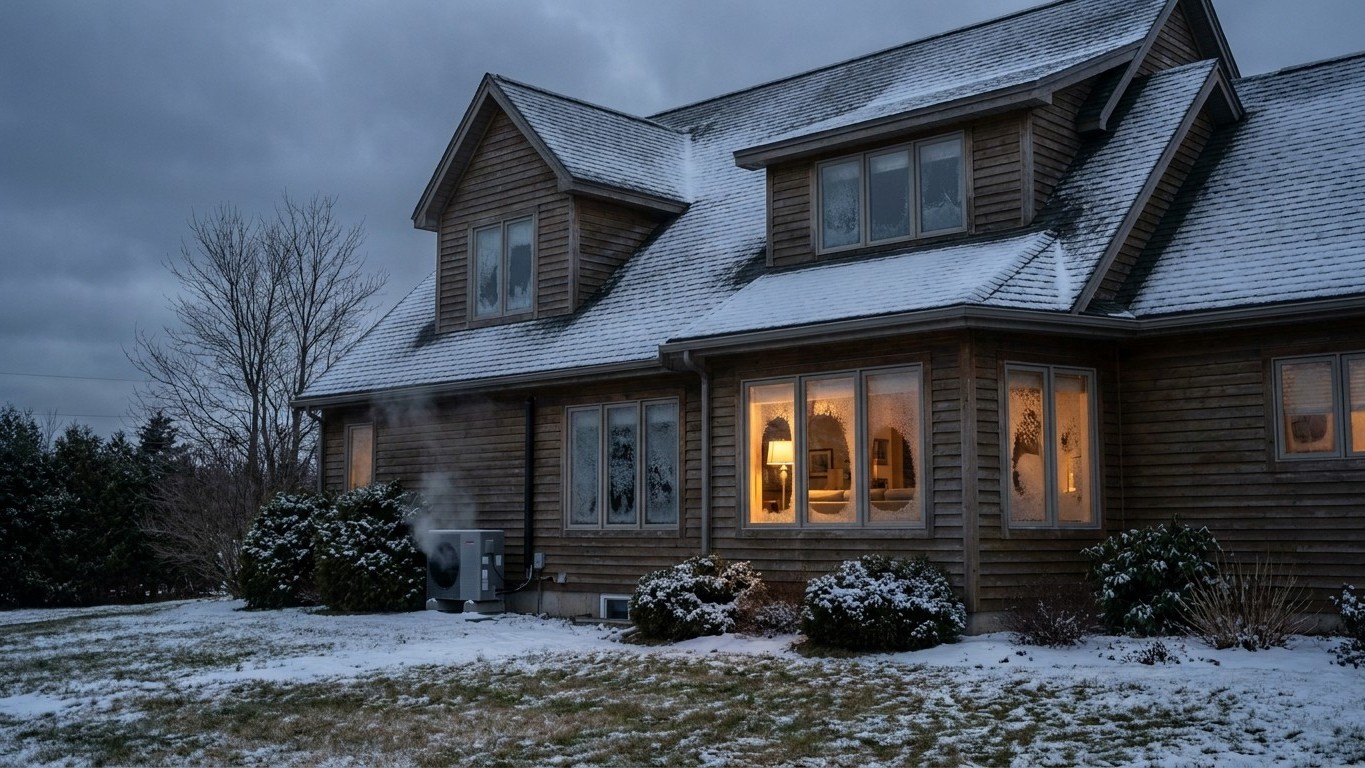

Nova Scotia winters hover close to the freezing line more than they plunge far below it, but the season is long. That combination shapes everything from how much wood you’ll burn to how a furnace should be sized, and it’s worth understanding before the first cold snap hits.
How cold it gets, and for how long

The mean daily minimum for Nova Scotia’s coldest month sits at 13.3°F, based on Canadian Climate Normals from 1981-2010 at the Halifax reference station. That’s not a record low, and it’s not some rare overnight dip. It’s the average low temperature you’d expect on a typical night during the coldest stretch of the year. Compare that to territories where the coldest-month minimum drops into single digits or below zero, and Nova Scotia starts to look almost mild by Canadian standards.
But mild-ish and short are two different things. This is a maritime climate, wedged between the Atlantic and the Bay of Fundy, and that ocean influence keeps temperatures from swinging as wildly as they do further inland. What it doesn’t do is shorten the season. Halifax winters typically demand sustained heating from November through April, sometimes bleeding into early May in a stubborn year. That’s five to six months of a furnace, heat pump, or wood stove working on some level almost every day.
What this means for your equipment
A house built for a winter that drops to 13.3°F on an average cold night doesn’t need the same equipment as a house built for a winter that regularly sees -10°F. Furnaces and heat pumps sized for extreme cold snaps in colder provinces can be oversized here, cycling on and off more than they should and wearing out faster. What matters more in Nova Scotia is duration. A system needs to run efficiently, night after night, for the better part of half a year. That favors steady, moderate-output heating over brute-force capacity. Heat pumps, in particular, have become a common choice here precisely because the province rarely demands the kind of deep-cold performance that pushes heat pump efficiency to its limits.
The takeaway isn’t that Nova Scotia winters are easy. It’s that they’re a marathon at a moderate pace rather than a sprint through extreme cold, and that distinction should guide how a household plans for heat.
What a cord of wood is worth here
If you’re heating with wood in Nova Scotia, the cord is the unit you need to understand, and it’s also the one buyers get cheated on most often. A cord isn’t a weight. It’s a volume: a stack measuring 4 feet by 4 feet by 8 feet, which works out to 128 cubic feet. Anyone selling you a “cord” that doesn’t fill that space, however it’s stacked or piled, is selling you less wood than the name implies.
| Measurement | Value |
|---|---|
| Standard cord dimensions | 4 ft x 4 ft x 8 ft |
| Total volume | 128 cubic feet |
| Heat energy (well-seasoned hardwood) | about 20 million BTU |
That 20 million BTU figure comes from Michigan State University Extension, and it’s an average for well-seasoned hardwood, not a guarantee for any specific load. Species and moisture content both move that number substantially, which is exactly why the seasoning question matters as much as the species question. For a household trying to picture what that translates to, MSU offers a useful comparison: one cord of seasoned hardwood delivers roughly the heat of 145 gallons of #2 fuel oil, or 215 gallons of LP gas.
Given Nova Scotia’s five-to-six-month heating season, a single cord won’t carry a household relying primarily on wood heat through the winter. Most homes burning wood as a significant heat source need multiple cords, and the exact number depends on the house, the stove’s efficiency, and how much of the load wood is actually carrying versus a furnace or heat pump doing the rest.
The seasoning point is worth repeating here because it directly affects that 20 million BTU figure. Wet wood doesn’t just burn poorly, it burns at a real energy deficit, because water sitting inside the wood has to be boiled off before any of that heat reaches your room. Buy or cut wood that hasn’t dried properly, and you’re paying to heat water vapor before you pay to heat your house.
How long wood takes to dry in Nova Scotia
Seasoning time isn’t a fixed number stamped on every log. It depends on humidity, summer heat, and how the wood was handled after it was cut, which means the same species dries at different speeds in different climates. Michigan State University Extension puts the target at 20 percent moisture or less before burning. Green, freshly cut wood can sit above 60 percent moisture, which is a massive difference in how much energy that wood is willing to give up.
Split green wood typically reaches that 20 percent target after one full summer of stacking, provided it’s actually split and stacked so air can move through the pile. Rounds left whole, or wood piled without airflow, dry far more slowly and can still be wet inside come the first frost. Nova Scotia’s coastal humidity works against fast drying compared to drier inland climates, so a full summer season, roughly May through September, is the realistic window rather than a shortcut.
Red oak is the named exception worth knowing if it’s available where you are. MSU notes it dries more slowly than most hardwoods because of its cell structure, so a single summer may not be enough. That’s not a reason to avoid red oak, it’s a reason to cut it earlier or season it longer than you would maple or ash.
Burning before wood is ready carries real, measurable costs beyond a weaker fire. Unseasoned wood produces more creosote in the flue, since incomplete combustion leaves behind more of the tars and particulates that stick to chimney walls. That means more frequent chimney sweeping, and a higher risk of a chimney fire if maintenance lags. It also means you’re burning more wood to get the same warmth, which erodes whatever a cord was supposed to deliver in the first place. None of this is a reason to panic over one damp log. It’s a reason to plan a summer ahead, not a week ahead, when you’re stocking wood for the coming winter.
Where to check before you buy
Everything above describes conditions at the Halifax reference station, and Nova Scotia is not one uniform climate. Elevation, distance from the coast, and exposure to the Bay of Fundy versus the open Atlantic all shift local conditions. A property in the Annapolis Valley or up toward the Cape Breton Highlands can see different drying speeds and different practical cold than Halifax itself.
For species availability, local wood suppliers, and current guidance specific to your county, the Nova Scotia Department of Agriculture is the right place to check before you commit to a wood supply or a heating plan. That’s also where you’ll find any seasonal burn restrictions currently in effect. These rules are set locally, tied to fire risk and air quality conditions that shift from year to year, so what applied last winter isn’t guaranteed to apply this one. A quick check before stacking your woodpile or lighting the first fire of the season costs nothing and avoids a surprise later.