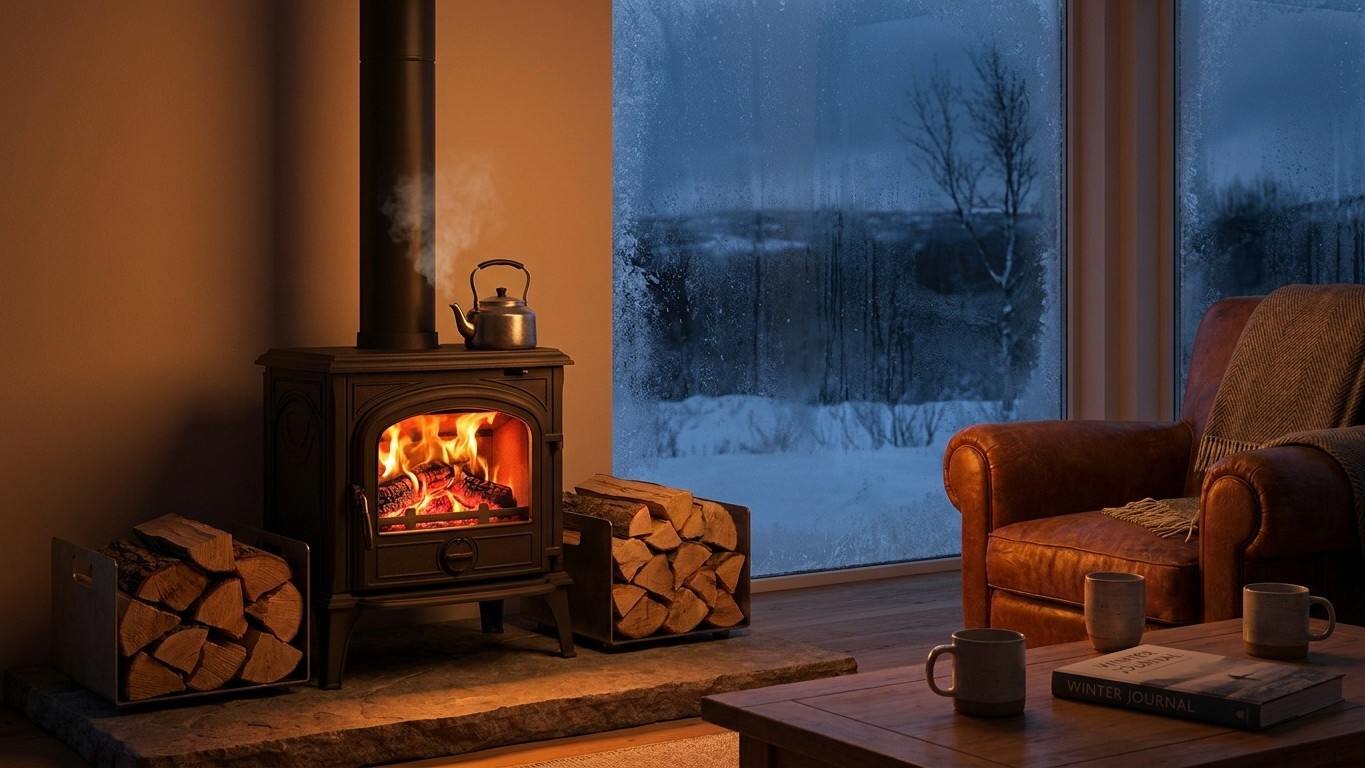

Winter in Ontario means a heating season that stretches from late fall into April, with a furnace or wood stove doing steady work rather than occasional duty. What that actually costs a household comes down to three things: how cold it gets, how much heat a cord of wood delivers, and whether that wood is dry enough to burn efficiently.
How cold it gets, and for how long

The mean daily minimum for the coldest month, measured at the Toronto reference station, is 13.6°F. That’s not the record low that makes headlines, and it’s not the average temperature you’d feel walking outside at noon. It’s the number that decides whether a heating system is sized right, because it reflects the coldest stretch a furnace has to handle night after night, not just once.
A mean minimum in the low teens puts Ontario in a category that demands sustained output, not occasional bursts. Compare that to a milder climate where the coldest month bottoms out near 30°F, and the difference isn’t just a few degrees on the thermostat. It’s the length of time a heating system runs at or near capacity. In a place like this, the season isn’t a handful of cold snaps between mild days. It’s four or five months where the furnace, boiler, or wood stove is the thing standing between a house and genuine discomfort.
What that means for equipment
A house heated primarily with wood in this climate needs a stove or insert rated for sustained burning, not a unit meant for supplemental warmth on chilly evenings. Same logic applies to a furnace: undersized equipment in a mild climate just runs a little longer per cycle. Undersized equipment in a climate with a 13.6°F coldest-month minimum struggles to keep up, and that struggle shows up as higher fuel consumption trying to compensate for a system working past its comfortable range.
This is also why the seasoning and volume of firewood matter more here than in warmer territories. When the heating season is long and the outdoor temperature routinely sits below freezing, every BTU a cord of wood fails to deliver becomes a fuel bill somewhere else, whether that’s more wood burned, more propane used as backup, or a thermostat nudged down against comfort.
What a cord of wood is worth here
A cord is a volume measurement, not a weight, and that distinction is where most firewood buyers get shorted. A cord is a stack measuring 4 feet by 4 feet by 8 feet, which works out to 128 cubic feet of stacked wood, including the gaps between splits. Two cords of different species can look the same size on a trailer and deliver very different amounts of heat, because density is what determines how much actual wood mass fits into that stack, and mass is what burns.
According to Michigan State University Extension, a cord of well-seasoned hardwood delivers roughly 20 million BTU. That’s an average across hardwood species, moving up or down depending on what’s in the stack and how dry it is. MSU frames it in terms a homeowner can use directly: one cord of seasoned hardwood is roughly equivalent to 145 gallons of #2 fuel oil, or 215 gallons of LP gas. In a heating season that runs four to five months with a coldest-month minimum near 13.6°F, that comparison matters, because it tells you how many cords a wood-heated house needs to get through the season without falling back on backup fuel more than planned.
| Measurement | Value |
|---|---|
| Cord dimensions | 4 ft x 4 ft x 8 ft |
| Total volume | 128 cubic feet |
| Heat content (seasoned hardwood) | about 20 million BTU |
| Fuel oil equivalent | roughly 145 gallons |
| LP gas equivalent | roughly 215 gallons |
That 20 million BTU figure assumes the wood is properly seasoned, which is the part sellers rarely mention and buyers rarely ask about. Wet wood spends a portion of its heat just boiling off the water trapped inside its cells before it ever warms a room, which is the whole reason seasoning time matters as much as the cord measurement itself.
How long wood takes to dry in Ontario
MSU Extension sets the target at 20 percent moisture or less for wood that’s ready to burn efficiently. Green wood, by contrast, can run over 60 percent moisture, which means more than half its weight fresh off the tree is water. Split and stacked so air moves freely through the pile, wood typically reaches that 20 percent mark after one full summer of drying. Left in rounds instead of split, or stacked tight against a wall with no airflow, it can take considerably longer, and there’s no fixed month count that applies regardless of how it was handled.
Red oak is worth calling out specifically. MSU notes it dries slower than other hardwoods because of its cell structure, so a stack of red oak needs more time than the general rule suggests, sometimes stretching past a single season.
Burning before wood hits that 20 percent threshold doesn’t just mean less heat per cord. It means more creosote building up in the flue, since the moisture-heavy smoke condenses on its way up the chimney rather than burning clean. That buildup is exactly what turns an annual chimney sweep into something closer to a twice-a-season job, and it’s a known contributor to chimney fires when neglected. None of that requires alarm, just planning: buy or cut a season ahead, split it small enough to dry, and stack it somewhere the wind and sun can actually reach it.
Where to check before you buy
Every figure above traces back to a single reference point, the Toronto station in Environment and Climate Change Canada’s climate normals. Ontario spans a lot of elevation and exposure between the Great Lakes shoreline and the north, and a property farther from that reference station, at higher elevation or further inland, can run colder or see a longer heating season than these numbers suggest.
For guidance specific to a given county, including which hardwood species are actually available locally and any seasonal restrictions on outdoor burning, the Ontario Ministry of Agriculture, Food and Rural Affairs is the place to check. Burn rules, in particular, are set at the local level and revised year to year, so a restriction that applied last winter isn’t guaranteed to carry over unchanged. Checking before stocking up on firewood or lighting the first fire of the season is a five-minute step that avoids a fine or a wasted delivery.