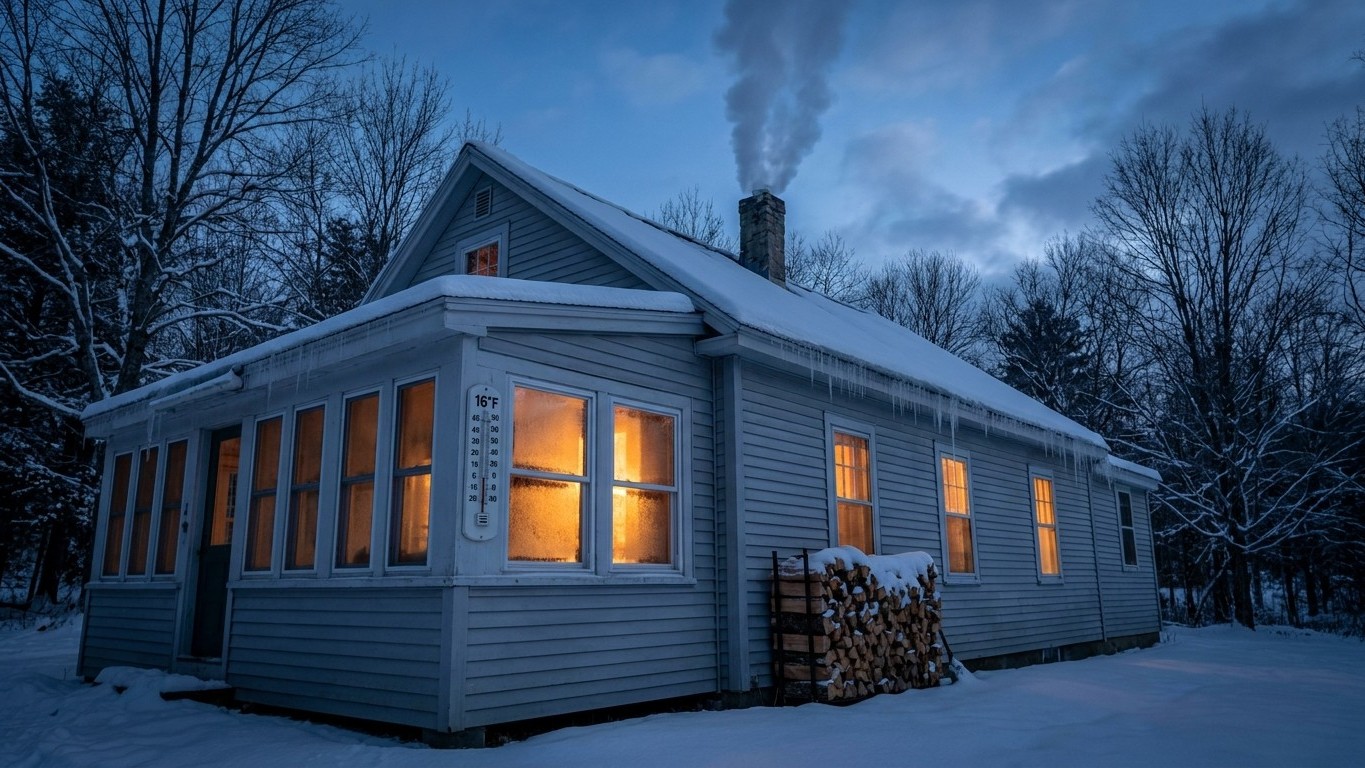

Maine winters mean four to five months of the furnace or woodstove running, with January mornings regularly bottoming out near 16°F. If you’re heating with wood here, or considering it, the numbers below tell you what a season actually demands, and where the common mistakes happen.
How cold it gets, and for how long

The average daily minimum in Maine’s coldest month sits at 15.6°F, based on NOAA’s 1991-2020 climate normals for the Portland reference station. That’s not the record low that makes headlines. It’s the ordinary morning Temperature, the one that repeats for weeks, and it’s the number that decides how hard a heating system works over the season.
A mean minimum in the mid-teens tells you something specific: this isn’t a climate where a stove runs hard for six weeks and coasts the rest of the winter. It’s a slow burn from November into April, with the coldest stretch demanding sustained heat output day after day rather than the occasional cold snap. Compare that to a winter where the coldest-month minimum hovers just under freezing, and the difference isn’t a matter of degree. It’s a difference in how much fuel a household needs to have on hand before the season even starts.
What this means for a Maine house
A heating season this long changes the math on wood, oil, or any fuel you’re stockpiling. Running a stove or furnace for four-plus months at output levels needed to keep a house above 15.6°F outdoor mornings means more total fuel consumed, not just colder individual days. It also means a chimney or flue sees more cumulative hours of use, which matters for creosote buildup and inspection timing. Homes here are typically built with that expectation baked in: tighter envelopes, better insulation standards, and heating systems sized for sustained output rather than occasional peaks.
The practical upshot is that a household heating primarily with wood needs to think in terms of a full season’s supply laid in before the cold arrives, not a cord bought here and there as needed. Maine’s winter doesn’t give you the luxury of catching up mid-January.
What a cord of wood is worth here
A cord is a volume, not a weight, and that distinction is where firewood buyers most often get shorted. The standard measure is a stack 4 feet high, 4 feet wide, and 8 feet long, totaling 128 cubic feet. Anything sold as a “cord” that doesn’t match those dimensions isn’t a full cord, regardless of what the seller calls it.
| Measurement | Value |
|---|---|
| Height | 4 ft |
| Width | 4 ft |
| Length | 8 ft |
| Total volume | 128 cubic feet |
| Heat output (well-seasoned hardwood) | about 20 million BTU |
According to Michigan State University Extension, a cord of well-seasoned hardwood delivers roughly 20 million BTU, though species and moisture content shift that figure considerably. MSU frames it in terms a Maine household can actually use: that one cord is roughly equivalent to the heat from 145 gallons of #2 fuel oil, or 215 gallons of LP gas. Given a heating season stretching from a coldest-month minimum of 15.6°F through several months of sustained cold, that comparison helps size up how many cords a season this long actually consumes.
Density matters as much as volume. A cord of dense hardwood packs more burnable mass into that same 128 cubic feet than a cord of a lighter species, which means it burns longer and delivers more of that 20 million BTU ceiling. Two cords that look identical on a truck can heat very differently once they’re in the stove.
How long wood takes to dry in Maine
Seasoning isn’t a fixed calendar item. It’s climate-dependent, and Maine’s summer humidity and heat set the pace differently than a drier or hotter region would. MSU Extension puts the target at 20 percent moisture or less before burning, with green wood often starting above 60 percent. That water has to boil off before the wood gives up any usable heat, and that boiling eats the energy a homeowner is counting on.
Split green wood typically reaches that 20 percent threshold after one full summer, provided it’s split and stacked so air moves through it. Wood left in rounds, or piled without airflow, won’t dry on that timeline no matter how many months pass. Red oak is a documented exception: its cell structure makes it dry more slowly than other hardwoods, so a single Maine summer often isn’t enough for it.
Burning wood before it’s ready carries real, measurable costs. Wet wood produces less heat for the same volume burned, since energy that should be warming the house is instead evaporating water. It also produces more creosote in the flue, which means more frequent chimney sweeping and a higher risk of chimney fire over a season. None of this is dramatic in the short term. It just means more wood consumed for less warmth, and a maintenance schedule that creeps up faster than expected.
The practical rule for anyone splitting their own wood in Maine: plan on a full summer of stacked drying time before that wood goes into the stove, and add extra time for red oak or any wood that sat in rounds longer than intended.
Where to check before you buy
The figures above describe conditions at the Portland reference station, and Maine spans a lot of elevation and coastal-to-inland variation that a single station can’t fully capture. Inland and higher-elevation areas typically run colder than the coast, which shifts both the heating-season length and the seasoning math for wood stored outdoors.
For species availability, local wood quality, and any burn restrictions in effect where you live, the University of Maine Cooperative Extension is the resource to check. Burn rules, including any restrictions tied to air quality or fire risk, are set at the local level and can change from year to year, so what applied last winter isn’t a guarantee for this one.
Checking with the extension service before laying in a season’s supply of wood is worth the ten minutes it takes, particularly if you’re new to heating with wood in this state or moving to a different part of it.